
By Joseph Morales
The 3 Av-149th St subway station is one of the busiest subway stations in The Bronx. Its location in The Hub section of The Bronx is one of the borough’s busiest cultural and commercial centers. The station is also just a few blocks away from St. Mary’s Park which has a slew of sports fields and is one of the larger green spaces in The Bronx. Other major destinations include the Bronx Documentary Center and The Dominican Consulate’s Bronx location. In addition, many Bronxites from neighborhoods north of the station take the Bx15 and Bx41-SBS bus routes to access the subway here. In fact, MTA data from 2019 shows that the transfer between the Bx15 and the subway at the 3 Av-149th St station was the most popular bus to subway transfer in the Bronx by more than 1,000 daily riders. The station should continue to get even busier as the South Bronx is one of the faster growing areas of NYC.
It has always been important that these stations are accessible to those with mobility disabilities given their importance in The Bronx transportation network. Unfortunately, the 3 Av-149th St station has been inaccessible for most of the year as the MTA has worked on replacing the two elevators there. Without these elevators, riders have had to take buses to other subway stations in the Bronx and Manhattan depending on their destinations. This has likely been a major inconvenience for many as data from Spatial Equity NYC shows that buses in the South Bronx and Harlem tend to be amongst the slowest in the city. Most residents who need elevators also have little recourse as only 26% of households in the Public Use Microdata Area(PUMA) that include the 3 Av-149th St subway station have access to a vehicle according to NYCDCP data.
Thankfully for riders, the elevator replacement project should be nearing completion. The MTA expects the elevator replacements at 3 Av-149th St station to be completed by the end of January 2025. This project has been a major undertaking through which the MTA has faced numerous hurdles and tough decisions. The 3 Av-149th St station was likely chosen for elevator replacement in part because the elevators have been there for a long time in comparison to other subway stations. While it’s hard to find exactly when the old elevators at the station were built, Google Street View images show that they were at the station since at least September 2007. This means that the elevators were at least three years older than the NYC Subway average of 12. Even though the MTA aims for life cycles of 20 years, many elevators do not make it this long as there are thousands of parts that need to age well for this to happen. These parts include and are not limited to mechanical systems, plumbing and brakes. It was likely that at least one or more parts were underperforming in the elevators given the MTA decided to replace them.
Also worth noting is that the performance of the elevators had fluctuated substantially in the last five years with availability being as low as 81.6% one month. Hence, the MTA probably felt that it was in their best interest to perform a planned elevator replacement than to continue patchwork maintenance during unplanned disruptions. This is also better for riders as they can plan ahead and find travel alternatives as they wait to return to a more reliable elevator. According to the MTA’s website, it is valuable to do an elevator replacement for this reason. Even though the replacement is likely a better path forward, the decision was likely not an easy one as the MTA has a myriad of infrastructure needs across the city.
As part of the elevator replacement, the MTA is upgrading many components of both elevators. This will not just make them more reliable, but also help to make them more user friendly than they were prior to construction.
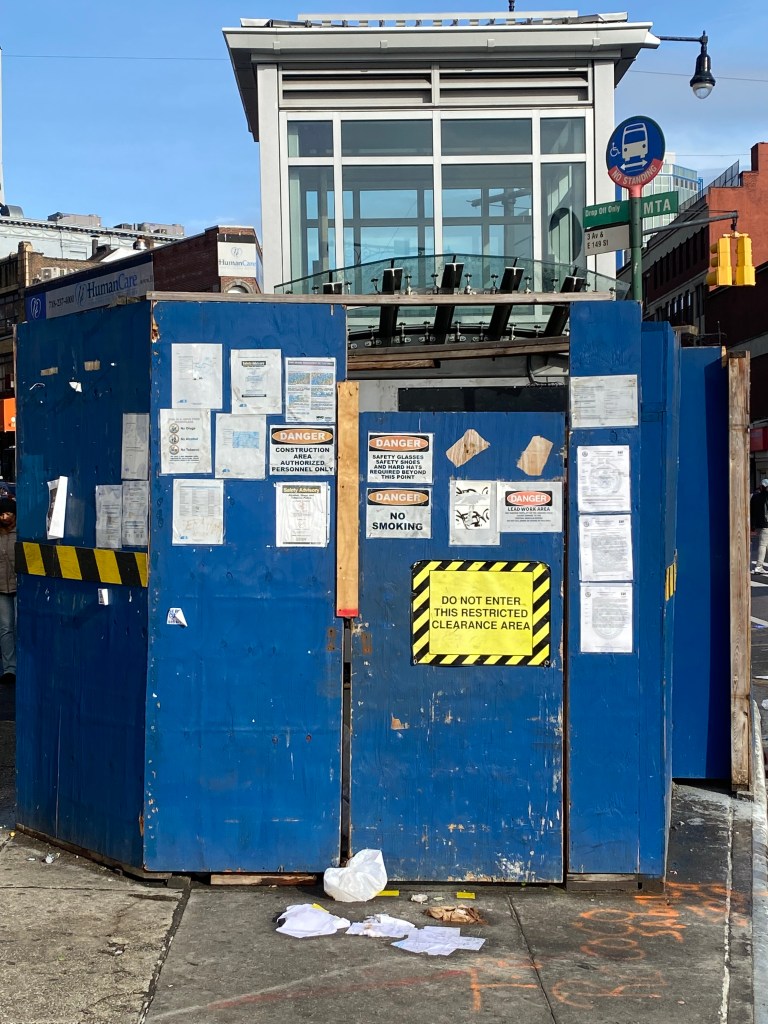
One of the most important things the MTA does is make modifications to the elevator’s shaft and pit in order to accommodate new equipment. The shaft is the space in which the elevator travels and the pit is the space between the elevator floor and the shaft floor. Modifying the shaft likely requires the MTA to navigate the surrounding subsurface and any existing infrastructure that is there. Navigating subsurface is one of the more significant challenges of building elevators and the MTA has said in the past that it takes a plethora of research to properly locate an elevator shaft. This likely also holds true for altering a shaft especially if its size or location needs to be shifted even slightly. The challenge could be harder at 3 Av-149th St since the businesses around the elevators use various forms and volumes of utilities that underground infrastructure provides. The businesses include a Krispy Kreme, Cricket Wireless and two large office buildings.
Once the MTA makes the needed modifications to the shaft and pit, they then add the new elevator and supporting equipment. The MTA also replaces and modernizes machine room equipment that is needed for elevator operations. Remote monitoring equipment is also upgraded in order to make sure the MTA can respond more promptly and effectively if an elevator outage occurs. This is especially important at 3 Av-149th St since it is an incredibly busy station and the traffic congestion and foot traffic near the station can prolong emergency responses. Outside of elevator reliability, the MTA also adds new fire alarm equipment and CCTV cameras to improve safety. The security upgrades are particularly critical now given how many people feel about subway safety after recent incidents at different stations that have made headlines.
At this station, the MTA has also made significant architectural changes to the new elevators. The new elevators will have a more modern and sleek look that is similar to those found at other subway stations across the city that have recently received elevators for the first time. The ones at 3 Av-149th St have a pattern of glass tiles that is distinct from patterns at other elevators built with the same material. This will give the 3 Av-149th St station a unique design that daily riders will be proud of and all can enjoy. The design made for these elevators can also help to welcome people to the neighborhood and represent The Hub’s position as one of The Bronx’s main commercial districts.
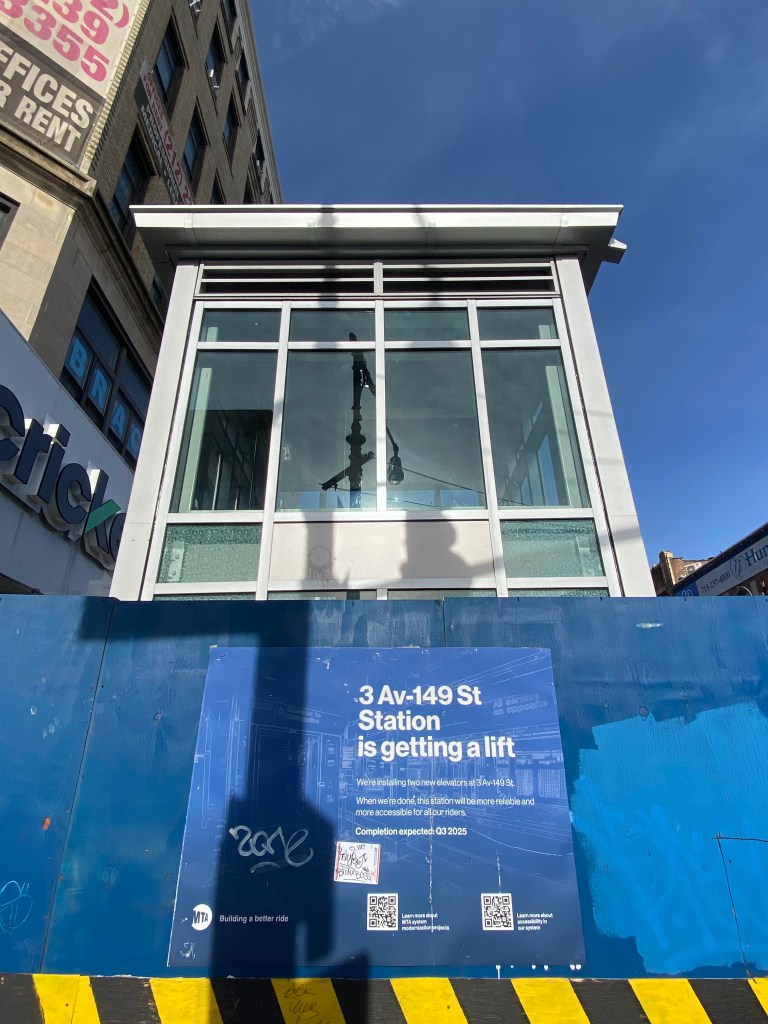
Once the entire project is constructed, the MTA will conduct a multitude of tests to ensure the elevators are ready for service. These include a 24 hour endurance test where the elevators will go up and down over 1,000 times. The test is done for all new elevators in the subway system to verify that they are fit for the 24/7 nature of subway operations. This is especially important for the 3 Av-149th St station due to the amount of trips here that are made at all hours of the day. Several nearby trip generators such as Lincoln Hospital and Horizon Juvenile Center are open 24/7. The surrounding neighborhood is also likely home to many workers who commute at off-peak hours as blue collar industries tend to be among the top sectors Bronxites are employed in according to a report from the State Comptroller. These factors mean that station elevators will really need to be ready to operate almost non-stop throughout the day in order to effectively serve riders.
When the project is complete next month and another accessibility project at 149th St-Grand Concourse is complete, riders will have three accessible stations on E 149th St. These stations all being accessible means that riders will be no further than a mile from another accessible station when at any station on the corridor. Riders will be able to get to other accessible stations by walking or taking a short ride on the Bx19 bus. This is important as those who cannot use stairs will have multiple viable alternatives nearby if an elevator is out of service. These riders will also have better access to other subway options if there are delays or service changes.
Accessibility at 3 Av-149th St is critical to the mobility of those who rely on the subway in The Bronx. It is also important for the economic prosperity of The Hub as the station allows people from throughout The Bronx to take advantage of what the neighborhood has to offer. Hopefully, the new elevators open a new era where those who need them can rely on them daily for years to come.
Works Cited
DiNapoli, Thomas P., and Rahul Jain. “The South Bronx: An Economic Snapshot.” Office of the NYS Comptroller, 16 November 2023, https://www.osc.ny.gov/files/reports/osdc/pdf/report-13-2024.pdf. Accessed 29 December 2024.
“399 E 149th St New York-Google Street View.” Google Maps, September 2007, https://www.google.com/maps/@40.8161215,-73.9177772,3a,75y,206.13h,90t/data=!3m8!1e1!3m6!1sLb4Lr8iVi8N2uN–wDV3Ug!2e0!5s20070901T000000!6shttps:%2F%2Fstreetviewpixels-pa.googleapis.com%2Fv1%2Fthumbnail%3Fcb_client%3Dmaps_sv.tactile%26w%3D900%26h%3D600%26pi. Accessed 29 December 2024.
Martinez, Jose. “Cost of Replacing 19 Subway Elevators Expected to Double.” The City, 6 April 2020, https://www.thecity.nyc/2019/12/13/cost-of-replacing-19-subway-elevators-expected-to-double/. Accessed 29 December 2024.
Metropolitan Transportation Authority. “Elevator and Escalator status.” MTA, 29 December 2024, https://new.mta.info/elevator-escalator-status. Accessed 29 December 2024.
Metropolitan Transportation Authority. “Elevator Replacements.” MTA, 4 June 2024, https://new.mta.info/project/station-accessibility-upgrades/elevator-replacements. Accessed 29 December 2024.
Metropolitan Transportation Authority. “Existing Conditions Report-Bronx Bus Network Redesign.” MTA, February 2019, https://files.mta.info/s3fs-public/2019-03/77_19_BBNRExisting_Working%20File_Final_Low%20Rez.pdf. Accessed 29 December 2024.
Metropolitan Transportation Authority. “Subway Elevator and Escalator Availability.” MTA Metrics, https://metrics.mta.info/?subway/elevatorescalatoravailability. Accessed 29 December 2024.
mtainfo. “What does it take to install an elevator in a subway station?” YouTube, 21 October 2019, https://www.youtube.com/watch?v=DveunMW9_bU. Accessed 29 December 2024.
New York City Department of City Planning. “Car Ownership in NYC.” Tableau, 24 November 2022, https://public.tableau.com/app/profile/dcptransportation/viz/ACSProfiles/Dashboard1. Accessed 29 December 2024.
Office of the State Deputy Comptroller for the City of New York, and Rahul Jain. “Recent Trends and Impact of COVID-19 in the Bronx.” Office of the New York State Comptroller, June 2021, https://www.osc.ny.gov/reports/osdc/recent-trends-and-impact-covid-19-bronx. Accessed 29 December 2024.
Transportation Alternatives, and Massachusetts Institute of Technology. “Council Districts Ranked By Bus Speeds.” Spatial Equity NYC, https://www.spatialequity.nyc/?c=2&b=council&md=f&v=histogram&mc=3&m=2&dt=f&cm=f&ct=tttttt. Accessed 29 December 2024.

