
By Joseph Morales
Marble Hill is a busy residential and commercial neighborhood located on the northside of the Broadway Bridge in Manhattan. It is the only part of Manhattan that is not part of an island. The neighborhood has two main streets, W 225th St and Broadway that make up the community’s commercial fabric. W 225th St east of Broadway is home to several major retailers including Target and Marshalls. On the other hand, Broadway is a hub for small mom and pop businesses including pharmacies and delis. The neighborhood has a dense population and many residents live in the Marble Hill Houses NYCHA development. The community is also home to the John F. Kennedy High School Campus, which is home to seven schools including Bronx Law & Finance and Bronx Theatre that primarily serve students from throughout The Bronx. The neighborhood is well served by mass transit with access to the 1 train, Metro-North and a slew of bus lines including the Bx9 and Bx10.
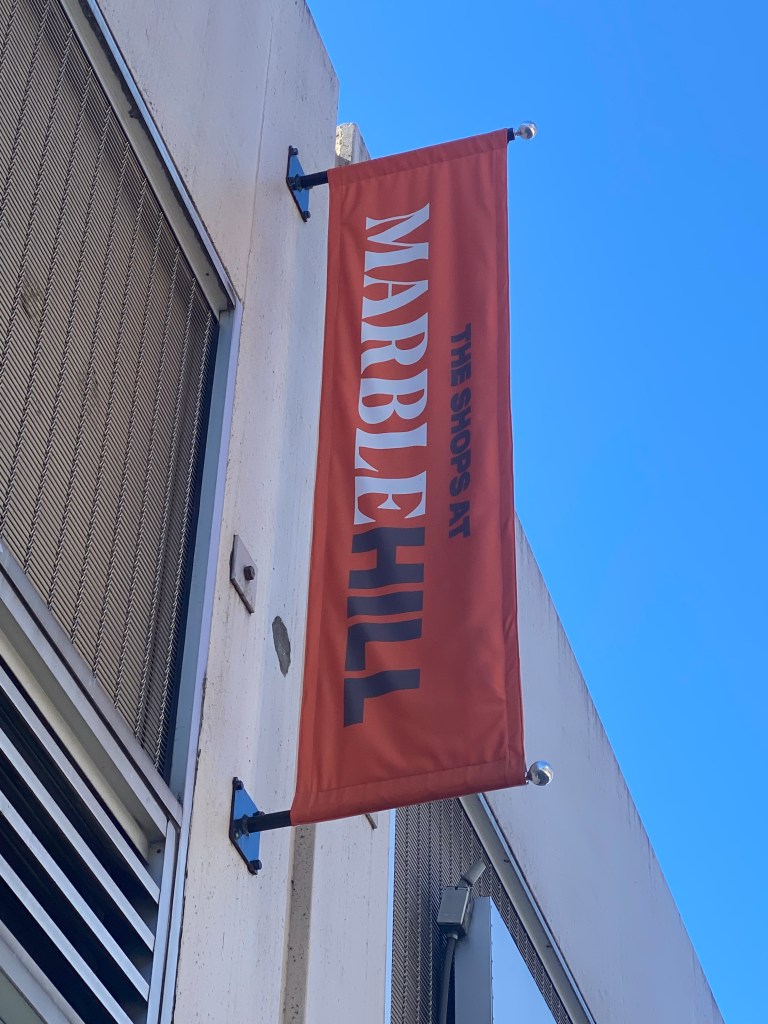
If you think part of that sounded weird, you’re probably not wrong. If Marble Hill is in Manhattan, why does the high school campus mainly serve Bronx students? Also, why would the neighborhood mainly be served by Bronx bus routes? Making this even more odd is the fact that most buildings have Bronx addresses on Google Maps. However, the MTA considers the Marble Hill-225th St(1) subway station to be part of Manhattan. You can see this on 1 train station maps both on the train and on digital screens at stations.

So what borough is Marble Hill in? As per New York State Law, Marble Hill is part of Manhattan. The controversy about which borough Marble Hill is in and the myth that Marble Hill is part of The Bronx is due to a long and fascinating history dating back to the American Revolution.
After the American Revolution, Marble Hill was home to many deposits of Tuckahoe Marble(also known as Inwood and Kingsbridge Marble), which is how Marble Hill got its name in 1891. Between the 1700s and the end of the 1890s, Tuckahoe Marble was one of the best forms of marble out there and it was used to build many iconic buildings. These structures included the Washington Monument and St. Patrick’s Cathedral. The presence of Tuckahoe Marble contributes to how Marble Hill’s borough dispute begins.
The events leading to today’s controversies started in 1817 when Marble Hill was cut off from Manhattan Island by two small streams that formed a 30-foot canal. After the streams were built, Marble Hill became its own island. The canal ran between the Spuyten Duyvil Creek and The Bronx and the streams surrounded the Island of Marble Hill. Also in 1817, Curtis and John Bolton purchased land for a marble mill that was powered by the canal and was used to extract Tuckahoe Marble. The canal was often known as Boltons’ canal, likely due to the presence of the marble mill.
As New York and the United States grew, there became a need for ships to get from the Harlem to the Hudson Rivers where Marble Hill Island was. At this point, the canal and creek were extremely narrow and were impossible for ships to pass through. This led to ships traveling all the way to New York Harbor in Lower Manhattan to get to the Hudson, costing a massive amount of time and money. Hence, in 1895, the existing canal was widened by the U.S Army Corps of Engineers and was known as the Harlem River Ship Canal. This made it so that Marble Hill had the wider canal to the south and The Bronx to the North. With almost all trade and long distance passenger travel being done by boat at the time, the new canal was by far one of the most significant infrastructure projects of the era.
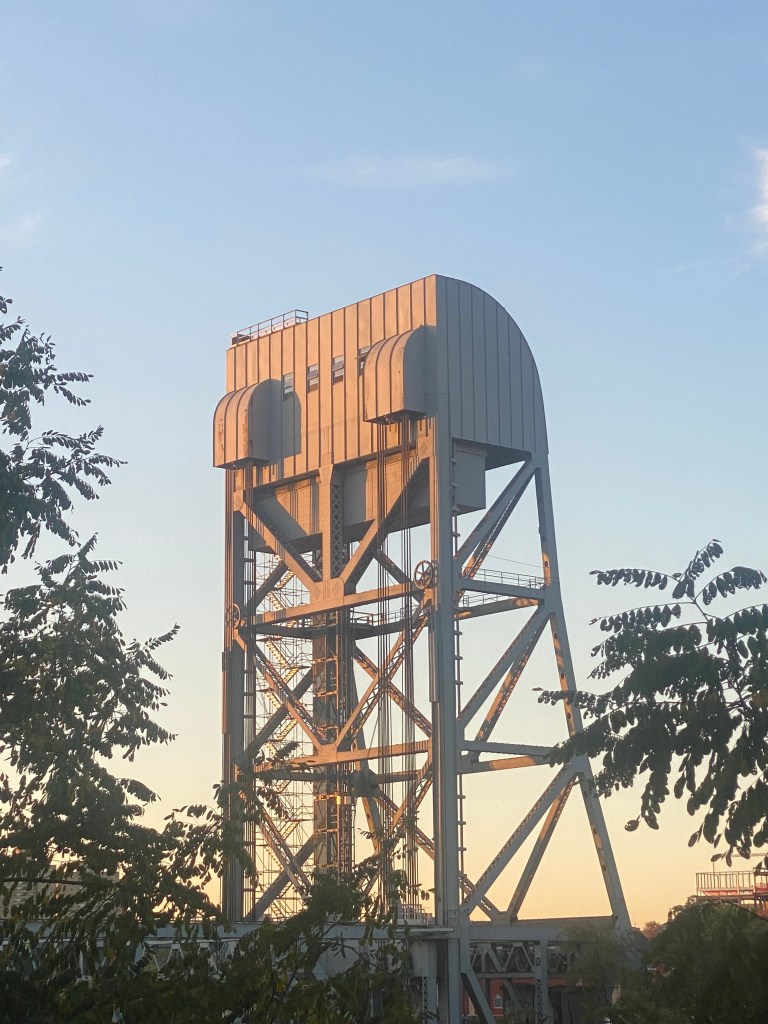
At this point, the gap between Marble Hill and Manhattan Island had expanded following the construction of the ship canal. Nonetheless, Marble Hill was still designated as part of Manhattan in the Greater New York Charter of 1897. This is the same document that formed the five-borough NYC as we know it. A new bridge carrying Broadway opened in 1895 but had to be replaced shortly thereafter to carry what is now the 1 train above Broadway. This bridge was replaced again in 1960 with the Broadway Bridge we know today.
In 1914, Marble Hill was linked to The Bronx by landfill and this is officially when the controversies of which borough Marble Hill was in began. On March 11th, 1939, Bronx Borough President James Lyons planted the Bronx flag on the intersection of W 225th St/Jacobus Pl in order to claim Marble Hill as part of The Bronx. Lyons also attempted to operate a defunct military tank on W 230th St where a U-HAUL facility currently stands to no avail as a publicity antic. A NY Times article from back then made fun of the stunt, referring to Lyons as an “invader” and “aggressor” while detailing Lyons’ actions. As most residents wished to remain part of Manhattan, they formed the Marble Hill Civic Association just days later to support these ideals. Residents got Lyons to end his campaign when they stormed a meeting of the Bronx’s Board of Estimate to protest against Lyon’s annexation attempt.

In more recent times, a group known as the Grand and Glorious Grand Army of The Bronx, has held an annual annexation of Marble Hill every year since 2014. When Ruben Diaz Jr was Bronx Borough President just a few years ago, he would support the event annually. Disputes over whether or not Marble Hill is part of Manhattan or The Bronx have also affected courts. In 1984, a woman claimed she should be exempt from jury duty in a Manhattan murder trial because she claimed she was a Bronx resident and not a Manhattan one. To avoid an overturned conviction, the judge dismissed her from the case and the defendant was ultimately found not guilty. Shortly thereafter, the State Legislature declared Marble Hill to be a part of Manhattan to avoid further confusion. Hence, in 2007, when a woman filed a personal injury lawsuit in Bronx County Court for an incident in the Marble Hill Houses, NYCHA petitioned it to be moved to Manhattan court and the judge granted the request.
While these campaigns were either for show or individualistic in nature, the borough boundaries of Marble Hill have had a substantial civic impact on the people that live there. When Ruben Diaz Jr was Bronx Borough President he even said that many Marble Hill residents do not realize they live in Manhattan until they are summoned for jury duty. As for residents today, the borough issue is still disputed and many residents feel more connected to The Bronx. However since Marble Hill is part of Manhattan, residents vote for many critical offices such as Borough President, City Council and District Attorney in Manhattan rather than The Bronx. This is despite them receiving mostly Bronx municipal services. In 2018, a 19-year resident of the neighborhood and annexation event participant Tom Waters was frustrated at the neighborhood’s political representation and said this to the Riverdale Press, “‘We have Bronx schools, Bronx cops, Bronx sanitation-everything is Bronx except cable TV and jury duty.’” “‘When we want to complain we should be able to complain to a Bronx elected official, not a Manhattan elected official’”.
Though Waters’ opinion makes sense, not all residents feel the same way as he did. In 2022, city council districts were being redrawn and residents of the Marble Hill Houses on the Bronx/Manhattan border wanted to be in one City Council District. This was due to three different council districts representing parts of their development making it hard for them to stand united on issues affecting them as tenants. Hence, they asked to be fully within Manhattan’s District 10, where seven out of 11 buildings already stood. This is despite the Bronx Councilman’s office being within a walking distance of the development and the nearest Manhattan City Council office being roughly a 20 minute subway ride away. Ultimately, the development became split between two council districts, BX-8(Eric Dinowitz) and MN-10(Carmen De La Rosa) rather than the three it was previously. The Marble Hill Houses did not get to be in one district due to technicalities in the City Charter regarding the number of City Council Districts spanning more than one borough.
With all the disputes, should Marble Hill be part of The Bronx or Manhattan? Colloquially, it does seem like it is considered part of The Bronx. This is similar to how the boroughs Queens and Brooklyn are technically on Long Island in addition to Nassau and Suffolk Counties. However, only Nassau and Suffolk are considered “Long Island” by New Yorkers.
As a graduate of Bronx Engineering and Technology Academy in Marble Hill, I have been frequently rebutted when I’ve tried to mention how our school is partially in Manhattan. However, which borough Marble Hill is a part of should be up to the residents whom it impacts their civic power and how their community is represented at the city, state and federal levels. Currently, Marble Hill residents mostly receive city services including schools, sanitation and police from Bronx sources and yet they can only vote for Manhattan representatives. This makes it harder for residents to advocate for themselves towards an elected official regarding the issues in their community. For instance, the NYPD 33rd and 34th Precincts, serve substantially more of MN-10’s residents than the 50th Pct does in Marble Hill. The situation could give a Manhattan representative less incentive to work with the 50th Pct on relevant safety issues knowing Marble Hill has less voting power.
While it may not seem like Marble Hill’s situation makes sense, there may be some benefits for residents with it being in Manhattan. If Marble Hill were in The Bronx, it would likely be in District 11 which includes Riverdale, Bedford Park, and Norwood. The district Marble Hill is currently a part of, MN-10, includes Inwood and Washington Heights. It’s possible that Marble Hill has more demographics and interests that align with MN-10 that would make voters want to stay in that district. In addition, many likely visit other parts of MN-10 often to work, shop and more. Hence, some residents may want to retain Manhattan voting power.
The borough Marble Hill is located in a dispute that many Bronx and Manhattanites alike consider fun and games. However, this geographical oddity undoubtedly has real social and political consequences for those who reside in Marble Hill. The fact that many do not know about their Manhattan location until jury duty is alarming as this means that many residents are unaware about their sore lack of political representation in The Bronx. Hopefully, more people become aware of Marble Hill’s history and more residents speak their word for the borough they feel Marble Hill should be a part of. At that point, the goal should be for there to be awareness for Marble Hill’s history while providing residents with the political representation the sense of borough-based community they want and deserve.
Works Cited
Ash, Mark, and Weed-Parsons Printing Company. “The Greater New York Charter as enacted in 1897. – — Albany.” Columbia University, https://www.columbia.edu/cu/lweb/digital/collections/cul/texts/ldpd_6864674_000/. Accessed 4 July 2024.
“Bill Would Clarify Marble Hill’s Status.” The New York Times, 27 June 1984, https://www.nytimes.com/1984/06/27/nyregion/bill-would-clarify-marble-hill-s-status.html. Accessed 4 July 2024.
Bronx County Supreme Court. “Montesano v New York City Hous. Auth.” Justia, 18 December 2007, https://law.justia.com/cases/new-york/appellate-division-first-department/2007/2007-09955.html. Accessed 4 July 2024.
“Bronx School of Law and Finance (10X284).” MySchools, https://myschools.nyc/en/schools/high-school/?dbn=10X284. Accessed 5 July 2024.
“Bronx Theatre High School(10X546).” MySchools, https://myschools.nyc/en/schools/high-school/?dbn=10X546. Accessed 5 July 2024.
Chambers, Marcia. “JUDGE’S RULING REVIVES DISPUTE ON MARBLE HILL.” The New York Times, 16 May 1984, https://www.nytimes.com/1984/05/16/nyregion/judge-s-ruling-revives-dispute-on-marble-hill.html. Accessed 4 July 2024.
City History Club of New York, and Frank Bergen Kelly. “Historical Guide to the City of New York.”
“The Conservation and Restoration of Tuckahoe Marble.” FasterCapital, https://fastercapital.com/topics/the-conservation-and-restoration-of-tuckahoe-marble.html. Accessed 24 June 2024.
“Council Members & Districts – New York City Council.” NYC Council, https://council.nyc.gov/districts/. Accessed 5 July 2024.
“The Great and Glorious Grand Army of The Bronx | New York NY.” Facebook, 11 May 2014, https://www.facebook.com/grandarmyofthebronx/. Accessed 4 July 2024.
“Marble Hill.” Washington Heights NYC, https://www.washington-heights.us/marble-hill/. Accessed 24 June 2024.
“Marble Hill Faces New Lyons Threat.” The New York Times, 20 May 1939, https://www.nytimes.com/1939/05/20/archives/marble-hill-faces-new-lyons-threat-bronx-fuehrer-seizes-upon-taxing.html. Accessed 4 July 2024.
Mayorga, Aaron. “Bronx Week ‘army’ invades Marble Hill.” The Riverdale Press, 18 May 2018, https://www.riverdalepress.com/stories/bronx-week-army-invades-marble-hill,65622. Accessed 4 July 2024.
McClendon, Sachi. “Marble Hill could gain minor win in redrawing of council districts.” The Riverdale Press, 22 July 2022, https://www.riverdalepress.com/stories/marble-hill-could-gain-minor-win-in-redrawing-of-council-districts,79409. Accessed 4 July 2024.
Newman, Andy. “New York Today: When The Bronx Invaded Manhattan.” The New York Times, 11 March 2014, https://archive.nytimes.com/cityroom.blogs.nytimes.com/2014/03/11/new-york-today-the-battle-of-marble-hill/. Accessed 4 July 2004.
New York City Department of City Planning. “NYC Police Precincts.” ArcGIS, 13 May 2024, https://hub.arcgis.com/datasets/c35786feb0ac4d1b964f41f874f151c1/explore?location=40.877592%2C-73.896809%2C13.00. Accessed 5 July 2024.
New York City Department of Parks and Recreation. “Inwood Hill Park Highlights – Spuyten Duyvil Creek.” NYC Parks, https://www.nycgovparks.org/parks/inwood-hill-park/highlights/8272. Accessed 24 June 2024.
Ostrander, Peter. “New York Marble Cemetery and Inwood Marble – The Kingsbridge Historical Society.” The Kingsbridge Historical Society, 24 June 2024, https://kingsbridgehistoricalsociety.org/forums/topic/new-york-marble-cemetery-and-inwood-marble/. Accessed 24 June 2024.
Pastor, Kate, et al. “Marble Hill: Betwixt, between, and sometimes befuddled.” The Riverdale Press, 27 May 2010, https://www.riverdalepress.com/stories/marble-hill-betwixt-between-and-sometimes-befuddled,36800. Accessed 4 July 2024.
Tuckahoe Historic Preservation Commission. “January 25, 2023 Tuckahoe Historic Preservation Commission Village Hall – 6:00PM.” Village of Tuckahoe, 25 January 2023, https://www.tuckahoe.com/sites/g/files/vyhlif3941/f/minutes/january_25_2023.pdf. Accessed 24 June 2024.
Wertz, Frederick. “How Manhattan Island Banished Marble Hill to the Mainland (but not to the Bronx).” New York Genealogical & Biographical Society, 26 September 2016, https://www.newyorkfamilyhistory.org/blog/how-manhattan-island-banished-marble-hill-mainland-not-bronx. Accessed 24 June 2024.
 Transit Central