By Joseph Morales
42nd Street is by far one of the busiest and most famous streets in New York City. Its streets are regularly lined with tourists, office workers, and others daily. 42nd Street also connects Times Square and Bryant Park, both world-renowned attractions that draw millions of visitors annually. The street is also filled with theaters, offices, retail, and almost everything else one can imagine. Almost every line in the subway system, minus the L, G, and certain shuttles, all stop on 42nd Street along with many express buses, connecting the heart of Midtown Manhattan to almost every corner of New York City and beyond. 42nd Street is also home to the world-famous Grand Central Terminal, which serves both the Metro-North and Long Island Railroads, connecting riders to destinations throughout New York’s suburbs. According to a Forbes article, 500,000 people pass through GCT daily, and about a million people pass through GCT during the holiday season. These numbers were taken before the opening of Grand Central Madison, which now serves LIRR trains.
Given the incredible number of people who visit, work, and travel along 42nd Street daily, it is no surprise that it is among Manhattan’s most congested thoroughfares and that crosstown buses are not very fast. The M42, which travels along 42nd Street, has had an average speed of around 5.5 mph for the past year compared to the Manhattan average of 6-6.5 mph, according to MTA statistics. While the S and 7 trains cross parts of 42nd Street, they only go between Grand Central Terminal and Times Square and are often difficult to get to, considering the crowds in both stations and the long walk to get to the train in both stations.
It may be interesting why the M42 has slower speeds than many Manhattan bus routes, as the M42 has painted dedicated bus lanes that are fully painted red except for a small stretch between Fifth and Sixth Avenues as well as between 11th and 12th Avenues. Unfortunately, according to MTA statistics, bus speeds remained flat a little over the 4 mph mark in 2019 when the bus lanes were enhanced along with numerous street-design features aimed at speeding up buses, such as the painted bus lanes and multiple bus-only signals at some major intersections. Bus speeds did not increase until March 2020, and this was likely primarily due to the sharp decrease in traffic around this time due to the initial onset of COVID-19. It had increased to an average of 6.6 mph between April and May 2020 before decreasing to about 5.5 in July 2020, where it has stayed relatively flat ever since. This means that bus speeds have increased by a net average of 1 mph since March 2020, and this is likely due to a combination of limited enhanced bus lane effectiveness and less congestion due to many office workers still working from home.
The limited speed increases despite the dedicated lines are likely because of what is still a high amount of activity on the corridor that still results in double parking, loading activities, and even cars using the lanes illegally which slows down buses.
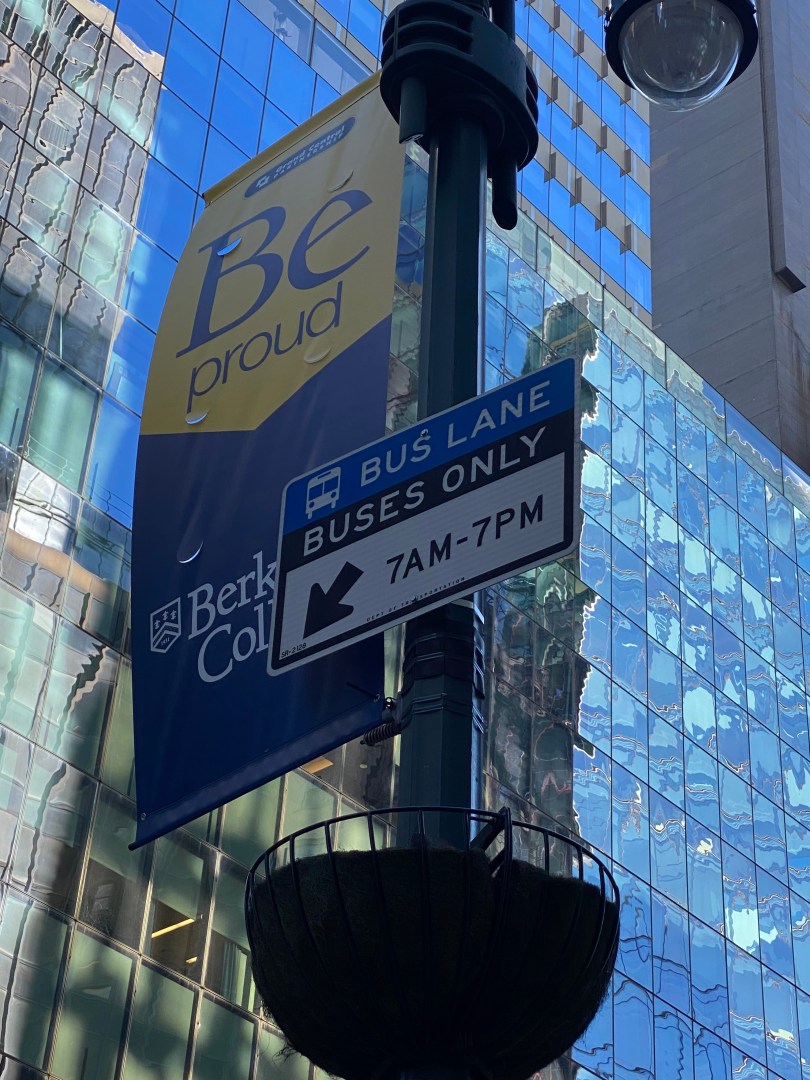
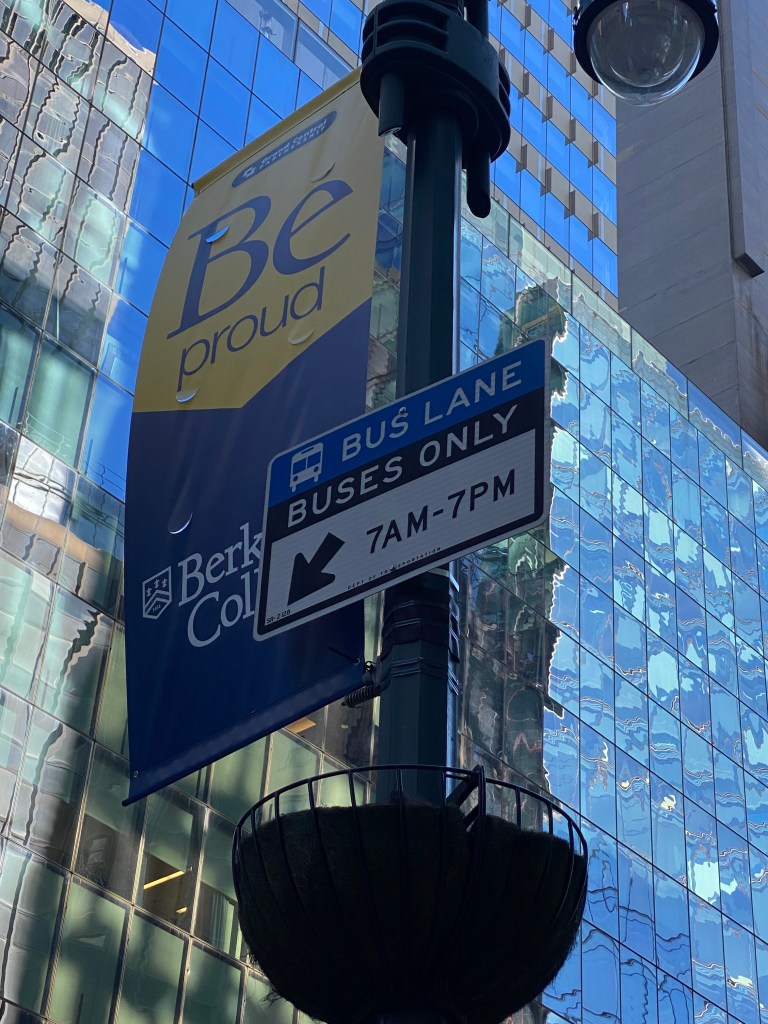
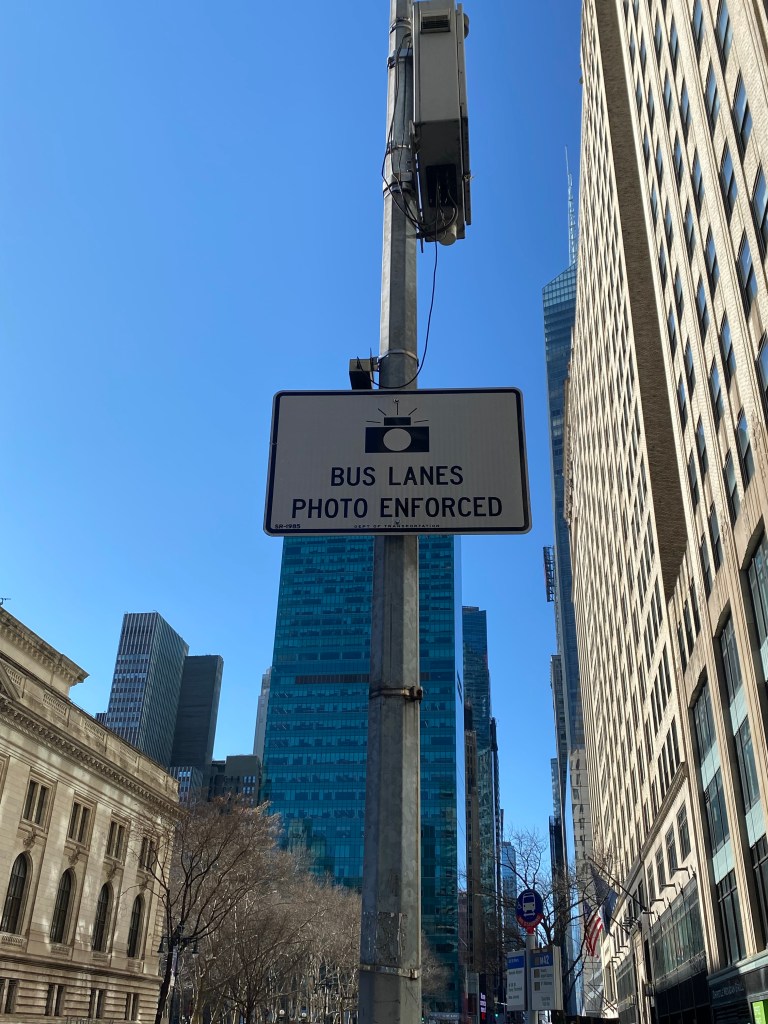
Also, the bus lane restrictions are inconsistent throughout with some stretches being buses only 24/7 and others being 7AM-7PM. Some obscure signs also state that the bus lane cameras are photo enforced. This means that drivers may often unknowingly illegally block bus lanes, but they also may accrue fines. While the red paint of a bus lane may be distinguishable to most New Yorkers, many motorists visit 42nd Street from throughout the country and may only find out about the rules once it is too late. Also, many bus lane violations may be inadvertently committed by out-of towners. As most advocacy for bus lane/busway adjustments in NYC comes from either grassroots community advocacy or local community boards, there may be little advocacy from motorists for signage to be improved.
While 42nd Street has received some notable bus service improvements in recent years, it has not received some of the most dramatic upgrades that have been proposed for it or even the same types of upgrades as other nearby Manhattan thoroughfares have.
In 1994, the 42nd Street Development Corporation and the NYCDOT made an effort to bring light rail to 42nd Street, and the City Council unanimously supported it. The plan was to convert the street’s southern side into a light rail line. However, the project quietly fell apart, and the mayor at the time, Rudy Giuliani stopped supporting the project for reasons associated with cost and feasibility. An advocacy group named Vision42 proposed constructing a light rail on 42nd Street as part of a bigger plan to turn 42nd Street into a car-free, pedestrian, and transit-oriented boulevard. They have completed several technical studies and received support from notable politicians such as former Manhattan Borough President Gale Brewer, State Senator Brad Holyman, and former NYC Comptroller and Mayoral Candidate Scott Stringer. However, even this effort seems inactive as going to the group’s website still discusses the 7-train extension to Hudson Yards being a proposal despite the extension opening in September 2015.
42nd Street also has yet to receive the full SBS treatment from the NYCDOT and MTA the same way many other major Manhattan corridors, such as 34th Street, 23rd Street and 86th Street, have. Some corridors have multiple routes extending to different places off their main corridor after traveling crosstown such as the M34A-SBS to the Port Authority Bus Terminal and the M14D-SBS to the Lower East Side. These routes also have articulated buses, which the M42 does not have. This is likely because certain other crosstown routes also have higher ridership, largely because they serve other areas besides their main corridors, including certain residential communities that lack subway access, such as Yorkville and the Lower East Side. Also, getting certain crosstown routes that have higher ridership such as the M79-SBS require walking through Central Park, to walk through a part of the route, so more people may opt for the bus in these cases. However, it is worth noting that these corridors have little to no more bus improvement features than 42nd Street, with the exception of off-board fare collection.
One theory as to why the full SBS treatment did not occur on 42nd Street besides its ridership totals is that considering many who get around the area are tourists, it may be harder for this group of riders to acclimate to using a different fare payment system in the off-board fare machines for the M42 and paying on-board on the other bus routes.
As more and more people continue to visit Midtown as the city recovers from the COVID-19 pandemic, it will be interesting to see if any further upgrades will be made to transportation along one of the busiest and most famous streets in New York City.
Works Cited
Goldsmith, Margie, and Amy Danise. “Touring Grand Central Terminal: So Much More Than Trains.” Forbes, 6 January 2023, https://www.forbes.com/sites/margiegoldsmith/2023/01/06/touring-grand-central-terminal-so-much-more-than–trains/. Accessed 12 March 2023.
Metropolitan Transportation Authority. “MTA Metrics.” mta.info, 2023, https://metrics.mta.info/. Accessed 12 March 2023.
Chan, Sewell. “Old Proposal to Build Light-Rail Line on 42nd Street Is Revisited (Published 2005).” The New York Times, 18 April 2005, https://www.nytimes.com/2005/04/18/nyregion/old-proposal-to-build-lightrail-line-on-42nd-street-is-revisited.html. Accessed 12 March 2023.
“Vision42 – The Purpose.” vision42, https://vision42.org/?page_id=38. Accessed 12 March 2023.
Vision42. “vision42 – Technical Studies.” vision42, https://vision42.org/?page_id=5941. Accessed 12 March 2023.
Vision42. “vision42 and #7 Subway.” vision42, https://vision42.org/?page_id=5952. Accessed 12 March 2023.
 Transit Central
Current M42 buses are crowded beyond capacity. Insane not to have SBS!
LikeLike