​​Could Trolleys Come Back in New York City?

By Joseph Morales

Trolleys were once a widespread and reliable means of getting around New York City and many other cities in the United States. Trolley lines were once just as widespread as today’s bus routes across cities. Since most Americans in cities took mass transit to work, trolleys had plenty of riders and the companies that operated them often made large profits. Unfortunately for the companies, the rise of the automobile led to cars often blocking trolley tracks and creating congestion which caused delays. According to the Daily News, trolleys were also considered old-fashioned by many due to the noises they made, such as “screeching wheels and clanging bells,” along with their wheels losing traction on icy inclines during the winter. This led to many NYC companies converting their trolley services into bus services and most bus routes run by the MTA today are the semblance of a former trolley line. 

                     While buses may have been better than trolleys in many ways, we are all too familiar with their shortcomings. New York City buses often have many issues, such as being stuck in traffic, showing up in pairs, and sometimes just being unreliable for their passengers. The NYCDOT often implements various strategies, such as bus lanes and transit signal priority to speed up buses with varying levels of success. Figuring out how to improve surface transit along routes without subway service has undoubtedly been one of the city’s most pressing transportation challenges. 

                      Could a return to the trolley be part of the solution? Philadelphia, the second-largest city in the Northeast and the sixth-largest city in the country, is one of the only American cities to have a vast, functioning trolley system. Trolleys are prevalent across the city, from the bustling area of Center City, which can be compared to Midtown, to areas of Southwestern Philadelphia on the city’s outskirts. Some routes even run into suburban areas throughout Delaware County, located just outside of Philadelphia. Rather than running on the side of streets, most trolleys run in the center to avoid traffic along with obstructions such as double-parked vehicles. This setup also allows for other forms of infrastructure to be on the side of the road, such as bike lanes. In fact, several streets in Philadelphia and Delaware County have center-running trolley tracks and some streets also have bike lanes on the side, making for true multimodal streets.

SEPTA trolley on Woodland Avenue in Southwest Philadelphia.
Woodland Avenue in Southwest Philadelphia with trolley tracks.

                 To see if trolleys could work in NYC, we need to consider how the trolley system works in Philadelphia and if can meet New York’s transportation needs. As stated earlier, trolleys in Philadelphia operate throughout neighborhoods with densities very similar to many areas of NYC. Trolleys do have several upsides such as offering the capacity to hold substantially more riders. For reference, a modern streetcar can hold 150-350 passengers while MTA articulated buses have a capacity of about 115 passengers. While SEPTA’s newest trolleys purchased in 2023 only have a capacity of 120, a five passenger difference could decide whether or not the rear doors close quickly or not when the bus is crowded, which substantially impacts reliability. Outside of capacity, trolleys tend to be more efficient with power delivered by overhead wires leading to no street-level exhaust. 

                    Based on this alone, trolleys can help resolve much of NYC’s bus crowding issues particularly on major routes such as the Bx12-SBS(Pelham Pkwy/Fordham Rd) and M15-SBS(First/Second Avenues). Additionally, New Yorkers in areas with higher asthma rates such as the South Bronx and Northern Manhattan would especially benefit from less emissions caused by mass transit vehicles. 

                    However, there are some downsides. For one, trolleys having center-running tracks in some spots does not always speed them up. A quick look at some commute times from the Southern and Western parts of Philly where trolleys are most prevalent into Center City is just about what you would expect for buses. In a city known for transit projects that are extremely expensive, New Yorkers may not really care for a new service without as clearly tangible benefits as reduced travel times.

                     Given trolleys’ upsides and downsides, whether or not it works in New York City is largely dependent on where trolleys run along with whether people want them. Trolleys clearly provide the most benefits, in the most densely populated areas of cities and when they can move at higher speeds. Trolleys like buses, can also benefit from numerous street design features, such as isolated lanes and transit-signal priority that help it move faster especially if operating in the center of the road. Hence, trolleys can definitely be a game changer for riders on New York’s busiest bus routes, such as the Bx12-SBS(Fordham Rd), M15-SBS(First/Second Aves), and B46-SBS(Utica Ave) should trolley service like this exists. Additionally, in Center City, SEPTA has an underground tunnel known as the Center City Tunnel where certain trolley routes converge to avoid heavy aboveground traffic in Philly’s Central Business District. If the MTA can build similar tunnels and run trolleys at major arteries such as Downtown Jamaica and Flushing in Queens, Fordham Rd in The Bronx, and near the Williamsburg Bus Terminal in Brooklyn, it could lead to much faster transit service for many. 

               However, some constraints would include whether or not residents and visitors in a certain community want a trolley. This could be in part due to the perceived noise of having a new type of transit vehicle on the streets. As trolleys do not make noise, this may be a misconception that the MTA has to ease the public about. In addition, many may be concerned about losing driving/parking space should the MTA designate trolley-only lanes. As you can see, much of New York’s enduring issues when it comes to dividing street space between transit and cars would remain. However, the transit could be more impactful than existing transit if implemented well in the correct places. Trolleys may not be for everywhere, as it would be a significant and expensive effort to build trolley infrastructure in a city without it. So, the MTA would likely need to be selective as to where trolleys would be most appropriate in NYC should it want to add them to its array of transit modes. While there are some trolleys in Philly’s suburbs, it is important to note that these lines as far back as at least 1902, when the mobility needs of the region were much different. 

                 So, what would it be like if NYC built a streetcar? Other American cities with less transit ridership such as Seattle, Atlanta and Washington, DC have all built trolley lines in recent years. These lines, branded as streetcars are larger than Philadelphia’s and look very similar to a light rail. The construction of streetcar lines in these cities has ranged from $13M-$200M for lines between 1 and 3 miles. Unfortunately, these lines are often considered to be slow and expensive for their marginal benefits. In the case of Atlanta’s streetcar, the streetcar moves at 5 mph which is not much faster than a human walking. In DC, a group known as Transit Enthuasists of DC ran an experiment that concluded that its streetcar was slower than an adjacent bus line,  However, these streetcars are all similar in that they were not built with their own right of way or any other infrastructure designed to give them priority in mixed traffic. 

                   Our city, however, had a different plan to avoid these mistakes. In 2016, former NYC Mayor Bill de Blasio proposed a streetcar line dubbed the Brooklyn-Queens Connector(BQX) to connect communities along the Brooklyn-Queens waterfront. The route would have connected Astoria to Sunset Park and served some of the most densely populated areas of the city outside of Manhattan. The areas this route would have served also had scarce and overcrowded transit options nearby to make the same trips. Unlike other streetcars in the U.S, this route would have operated in its own right of way for 90% of its route. Between the route selection and the right-of-way, the BQX truly had the potential to be a very successful line and a model to the rest of the country. Unfortunately, between cost overruns and the COVID-19 pandemic, the plan completely flopped. However, when seeing that many commutes woud have been substantially reduced under the BQX proposal, the planning of the BQX could still be seen as a model for what trolleys can one day look like in NYC.  

                       As trolleys are prevalent in Philadelphia and across the country, it is interesting to think about how they could work here in New York City. Since surface transit is one of our biggest challenges, it is interesting to see how we could implement new and old technologies to address our surface transit deficits. Whether its trolleys or something else, it is intriguing to wonder what modes of travel New York can have in years to come.

Works Cited

“Asthma.” Columbia University Mailman School of Public Health, 2024, https://www.publichealth.columbia.edu/research/centers/columbia-center-childrens-environmental-health/our-research/health-effects/asthma. Accessed 29 April 2024.

Fitzgerald, Thomas. “New SEPTA trolleys approved for up to $863 milion.” The Philadelphia Inquirer, 23 February 2023, https://www.inquirer.com/transportation/septa-philadelphia-trolley-modernization-accessible-vehicles-20230223.html. Accessed 29 April 2024.

Green, Josh. Atlanta Magazine, 7 November 2016, https://www.atlantamagazine.com/news-culture-articles/will-voters-decide-double-atlanta-streetcar/. Accessed 29 April 2024.

Hepp, John. “Streetcars.” Encyclopedia of Greater Philadelphia, https://philadelphiaencyclopedia.org/essays/streetcars/. Accessed 29 April 2024.

Maguire, Steve. “Delaware County Trolleys and Transportation.” Welcome to Delaware County PA History, https://delawarecountyhistory.com/DelawareCountyTrolleysandTransportation.htm. Accessed 29 April 2024.

Mooney, Richard E. “From Rail to Rubber: How the bus replaced the streetcar on New York City’s streets.” New York Daily News, 14 August 2017, https://www.nydailynews.com/2017/08/14/from-rail-to-rubber-how-the-bus-replaced-the-streetcar-on-new-york-citys-streets/. Accessed 29 April 2024.

Mostoller, Charles. “Debating Philly’s iconic trolley system: Time for an expansion? Pro/Con | Opinion.” Philadelphia Inquirer, 21 August 2019, https://www.inquirer.com/opinion/commentary/trolley-philadelphia-septa-public-transportation-transit-20190821.html. Accessed 29 April 2024.

New York City Department of Transportation. “Better Buses Goals.” NYC.gov, April 2024, https://www.nyc.gov/html/brt/html/betterbuses/betterbuses.shtml. Accessed 29 April 2024.

NYC Office of The Mayor. “Mayor de Blasio Details Latest Plans For The Brooklyn Queens Connector.” NYC.gov, 16 February 2016, https://www.nyc.gov/office-of-the-mayor/news/176-16/mayor-de-blasio-details-latest-plans-the-brooklyn-queens-connector–new-21st-century-transit#/0. Accessed 29 April 2024.

Stringer, Scott. “The Other Transit Crisis: How to Improve the NYC Bus System.” NYC Comptroller, 27 November 2017, https://comptroller.nyc.gov/reports/the-other-transit-crisis-how-to-improve-the-nyc-bus-system/. Accessed 29 April 2024.

Stromberg, Joseph. “The real story behind the demise of America’s once-mighty streetcars.” Vox, 7 May 2015, https://www.vox.com/2015/5/7/8562007/streetcar-history-demise. Accessed 29 April 2024.

“sustainability case study: first hill streetcar, leed gold.” Waterleaf Architecture, 6 December 2021, https://waterleaf.com/news/2021-12-06/sustainability-case-study–first-hill-streetcar-leed-gold.html. Accessed 29 April 2024.

Tikkanen, Amy. “List of the largest U.S. cities by population | Estimate, Census, New York City, & Facts.” Britannica, 19 April 2024, https://www.britannica.com/topic/Whats-the-largest-US-city-by-population. Accessed 29 April 2024.

Webb, Tyler. “Atlanta streetcar: Grand plans and failed ambitions.” Georgia Public Policy Foundation, 16 February 2023, https://www.georgiapolicy.org/news/atlanta-streetcar-grand-plans-and-failed-ambitions/. Accessed 29 April 2024.


Williams, David. “A year after opening, DC Streetcar is just an expensive relic of the past.” Washington Examiner, 23 February 2017, https://www.washingtonexaminer.com/opinion/2211254/a-year-after-opening-dc-streetcar-is-just-an-expensive-relic-of-the-past/. Accessed 29 April 2024.

Bus Service To Six Flags Slashed Ahead of Theme Park Season

By Joseph Morales

Six Flags Great Adventure is by far one of the most popular amusement parks in the Northeast. Located about 70 miles from NYC, the park is known for its jaw-dropping roller coasters and fantasy-themed rides. In 2021 according to AECOM, Six Flags Great Adventure attracted more than 2.9 million visitors, making it a premier family recreation destination. As COVID-19 concerns have eased since then, the number of visitors in 2022 and 2023 was likely higher. 

                  Given Six Flags’ location, it is no surprise that many of the park’s visitors come from New York City as well as from all corners of New Jersey. After all, Six Flags describes the park’s location as being “…conveniently located off I-195 in Jackson, NJ between New York and Philadelphia” on its website. Additionally, Great Adventure is on almost every list of top amusement parks near NYC including on popular sites such as TimeOut NYC and SecretNYC.

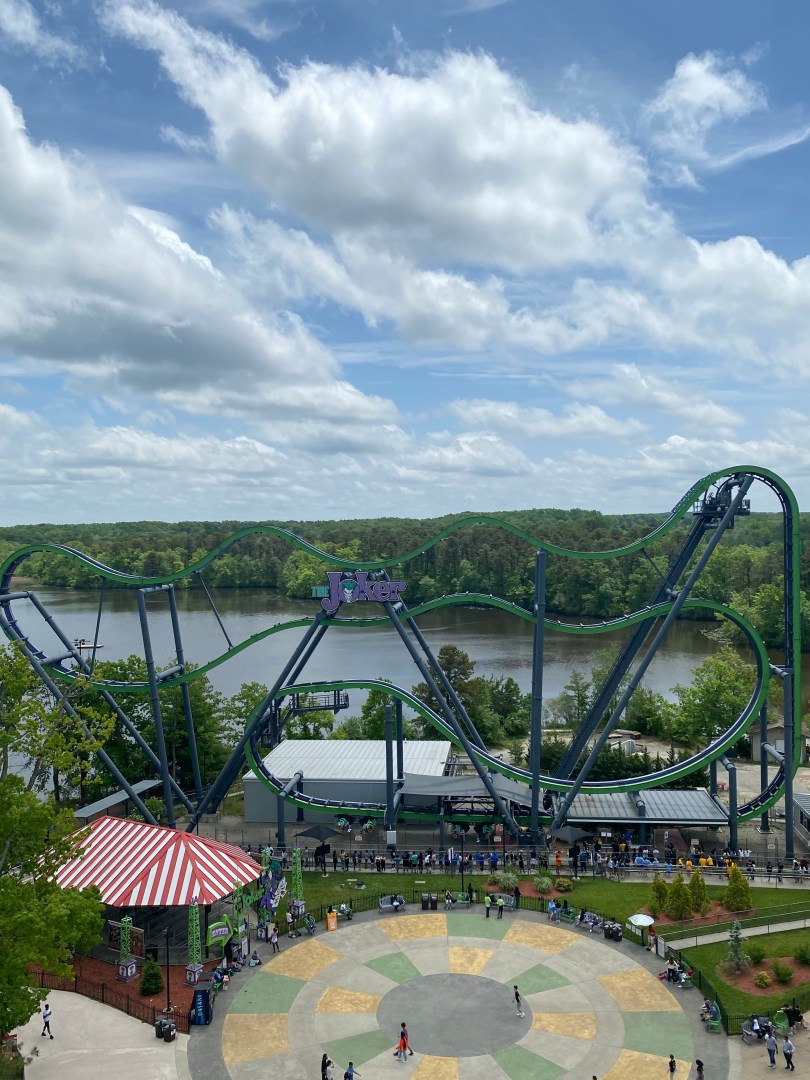
Six Flags Great Adventure’s famous “The Joker” rollercoaster as seen from gondola.

                  Unfortunately like many places in New Jersey, getting to the park from NYC or anywhere else is not exactly a “Great Adventure”, especially by public transportation. For many years, NJ Transit operated the 308 express bus from both Newark Penn Station and the Port Authority Bus Terminal(PABT) in Manhattan. The service even came with special theme park discounts as recently as last year where transit riders were able to save on tickets to either Great Adventure or Hurricane Harbor. To the likely dismay of riders, the service was discontinued this year with little explanation as to why from NJ Transit. While the agency is facing a nearly $1 billion deficit, the agency has not pursued any other major service cuts. The loss of Great Adventure service is almost certain to make it harder for guests to get to the park and make the most of what it has to offer.

                  As Great Adventure is located almost 2 hours from NYC in a lower-density suburban area, one may question the need for public transportation to the amusement park. However, it is important to note that 54% of NYC residents and 12.3% of NJ residents do not have a car. As Great Adventure is truly a regional destination, ensuring that everyone throughout the region can get there is critical to ensuring as many guests as possible have access to the park. Additionally, since Great Adventure and Hurricane Harbor are among the few theme parks of their kind near NYC, public transit can be the difference maker in which theme parks get customers. Outside of access, there is often congestion in Great Adventure’s parking lot due to the immense amount of cars traveling in and out of the facility. At closing time, congestion may worsen as many vehicles attempt to exit at the same time. This creates inconvenience for motorists and prevents them from making the most of their time since they often leave earlier to beat traffic. 

           To improve mass transit to Great Adventure, NJ Transit could take numerous steps. One and the most clear would be to reinstate the 308 express bus service. If the reasoning was due to budget constraints, than NJ Transit will need to make other moves to balance its budget and obtain funding. This is an issue that is much larger than Great Adventure bus service. However, if the route were to be reinstated, NJ Transit would likely want to run the route more later in the day and make its scheduling less confusing. According to a Reddit Post from 2023, the 308 bus did not run to Great Adventure after 9:30AM. This eliminated the bus as a travel option for those who plan to get to the park later in the day. Additionally, the scheduling of bus trips was quirky to say the least. While buses were scheduled to leave at certain times, they could depart sooner if they were full or later if they were empty. This left park-goers unsure as to when they could get to the park, making it hard to plan stays and coordinate meeting others at the park. Also, if a bus filled up, travelers may have been forced to make alternate travel plans, causing them to lose valuable time at the park.

             To remedy these issues, NJ Transit can simply run service solely based on daily ridership the way it does its other bus routes. NJ Transit likely used demand-based/fixed scheduling in an effort to get as many riders to the park as early as possible. Though this does have its benefits, the risk of unreliable service for many may outweigh the benefit of some people being able to leave to Great Adventure sooner. Solely having fixed-scheduling on the other hand, would have buses scheduled at times NJ Transit knows ridership warrants it the most, making service more accessible for more people. In addition, fixed-scheduling may make transit service more sustainable as it could be easier for NJ Transit to recoup more of the route’s operating cost in fare revenue.

               Outside of scheduling, NJ Transit can look to offer bus service from more locations. Buses from Newark and the PABT do serve a substantial amount of riders in the region. However, as commuting into either Newark or Midtown Manhattan can be tedious, these locations are not accessible to everyone. To help mitigate this issue, NJ Transit can add service from other travel hubs such as the Eltingville Transit Center on Staten Island and the Journal Square Transportation Center in Jersey City. This could make Great Adventure transit service accessible to more riders and reduce congestion at the park. Transit service can also make the park more desirable to visit by providing people an alternative to driving on the NJ Turnpike and I-195, which are among New Jersey’s busiest highways. NJ Transit can also consider bus service from the Hamilton Rail Station, which is the closest NJ Transit train station to Great Adventure. 

                   Besides providing transit service itself, there are several additions NJ Transit and Six Flags can pursue to make public transit more compelling to park-goers. One could be the ability to purchase tickets at the bus terminal via machines or kiosks, saving riders time at the park. Additionally, Great Adventure buses can include luggage racks for those staying at the soon-to-open Six Flags Savannah Sunset Resort and Spa on the theme park campus. Above all, NJ Transit could work with Six Flags for buses to stop closer to the entrance of the theme park. Currently, all buses arriving at the Great Adventure must park at the southwest corner of the parking lot and get there via a circuitous route on the Six Flags’ inner roadways. Couple with a long walk to the gate; it can be 15 minutes or more between when one sees signs for Six Flags and when they reach the entrance of the park. These changes would help to substantially reduce the time between when people arrive and can actually enter the theme park. 

                   As Great Adventure is a premier destination in the country’s most transit-dependent region, it is only fitting that it is well connected to the NYC area by public transportation. Hopefully, NJ Transit can find a transit solution that works for everyone and ensures that a trip to Six Flags Great Adventure can truly be a “Great Adventure” for those who rely on mass transit.

Works Cited

“Directions to the Park.” Six Flags, https://www.sixflags.com/greatadventure/plan-your-visit/directions. Accessed 21 April 2024.

Fuller, Corey. “The Best Amusement Parks Near NYC (2024).” Secret NYC, 18 May 2023, https://secretnyc.co/best-amusement-parks-nyc/. Accessed 21 April 2024.

Gorra, Jeff. “New Jersey Has One Of The Lowest Rate Of Car Ownership in America.” WRAT 95.9, 19 May 2023, https://wrat.com/2023/05/19/new-jersey-has-one-of-the-lowest-rate-of-car-ownership-in-america/. Accessed 21 April 2024.

Gralish, Tom, and Thomas Fitzgerald. “NJ Transit wants to raise fares 15% to stay ahead of budget shortfall.” Philadelphia Inquirer, 4 March 2024, https://www.inquirer.com/transportation/nj-transit-fare-hike-proposal-20240304.html. Accessed 21 April 2024.

New York City Department of City Planning-Transportation. “Car Ownership in NYC.” Tableau, 24 November 2022, https://public.tableau.com/app/profile/dcptransportation/viz/ACSProfiles/Dashboard1. Accessed 21 April 2024.

“New York to Six Flags Great Adventure – 3 ways to travel via train, and bus.” Rome2Rio, https://www.rome2rio.com/s/New-York/Six-Flags-Great-Adventure. Accessed 21 April 2024.

“NJ TRANSIT OFFERS SPECIAL SAVINGS TO SIX FLAGS! |.” NJ Transit, 19 May 2023, https://www.njtransit.com/press-releases/nj-transit-offers-special-savings-six-flags. Accessed 21 April 2024.

Refuerzo, Francisco. “Global Attractions Attendance Report-The Americas.” AECOM, https://aecom.com/wp-content/uploads/documents/reports/AECOM-Theme-Index-2021.pdf. Accessed 21 April 2024.

Six Flags Savannah Sunset Resort & Spa.” Six Flags, https://www.sixflags.com/savannahsunset?utm_campaign=SFGAD_2024&utm_medium=cpc&utm_source=google&utm_content=savannah_sunset&gad_source=1&gclid=Cj0KCQjwlZixBhCoARIsAIC745BxPoG4vaG2n-ftNjUDHzmA143r14ZgUrd19XQQxFV42cjsjItTVnEaAmLmEALw_wcB. Accessed 22 April 2024.

the_D_clan. “Six Flags Great Adventure Bus Operations (NJ Transit 308) : r/sixflags.” Reddit, 29 May 2023, https://www.reddit.com/r/sixflags/comments/13uhgpq/six_flags_great_adventure_bus_operations_nj/. Accessed 21 April 2024.

TimeOut Contributors, et al. “12 Best Amusement Parks Near NYC For For A Thrilling Excursion.” TimeOut, 23 May 2023, https://www.timeout.com/newyork/attractions/day-trips-amusement-parks-worth-the-admission-arcades-amusements. Accessed 21 April 2024.

Could The Nostrand Avenue Line Be Extended?

By Joseph Morales

The Nostrand Avenue Line is a busy subway line in Brooklyn. The line runs from Franklin Ave-Medgar Avenue College and Flatbush Av-Brooklyn College and is served by the 2 and 5 lines. The Nostrand Avenue Line connects several densely populated neighborhoods in Central Brooklyn, such as Midwood, Flatbush, and Prospect Lefferts Gardens. Additionally, the line provides connections to both local and express service on the Eastern Pkwy Line(2,3,4,5), which provides access to even more destinations across Brooklyn and Manhattan. Overall, the line served over 35,000 riders per day in 2022 according to MTA statistics.

Read More »

How Can New State Legislation Impact New York City Transit?

By Joseph Morales

Public transportation is the backbone of New York City. Due to the city’s congestion and limited parking space, many take public transportation to avoid the hassles associated with driving. Given the city’s high cost of living, many find driving to be prohibitively expensive and hence also decide to opt for transit. As a result of these factors and others, 46% of New Yorkers do not own a car and hence rely on public transit to get wherever they need to go. This tally does not include suburbanites who take mass transit in New York City in lieu of driving for the same reasons as residents. 

Read More »