The Metro-North Railroad is a commuter rail network with three main lines connecting New York’s northern suburbs with The Bronx and Manhattan. Countless suburban downtowns across the Mid-Hudson Region and Connecticut have been built around Metro-North stations. The network’s hub at Grand Central Terminal gives riders access to Manhattan’s Central Business District. It is here where riders can also transfer to the NYC Subway and the Long Island Rail Road in order to make trips across NYC and the NY Metro region. Overall, the Metro-North has served an average of roughly 230,000 riders daily according to data from October 2024.
The Long Island Rail Road(LIRR) is a vital mode of transportation for thousands of Queens residents. This is especially true in Southeastern Queens, where many communities are miles from a subway station. In addition, the railroad is the only means that many have to get to Long Island and major reverse commuting destinations such as Mineola and Rockville Centre. Many LI residents also rely on the railroad to get to Queens given the number of areas such as Long Island City and Forest Hills that are hard to drive to. According to data from the NYC Department of City Planning, 37% of Queens residents do not have access to a car. This demonstrates just how critical the LIRR is to the mobility of residents.
The New Haven Line(NHL) of the MTA’s Metro-North Railroad(MNR) is one of the busiest commuter rail lines in the New York area. The NHL is the line that connects Connecticut and parts of Westchester County near the Long Island Sound to New York City. In addition to getting to NYC, many use the line to travel to other growing cities such as New Rochelle, Stamford, and Bridgeport. The line has three branches in addition its main branch that run to Waterbury, New Canaan and Danbury, making the line essential for commuter travel across the state of Connecticut. The operating costs for the main NHL are split between the Connecticut Department of Transportation(CTDOT) and the MTA by a 65%/35% split, respectively. The CTDOT fully bears the cost of operating the line’s branches. In 2023, the NHL was the MTA’s busiest Metro-North Line, with 26.1 million trips despite many people still working from home.
With this high ridership in mind, the MTA and the Connecticut Department of Transportation(CTDOT) worked together to make major service improvements to improve commutes for riders. The most significant of which was the addition of super express trains from New Haven to Grand Central Terminal. These trains run three times during the AM and PM peak periods in the peak direction and only make stops at New Haven, Bridgeport, Stamford and Grand Central. This turned a trip that would almost always take over two hours to one that could be completed in just an hour and 39 minutes when people need to get into Manhattan the most. In comparison, a transit trip from many parts of NYC to Grand Central could take a similar amount of time.
New Haven Line train parked at Grand Central Terminal.
In addition to express trains, the Metro-North added seven more trains a day to the Waterbury Branch, a 47% service increase as a result of infrastructure improvements made to the branch. These new trains have led to service beginning earlier in the morning and there being more trains available during the off-peak hours. This flexibility makes it easier for those with nontraditional work schedules and other obligations in New York City to get there using mass transit. Infrastructure improvements that allowed for the service increase included new signals and tracks, replaced railroad ties and repaired grade crossings.
With both projects being almost two years old, riders definitely seem to be benefiting from the added rail services. A ridership overview given by the MTA during their most MNR/LIRR joint committee meeting partly attributes increased Metro-North ridership to both the new Super Express Trains and Waterbury Branch trains running on the NHL. It is clear that when riders have service options that fit their needs, they utilize them and reap the benefits of faster, easier, and cheaper commutes. This is especially true for Manhattan-bound commuters, given the challenges and costs of driving into the Central Business District. According to a report from the NYC Department of City Planning in 2011, 35% of those who drove into Manhattan did so because of transit schedules, and another 13% did so due to transit stops. These were both among the leading reasons for driving into Manhattan amongst suburban drivers. Hence, the recent Metro-North improvements can go a long way toward continuing to increase transit ridership and reducing congestion in Manhattan as well as major roads such as the Connecticut Turnpike(I-95). Since congestion pricing is on the way, the new services will likely also help CT residents save money on congestion pricing tolls.
Despite these additions being a game-changer for riders, there are numerous signs that even more substantial service upgrades are coming. Both Super Express service and increased Waterbury Branch service were included in some of Governor Ned Lamont’s state budgets and are a part of Lamont’s TIME FOR CT rail initiatives. TIME FOR CT is Governor Lamont’s plan to save CT riders 25 minutes by 2035 through a massive $10-12 billion investment throughout Connecticut’s rail infrastructure.
The plan is split into three major components: service, infrastructure, and “a rail fleet for everyone”. Service essentially includes projects like the Super Express service and the increased Waterbury branch service that provide more travel options to commuters. Infrastructure improvements enhance the systems necessary for quality train service to operate, including tracks, signals, and bridges. Projects under this category include several bridge replacements on the NHL along with the addition of a fourth track near the Milford station. Connecticut’s goal is to allow for train speeds of 90-110 mph while sparking employment and economic growth throughout the state. While 90-110 mph is not the speed of high-speed rail seen across the world, it is still substantially better than the line’s current top speed of 80 mph. Hence, riders will be able to travel much further faster, allowing them to get to more places and access more opportunities. Lastly, “a rail fleet for everyone” will allow for better trains that fully serve the needs of those riding them. This will include ensuring that all trains are fully accessible to riders along with adding dual-mode locomotives to run on NHL branches that would allow for more one-seat rides between branch lines and NYC.
The Time for CT plan has the potential to dramatically change rail travel in the state of Connecticut. As the most recent service changes have already had a major impact on riders, there is no telling how much better the system will become once all projects in the plan are completed. In addition to travel improvements, Connecticut is likely to see transformative economic benefits, too. According to the American Public Transportation Association, every $1 invested in public transportation results in $5 in economic value. Additionally, every $1 billion in transit investment creates about 50,000 jobs. The economic impact could be recognized through various means, such as increased sales for small businesses, new corporations moving into the state, and new transit-oriented developments. Transit-oriented developments are mixed-use developments that include commercial and residential spaces within walking distance of a transit station. Some transit-oriented developments include Darien Commons near the Noroton Heights NHL station and Avalon Harrison, located near the Harrison NHL station, three stops from the CT state line.
Connecticut has and is continuing to show how commuter rail investment can lead to great things on so many levels. It will be interesting to see the full effects of the Time for CT plan, given how it is such a large-scale, comprehensive investment into the New Haven Line. Given the early successes of the plan, optimism is brewing for a new era for commuter rail and enhanced economic activity in the state of Connecticut.
Fazzalaro, James J. “SUMMARY OF MAJOR PROVISIONS OF CONNECTICUT/METRO NORTH RAIL CAR PURCHASE AGREEMENT.” ct.gov, 17 November 2006, https://www.cga.ct.gov/2006/rpt/2006-R-0678.htm. Accessed 8 May 2024.
Rosebank is a residential community on the East Shore of Staten Island. The neighborhood is directly adjacent to major thoroughfares such as Hylan Blvd and Bay St that connect residents to communities around Staten Island and even the region Additionally, Rosebank is just a 10 minute drive from the Staten Island Ferry and even closer to other busier neighborhoods such as Stapleton and Tompkinsville. The community is also adjacent to the Verrazano Bridge, providing seamless vehicular and transit connections to Brooklyn.
In New York City, much of the population relies on mass transit run by the MTA(Metropolitan Transportation Authority)to get around. According to data from the NYC Department of City Planning, only 46% of city households own a car. Even vehicle owners often use mass transit to get to Manhattan due to traffic congestion and high parking costs. Additionally, hundreds of thousands of riders from outside of the city ride the Metro-North and LIRR commuter rails to get around the suburbs as well as into the city daily. Given how many people it moves, the MTA also plays a major part in New York’s economy. An NYU study from October 2020 found that a 40% reduction in bus/subway service and a 50% reduction in commuter rail service would cost riders more than $1.7 billion in lost time each year. This is only reflective of the impact of transit service reduction and does not reflect the impact of if mass transit were to not exist at all.
The Hartsdale Metro-North(MNR) station on the Harlem Line is the main commuter rail station serving the Hamlet of Hartsdale with a population of 2,964 residents according to Niche.com. The station is also the closest station for some Scarsdale residents, given its proximity to the Scarsdale Town Line. In addition to being a major transportation asset for the community, the station is also on the National Register of Historic Places.
The Riverdale station on the Metro-North’s Hudson Line is located in the serene Riverdale section of The Bronx. The station is the closest rail station of any kind to the College of Mount Saint Vincent. As the station is nearly two miles from the subway, many Riverdale residents rely on the Metro-North in order to get to Manhattan. In addition, the line also provides direct access to nearby Westchester County and popular reverse commuting destinations such as Yonkers and Tarrytown.
Elmhurst, Queens, is one of New York’s most diverse and arguably one of Queens’ most vibrant communities with a high commercial and residential density. It is home to Elmhurst Hospital, one of Queens’ two public hospitals, and the Queens Center Mall, which likely draws shoppers from throughout the borough as Queens’ only major indoor shopping mall. For the most part, the community is well served by mass transit, with several stations on the M, R, and 7 subway lines that traverse various areas of Queens, Manhattan, and Brooklyn. Additionally, the area is served by many bus lines, including the Q52/Q53-Select Bus Service, which runs from Jackson Heights to the Rockaways and is the longest north-south bus line in Queens. Both the Q52 and Q53 were also among the highest-performing and most reliable bus routes in Queens in both May and October 2019, according to data from the NYC Bus Turnaround Coalition.
The NYC Subway System is one of the most vast and most used subway systems in the entire world, with 472 subway stations serving millions of riders daily. The MTA’s commuter rails are also similarly impressive, with 250 rail stations serving hundreds of thousands of riders from New York’s suburbs as well as certain parts of the Bronx, Brooklyn, and Queens.
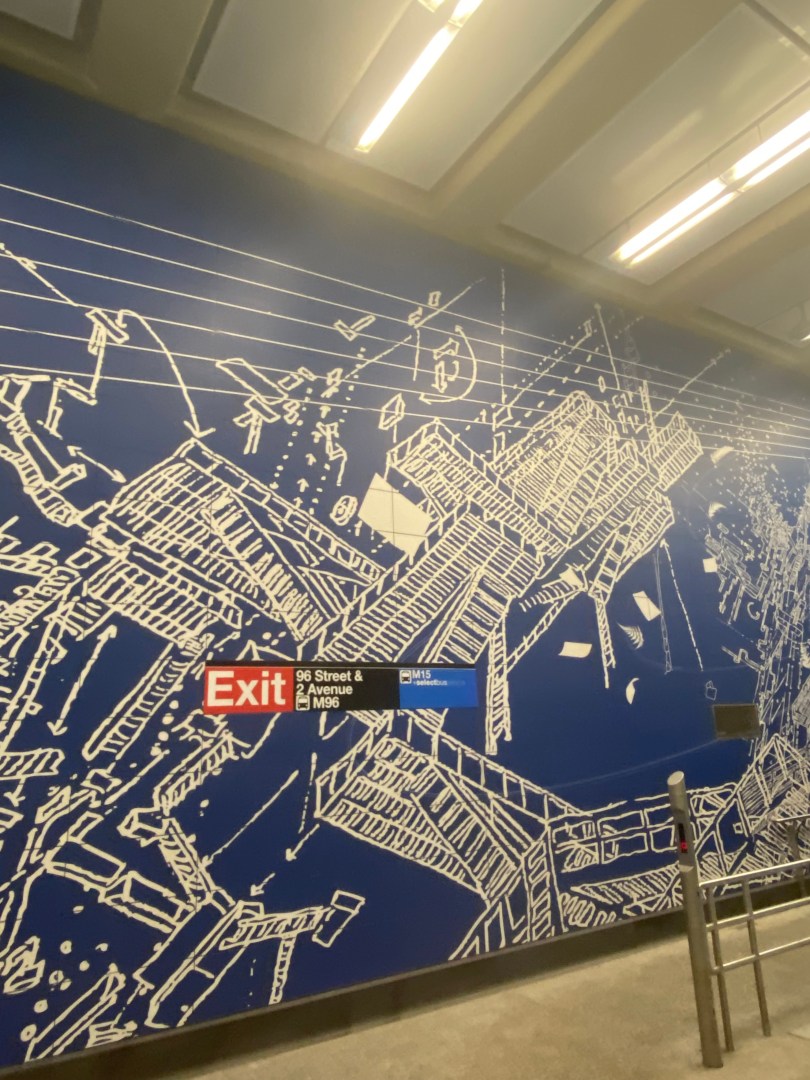
Besides being able to get to many parts of NYC and the NY region without a car, the sheer number of stations allows for the ability for hundreds of unique, elegant, and inspiring artworks to be on display throughout the subway system as well as the Metro-North and LIRR. Large station complexes such as Grand Central Terminal tend to have many pieces of art, as the size of these complexes provides artists with plenty of possible canvases. The transit system’s artwork generally consists of various forms, including mosaics, terra cotta, and more.
The New Canaan Line is a branch of the Metro-North’s New Haven Line(NHL) that runs from Stamford to New Haven, CT. The line connects areas north of the Stamford station with the rest of the NHL, which offers riders ample connections to other areas of Connecticut along with Westchester County, NY, and New York City. Additionally, the branch’s terminus at the Stamford station provides riders with access to Downtown Stamford, which is one of Southern Connecticut’s most prominent economic and cultural hubs. The Stamford station is also home to Amtrak trains, with the Stamford Transportation Center being just a block away, providing riders with access to trains that traverse the northeast along with bus routes that traverse Fairfield County, respectively.





 Transit Central