By Joseph Morales
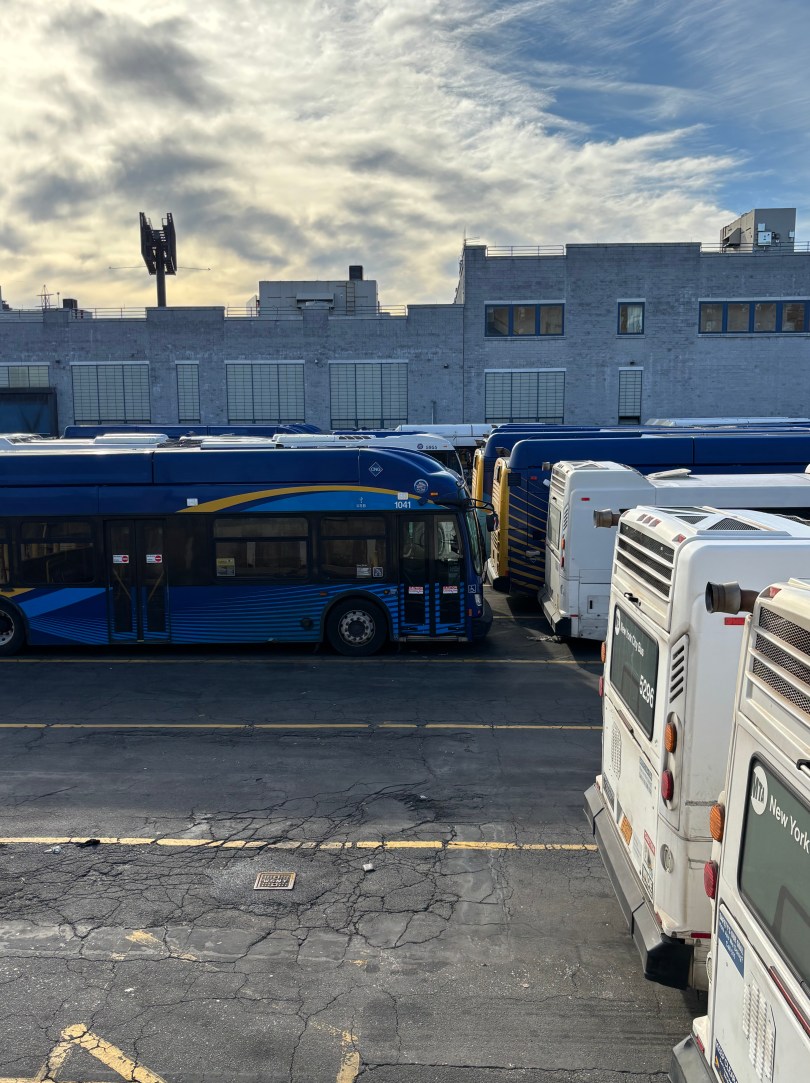
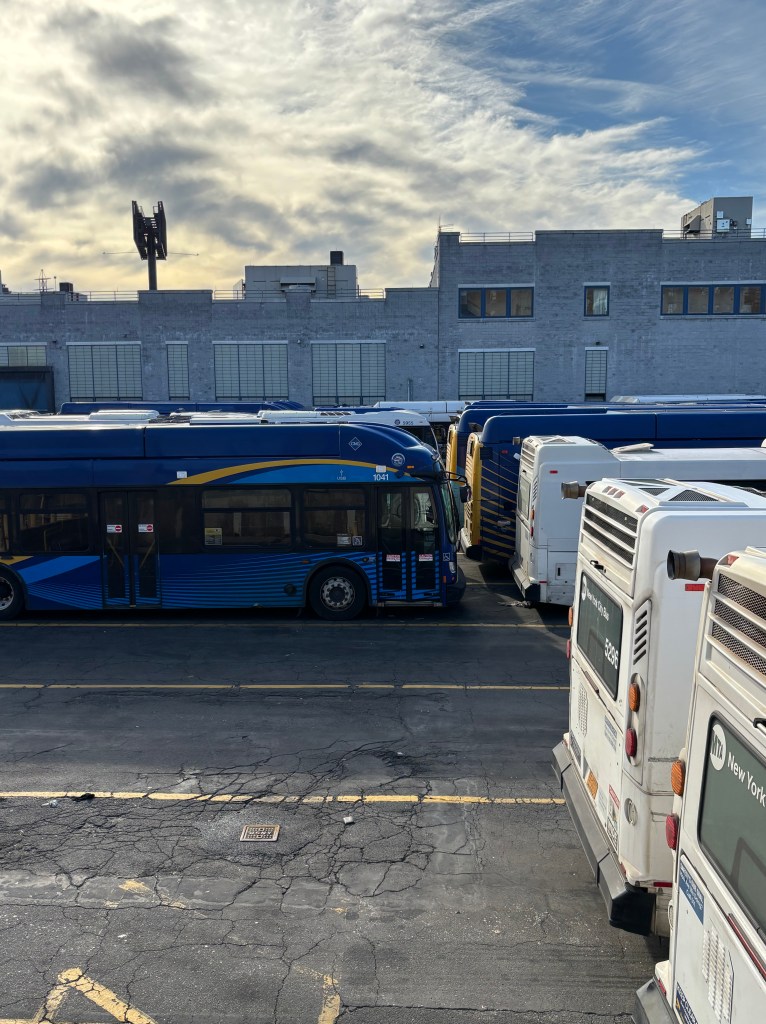
Functioning bus depots are critical to the MTA being able to provide bus service to riders across New York City. At any of the MTA’s 38 depots/facilities, there are a plethora of infrastructure components that are essential for the safe storage and maintenance of the bus fleet. These include chassis wash stations, specialized maintenance bays and fuel storage locations. Even parking areas for buses are meticulously designed so that buses have clear and safe paths to enter and exit the depot. Due to the importance and complexity of bus depots, the MTA is dedicating $370 million to them in its 2025-29 Capital Plan.
The $370 million the MTA has recently allocated to bus depots does not include projects that are being worked on or have been completed as part of its previous capital plans. It is normal for projects to extend out of their capital plans due to numerous factors including project start times, project durations and delays.
There are a number of bus depot-related projects from the 2020-24 capital plan that are still in progress that will have an immense impact on bus operations once completed. A couple of projects include work on multiple infrastructure systems at the College Point Depot in Queens, and the Spring Creek Depot in Brooklyn. These projects include generator replacement and HVAC replacement. While they do not represent the most glamorous MTA projects, this work is critical to the depots functioning smoothly and for buses to reliably serve passengers. Overall, the College Point Depot houses most of Queens’ express bus routes along with busy local routes such as the Q66(Northern Blvd West) and the Q25/Q34(Kissena Blvd). The Spring Creek Depot serves most of Brooklyn’s express bus routes along with the B100 and B103 buses.
Working generators are critical as they ensure bus operations can continue in the event of a power outage. Essential bus depot components that require electricity include lighting, communications and HVAC.
Generators have played a key role in ensuring continued bus operations during multiple recent power outages. During the Manhattan Blackout of July 2019, the MTA was able to advise riders to take buses instead of subways when the entire subway system was impacted by the blackout. This was only possible because of working power at the Michael J. Quill Depot in Midtown where much of the buses that serve Manhattan between Midtown and Harlem are housed. More recently after Hurricane Ida, generators at the Gun Hill Bus Depot kept buses running when the power was out and subways were disrupted due to flooding. This included the Bx12-SBS, which at the time was the second busiest bus route in the city.
It is without questions that the generators are critical due to their potential use in emergency situations. This is especially true for the Spring Creek and College Point Depots since they are both in locations that may have traditional power restored later after power outages. Information obtained by newssite Epicenter says that Con Edison prioritizes areas with critical infrastructure such as hospitals and police stations followed by areas with denser populations. The areas surrounding the bus depots do not really meet this criteria. Both depots are in areas with more low to mid density housing and industrial buildings. Additionally, they are not in the vicinity of any hospitals, the subway or police/fire stations. Thus, it is likely that these communities are among the last in line when it comes to power restoration after outages. This makes it more critical that these depots have their own power sources in the event of an outage.
In addition to power for the depot, the generators will be critical if the depots receive electric buses in the future. This is likely at some point given the MTA’s plan for all new buses to be zero-emissions vehicles by 2029. It is critical even today the bus depots have electricity in order for charging equipment to function properly. However, the depot’s electricity demand will likely rise even more once buses themselves are powered by electricity. This means that buses being able to enter service from the depot will be dependent on whether or not they could be charged. Hence, here is just one more reason why reliable power brought by generators is critical for the Spring Creek and College Point Depots.
The project to replace the generators at both depots is costing the MTA $17.7 million according to its capital program dashboard. Work is set to be done this month and is 77% complete as of the third quarter of this year.
Outside of generators, the depots are both in phase 2 of a project to replace HVAC equipment. It is relatively self-explanatory why proper heating and air conditioning is important for bus depots, where many bus drivers and essential personnel spend many hours each day. Functioning HVAC is also critical for future electric buses as cooling systems ensure that batteries do not overheat. Cooling from HVAC is equally important for other electrical components of depot and bus infrastructure that is necessary to keep bus service running reliably.
New HVAC systems will likely go a long way from preventing critical failures like the one at the East New York Depot in December 2023. At the ENY depot, there was no heat for a period of time after there were issues with a 70-year old heating system. This left drivers with having to sit inside buses or use MTA-provided portable heaters to keep warm. There were also challenges making the necessary repairs due to supply-chain delays for components that needed to be replaced. Hence, the MTA’s proactive, phased approach for the College Point and Spring Creek Depots will likely go a long way to preventing similar situations at these depots.
For Phase 2 of the HVAC project, it is not totally clear what exactly is included in this phase. On the MTA’s Capital Plan Dashboard, the lone explanation is that the MTA will “replace HVAC equipment.” Work at Spring Creek may have been impacted by a boiler replacement that was completed there recently. A deeper explanation was likely not provided due to the complex technical nature of the work being done.
Overall, the MTA has committed $12M to HVAC work at Spring Creek and $22.4M to work at College Point. Despite both projects being set for completion this month with an objective start date of December 2023, work at Spring Creek is 75% finished and work at College Point is 39% finished. Both completion percentages were updated in the third quarter of this year. The stark difference in cost and completion timelines is likely due to a variation in supply chain constraints and labor intensity for the components that need replacement at each depot. Regardless, the work will have an immense impact on depot operations and the wellbeing of depot staff once completed.
Generator and HVAC replacement at the College Point and Spring Creek Bus Depots is critical for the resiliency of the depot’s infrastructure. Overall, the upgrades will ensure that buses can operate reliably at all times including adverse events such as power outages and severe weather. The HVAC work will also ensure that drivers and other depot staff can work comfortably during extreme heat and cold conditions. These projects are a reminder of the behind-the-scenes, state of good repair work the MTA does to ensure reliable bus operations across New York City daily. Hopefully, the new generator and HVAC components can serve the College Point and Spring Creek Depots well for years to come.
Works Cited
Castillo, Ambar. “Why certain NYC neighborhoods endure longer power outages than others after severe weather.” Epicenter, 13 May 2024, https://epicenter-nyc.com/hardest-hit-nyc-communities-left-in-the-dark-longer-after-severe-weather/. Accessed 19 December 2025.
Chojnowski, Catherine. “South Bronx recovers from Ida while some MTA service remains suspended.” Mott Haven Herald, 3 September 2021, https://www.motthavenherald.com/2021/09/03/south-bronx-recovers-from-ida-while-some-mta-service-remains-suspended/. Accessed 19 December 2025.
Martinez, Jose. “Bus Depot Workers Without Heat as Cold Settles on the City.” THE CITY – NYC News, 7 December 2023, https://www.thecity.nyc/2023/12/07/bus-depot-workers-no-heat/. Accessed 19 December 2025.
Metropolitan Transportation Authority. “Capital Program Dashboard.” MTA, Q3 2025, http://web.mta.info/capitaldashboard/CPDPlan.html?PLN=8&AGY=a. Accessed 19 December 2025.
Metropolitan Transportation Authority. “Subway and bus ridership for 2021 – New York City Transit.” MTA, 2022, https://www.mta.info/agency/new-york-city-transit/subway-bus-ridership-2021. Accessed 19 December 2025.
Metropolitan Transportation Authority. “Transitioning to a zero-emissions bus fleet.” MTA, 7 August 2024, https://www.mta.info/project/zero-emission-bus-fleet. Accessed 19 December 2025.
Metropolitan Transportation Authority. “2025-2029 Capital Plan: The Future Rides With Us.” MTA, 18 September 2024, https://www.mta.info/document/174186. Accessed 19 December 2025.
Pulliam-Bailey, Sarah, and Laura Bassett.
“New York City power outage hits thousands in the heart of Manhattan.”” The Washington Post, 13 July 2019, https://www.washingtonpost.com/nation/2019/07/14/new-york-city-power-outage-hits-least-heart-manhattan/. Accessed 19 December 2025.
 Transit Central