
By Joseph Morales
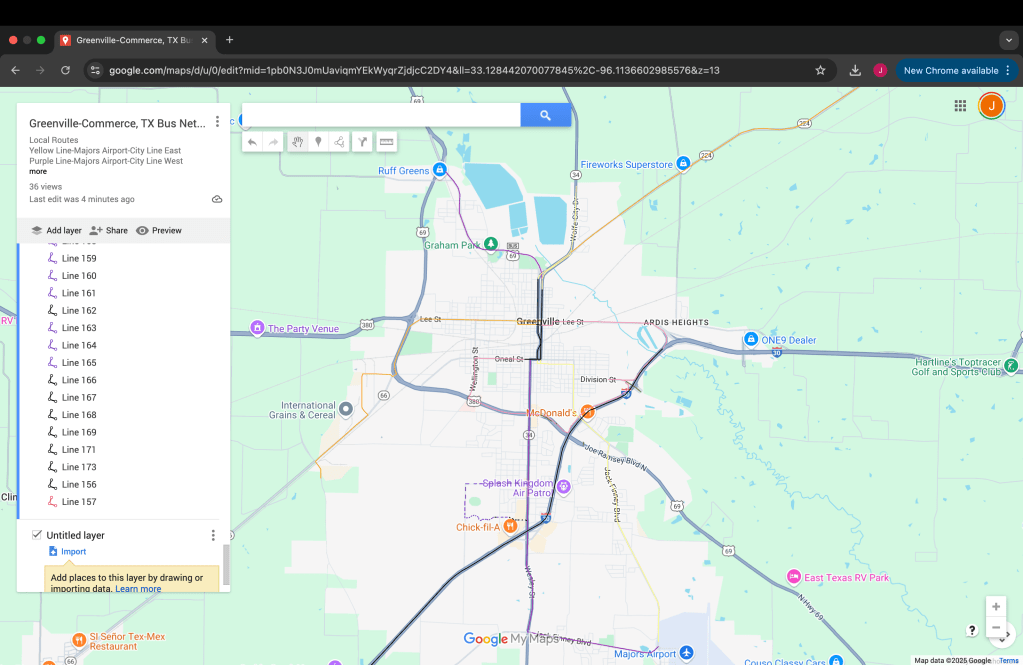
Maps for the proposed bus system can be found in the article. For a closer look at the map, click here: https://www.google.com/maps/d/edit?mid=1pb0N3J0mUaviqmYEkWyqrZjdjcC2DY4&usp=sharing
Greenville, TX is a small city located about 50 miles northeast of Downtown Dallas. The city started to grow substantially in the early 1910s when it became famous for its cotton production. Greenville was considered the “cotton capital of the world” and between 1911-1912 the city had the world’s largest cotton compress. A cotton compress reduces the size of cotton to make it easier to ship. Growth in the cotton industry led to railroads coming to the city and in turn, Greenville’s population grew by the thousands. Eventually, the city became a transportation hub with six railways making stops in the town.
The city of Greenville continued to grow while the local economy shifted from agriculture to industry in the 1950s. Industry is still an important part of Greenville’s job market, with a significant cluster of industrial land use in the southwestern part of the city along Oneal St and Hwy 66. Greenville now touts itself as a place where one can enjoy the nature of a small town while still being in the proximity of one of America’s larger cities. Today, Greenville has a population of about 34,000 and is expected to exceed 40,000 by 2030 according to Business View Magazine. Greenville Mayor Jerry Ransom referred to the city as “‘one of the fastest-growing cities in Texas for cities our size.’” in a report with the news outlet.

Despite Greenville’s history with railways, the city has no form of traditional public transportation. Greenville does have a microtransit service that offers door to door trips to destinations within Hunt County. However, riders must schedule trips a day in advance or face double fares, leaving them with little flexibility. It is also worth noting that since the service requires reservations and covers the entire county, riders likely cannot always get trips at guaranteed and predictable times. In addition, connections to the nearby city of Dallas are almost nonexistent. Transit to the Dallas area exists solely in the form of a shuttle that makes two trips in the AM and PM peaks in the peak direction to the Downtown Rowlett DART station. Downtown Dallas is a 45 minute light rail ride from the DART station. This level of service leads to longer trips and scarce opportunities to take advantage of being close to such a large city.
To address these issues, the city of Greenville can adopt a new, small fixed-route transit system. Service could be run with the larger mini buses used in places with lower population density such as in New York’s Finger Lakes Region and in East Chicago, Indiana. The bus system would consist of four local routes that cover almost the entirety of the city. Each route connects to the city’s downtown and provides access to different neighborhoods and destinations of interest. Two routes begin at Major’s Airport, which is a city-owned airport on the southeastern side of the city. This decision was made since the airport is a significant job hub and was a natural starting point for the two routes that both travel to the airport’s north. There is also a route that travels northeast through the city before running continuing to the city of Commerce. Commerce is another significant city in Hunt County and is home to East Texas A&M University.
Routes will likely run every 15-60 minutes depending on ridership with service from 5AM-11PM. This will provide riders with much more flexibility than the existing system. All local routes will offer what is known as route deviation, where riders can request deviations of up to ¾ mile from the fixed route. This is used by many transit systems across the United States in areas with a similar population density to Greenville. If the system were run by a transit agency, riders would likely have to call one business day in advance to schedule a diversion. This is common practice across systems that offer route diversion and would still provide Greenville riders with much more flexibility than the status quo.
In addition, there will be two express routes that provide service to areas a distance from Greenville. This will include a route to Downtown Dallas as well as Downtown Garland, a major Dallas suburb.
This article’s purpose is not to make a vindictive suggestion as to what Greenville’s transit system should be. Rather, it is to showcase an idea of what mass transit could look like in the city. A system map and detailed description of each route can be found below. Routing in black is shared by either local routes in Downtown Greenville or express routes on I-30. The express route inset is in the express route section of the article.

LOCAL ROUTES
Yellow Line Majors Airport-City Line East
Via TX-34
The Yellow Line would run from Majors Airport on the city’s southeastern side to the studio of 93.5 The Coyote in the northeastern section of the city. This route would use Jack Finney Blvd and Business US-69 to get to Downtown Greenville, before proceeding to the radio station on TX-34. The Yellow Line connects Downtown Greenville with multiple residential neighborhoods along with the airport. In addition, the route serves multiple key destinations including schools, hotels, a golf course and the Fletcher Warren Civic Center.
Purple Line Majors Airport-City Line West
The Purple Line would also start from Majors Airport but would instead use Wesley St to get Downtown and would then use N Rees St(Business US-69) in order to serve the city’s northwest side. Routing on Wesley St will serve much of Greenville’s larger shopping destinations including the Greenville Promenade and the city’s Walmart Supercenter. Also served by the route, are the city’s three largest parks(Betts, Jones and Graham). Buses can be diverted at Lions Lair Rd to serve Greenville High School, Greenville High School Stadium and the Greenville SportsPark during school/arrival dismissal times along with special events respectively. The frequency of diversions may need to be revisited once the city opens a brand new 120,000 sq ft recreation center in the SportsPark.
Green Line Greenville Loop
The Green Line would form a loop around the city, utilizing Lee St, the I-30 Frontage Rd along with streets within the city’s western and downtown areas. This route will serve several neighborhoods and connect them with Downtown Greenville. Major destinations include the Audie Murphy/American Cotton Museum, the Longhorn Arena and Event Center, and the Hunt Regional Medical Center.
Orange Line Greenville Industrial Area-Commerce
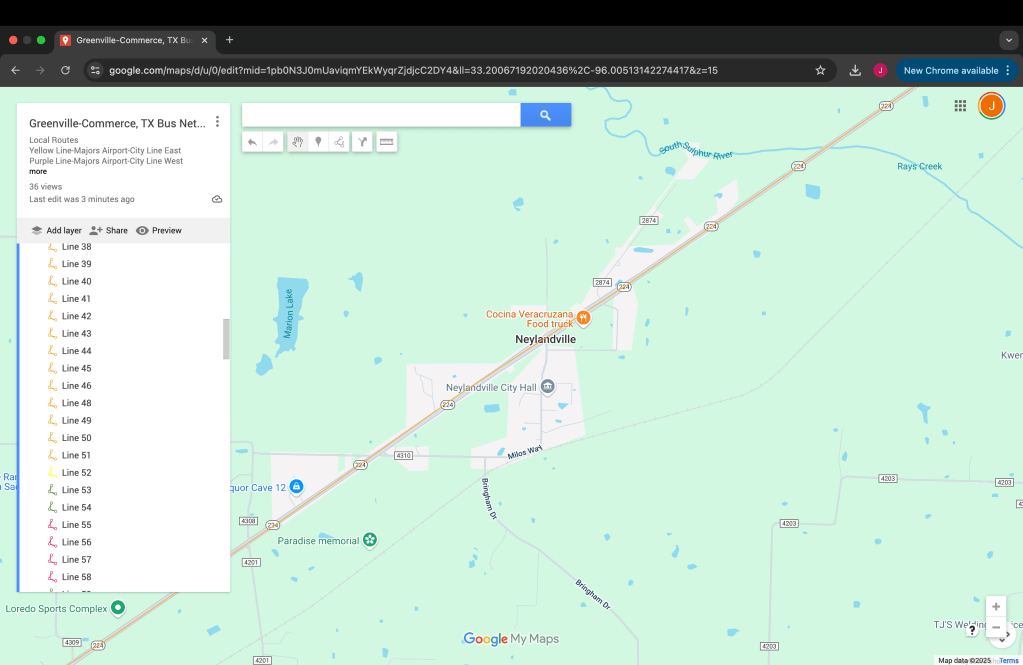
The Orange Line would run from the industrial strip on Hwy 66 and run through Downtown Greenville connecting to Commerce, TX via TX-224. The route would also include stops at the Laredo Sports Complex and in the City of Neylandville on TX-224. While Neylandville has a population of just 74 and no major destinations, the city’s location directly along the route provides the opportunity for a stop that will be within walking distance of all residents. Routing in Commerce will serve almost all significant destinations in that city including East Texas A&M University.
EXPRESS ROUTES
In addition to the local network, there will be two express routes to connect Greenville to important places far from the city. Both routes will have at least bihourly service in each direction from 5AM-11PM. One of them, the Blue Line, will run from Downtown Greenville to Downtown Dallas. The other route will be the Brown Line and will run from Downtown Greenville to Downtown Garland.
Blue Line Downtown Greenville-Downtown Dallas
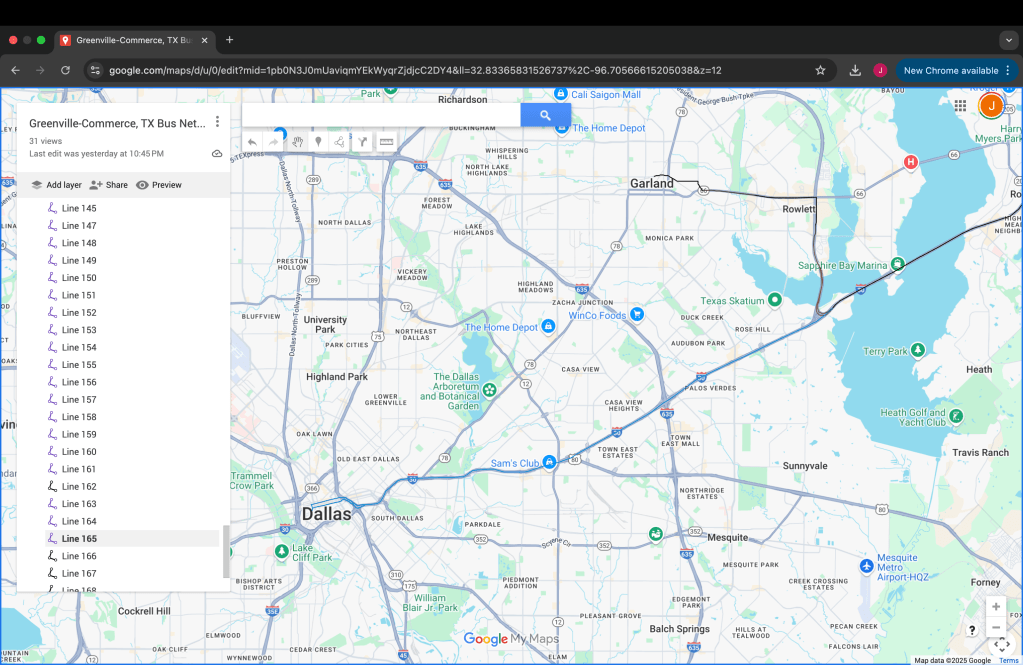
The Blue Line will run from Downtown Greenville to Downtown Dallas via I-30, allowing Greenville residents to have direct transit access to the DFW region’s largest activity hub. Since Downtown Fort Worth is over 80 miles from Greenville, it is likely that more out of city commuters than not go to Dallas. Having the direct route here will also provide residents with connections to DART services, Amtrak and other travel options that will allow for transit trips to be made throughout the DFW area and beyond.
Brown Line Downtown Greenville-Downtown Garland
The Brown Line will connect Downtown Greenville to the Downtown Garland DART Blue Line Station to provide access to the DFW region’s northeast suburbs. This is likely one of the other regions that a higher number of residents commute to. Unlike the existing route to nearby Rowlett, Garland offers connections to a slew of DART bus routes that traverse much of the northeast suburbs along with Northern Dallas. It is also worth noting that since Rowlett is one light rail stop east of Garland and the Blue Line runs every 15 minutes during rush hours, the route adjustment should not have a significant adverse impact on those going to Rowlett.
The Benefits of a Public Transit System
A transit system in Greenville, TX could be a boon for the city’s residents and visitors in various ways. For starters, public transit is 10 times safer per mile than driving according to data from the American Public Transportation Association. Public Transportation can also help residents to save money. This is particularly important in Greenville where the poverty rate is 10.9% and many residents struggle to make ends meet. Additionally, 63.6% of residents travel 25 miles or more to work, meaning that much of Greenville’s population faces higher fuel costs. Hence, a public transit system would give residents opportunities to save on transportation, even if they don’t take the bus for every trip. Other possible benefits of public transit can include reduced carbon emissions and economic growth from increased trips to businesses.
Conclusion
Greenville, Texas is a thriving and growing city. It is truly a unique place in how it combines the community of a small town with the benefits of being near a city as large as Dallas. A public transit system can contribute to this blend by providing the mobility options of larger suburbs while enhancing the community bonds that small towns are known for. People being able to travel throughout the city and its surroundings without a car also offers a plethora of other benefits to all city residents. These include lower transportation costs, safer trips and more. Hopefully, whether it’s a bus system or something else, Greenville can improve its transportation network so people can get the most out of what the city has to offer for years to come.
Works Cited
Cubit. “Greenville Demographic Statistics.” Texas Demographics, 2025, https://www.texas-demographics.com/greenville-demographics. Accessed 1 August 2025.
“Greenville SportsPark Recreation Center.” Brs Arch, https://brsarch.com/projects/greenville-sports-park-center/. Accessed 3 August 2025.
“History of Greenville.” Greenville, TX, https://www.ci.greenville.tx.us/911/History-of-Greenville. Accessed 1 August 2025.
“Public Transportation Facts.” American Public Transportation Association, 28 September 2023, https://www.apta.com/news-publications/public-transportation-facts/. Accessed 1 August 2025.
“Route Deviation Service Requirements.” National Rural Transit Assistance, https://www.nationalrtap.org/Toolkits/ADA-Toolkit/Service-Type-Requirements/Route-Deviation-Requirements. Accessed 1 August 2025.
Senior Center Resources and Public Transit. “SCRPT – Transportation.” Senior Center Resources and Public Transit in Hunt County, Texas, https://www.scrpt.org/transportation.htm. Accessed 1 August 2025.
United States Census Bureau. “Distance/Direction Analysis.” OnTheMap Text Only Tool, https://onthemap.ces.census.gov/. Accessed 1 August 2025.
“Where Growth Meets Hometown Heart Balancing rapid economic growth with the preservation of its authentic Texas charm.” Business View Magazine, 29 May 2025, https://businessviewmagazine.com/greenville-tx/#:~:text=Greenville’s%20Growth%20and%20Strategic%20Vision&text=With%20a%20current%20population%20of,our%20size%2C%E2%80%9D%20says%20Ransom. Accessed 1 August 2025.
 Transit Central