
By Joseph Morales
Madison Avenue is one of New York City’s busiest and most famous streets. The roadway goes from 23rd St in Midtown to 135th St in Harlem. At its northern terminus, it connects with the Madison Avenue Bridge to The Bronx. The street is home to a plethora of businesses, residences and other major destinations. Points of interest along the corridor include One Vanderbilt, St. Patrick’s Cathedral and the Mt. Sinai Hospital. There are also a countless number of cultural institutions and other important places on the surrounding blocks. While Madison Ave has no subway lines, it is served by four local bus routes that traverse most of the corridor. Interborough and regional transit options include trains at Grand Central Terminal and express buses that connect Madison Avenue to each of the four outer boroughs.
With the high activity density of Madison Ave coupled with the number of express buses on the street, it is no surprise bus ridership on the corridor is extremely high. Data from the New York City Department of Transportation(NYCDOT) says that 92,000 people ride buses on Madison Avenue daily.
Unfortunately, the street being one of NYC’s busiest often leads to buses on Madison Ave being extremely slow. Other NYCDOT numbers show that bus speeds along the corridor can be as slow as 4.5 mph. This is just 1.5 mph more than the average human walking speed of 3 mph. These speeds impact riders from across the city as most New Yorkers take public transportation to get into and around Manhattan. In addition, only 23% of Manhattan households have access to a car. Hence, there is a strong demand for fast and reliable bus service on Madison Ave.
The MTA and NYCDOT have made some significant strides over the years in order to speed up Madison Ave buses. For starters, the NYCDOT has already installed double bus lanes between 42nd and 60th St. Double bus lanes work like traditional bus lanes except they include two bus lanes on the right side of the road instead of one. The extra lane is there so that more buses can use the bus lanes and move without interruption if another bus needs to make a stop. This feature is especially critical on Madison Ave where there are 34 total routes and a combination of local, limited, and express service.
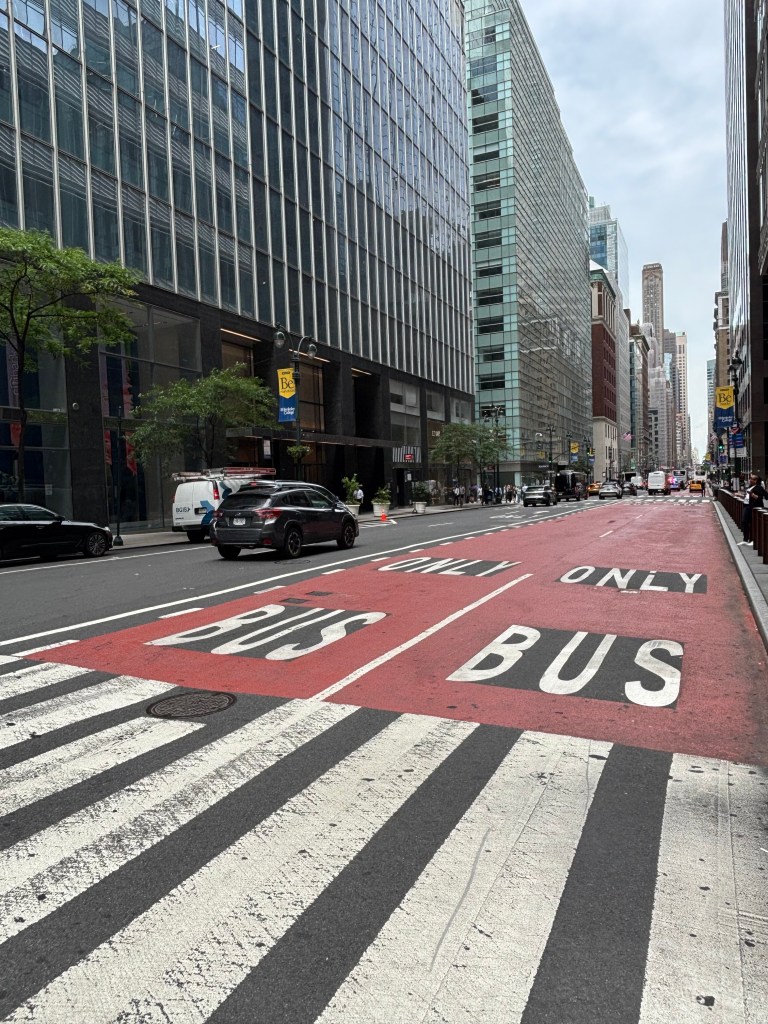
In addition, the MTA has just installed Automated Camera Enforcement(ACE) cameras on the M2 and M4 routes that run through the entirety of Madison Ave’s existing bus lanes. These cameras are able to issue tickets to drivers who block bus lanes and/or double park. ACE is extremely effective as only 9% of drivers who have received a summons have committed third offenses. This level of effectiveness has resulted in bus speeds on 39 ACE routes in NYC seeing an average 5% speed increase with some seeing gains of up to 30%. Though the 5% average speed gain does not seem like a lot, this represents time-savings of several minutes and helps buses to avoid traffic bottlenecks that worsen during peak hours.
Now, the NYCDOT is looking to bring these initiatives even further south along Madison Ave. In June, the agency proposed extending the double bus lane to also serve the area between 23rd and 42nd St. This proposal will convert the right two lanes to double bus lanes, while there will be one lane each for general traffic and parking. The leftside parking lane will also be able to turn into a travel lane during peak hours. A very similar design has already been implemented along a segment of the adjacent 5th Ave, which led to speed increases of 6-12% for local buses and 11-20% for express buses. It is important to note that the data was taken in 2019 and does not reflect additional speed increases that will likely occur with ACE enforcement now working in the bus lanes. The ACE cameras currently in use on the M2 and M4 routes will also be able to enforce the new double bus lanes. Given how Madison Ave bus routes traverse a large portion of the city, similar speed increases will not just benefit bus riders here but also from throughout NYC.

The new bus lanes are likely to be lauded by bus riders who are desperate to see faster rides along such a vital corridor. Motorists will likely have an opposing sentiment as they will see their driving and/or parking space significantly reduced. It is probable that two types of concerns will likely arise. For one, cars will have only one lane during off-peak hours where traffic can still be high. Congestion in Midtown Manhattan takes place around the clock and drivers are unlikely to be happy with anything that can lead to even slightly longer delays on streets. Also, motorists are also bound to be upset at the loss of practically all parking on the corridor during rush hours. Parking is at a premium anywhere in NYC and losing so many free spots in one of the city’s busiest neighborhoods will almost certainly not sit well with those who rely on those spaces. In addition, many may also be anxious about how the one travel lane setup can affect vehicle movements considering how New York drivers are known to compete for space and ways to get ahead on the road. This design may also require an adjustment from motorists considering how only having one lane is a rare if not nonexistent situation on the busier Manhattan streets.
While the new street design might concern drivers, the NYCDOT said that the volume of traffic on the segment in question can operate with just one lane based on their traffic count data. It’s worth noting that the data came from December 2017 and October 2024, which are two months where there were no significant pandemic impacts on car travel. As most who traverse Madison Ave do not live in Manhattan, there is unlikely to be much organized support or opposition against the project. Many bus riders who experience existing and/or will experience the new bus lanes may not even know they are in double bus lanes given how express buses are so high off the ground. Only time will tell how different road users will feel about the new design, and hopefully it is able to speed up buses while still giving motorists the space they need to move efficiently.
Outside of bus related improvements, Madison Ave is also getting a major safety upgrade with the addition of left turn bays at four intersections. The intersections include 27th, 29th, 31st, and 33rd Sts. Left turn bays provide motorists with designated areas of the road to make left turns. According to data from the Federal Highway Administration, left turn bays can lead to a 28-48% reduction in crashes. Reductions of that level would be especially welcome on a street like Madison Ave that has such a high volume of motorist and pedestrian activity. Left turn calming may be especially valued by families who are looking to enjoy Midtown attractions with younger children. Though there are no other significant non-bus related features in this project, the NYCDOT is implementing what is arguably one of the most significant tools they have in order to improve safety on streets.
The new bus lanes on Madison Ave are poised to bring faster and more reliable bus trips to riders from across the city. Also, the addition of left turn bays will undoubtedly make the street safer for all road users given their track record of doing so around the United States. The loss of parking/travel space for cars will likely be a concern as it has been for other bus lane projects in the city. Hopefully, the project has a minimal adverse effect on motorists and all road users can benefit from the transit and safety upgrades the project is set to provide.
Works Cited
“Dedicated Left- and Right-Turn Lanes at Intersections | FHWA.” Federal Highway Administration, https://highways.dot.gov/safety/proven-safety-countermeasures/dedicated-left-and-right-turn-lanes-intersections. Accessed 21 July 2025.
Fletcher, Jenna. “Average walking speed: Comparisons by age, sex, and walking for health.” Medical News Today, 16 November 2022, https://www.medicalnewstoday.com/articles/average-walking-speed. Accessed 21 July 2025.
Metropolitan Transportation Authority. “Automated Camera Enforcement Fines Begin July 18 on Two Manhattan Bus Routes.” MTA, 17 July 2025, https://www.mta.info/press-release/automated-camera-enforcement-fines-begin-july-18-two-manhattan-bus-routes. Accessed 21 July 2025.
New York City Department of City Planning-Transportation. “Car Ownership in NYC.” Tableau Public, 24 November 2022, https://public.tableau.com/app/profile/dcptransportation/viz/ACSProfiles/Dashboard1. Accessed 21 July 2025.
New York City Department of Transportation, and Metropolitan Transportation Authority. “Madison Avenue Bus Improvement Project Manhattan Community Board 6 Transportation and Environment Committee | June 2nd, 2025.” NYC, 2nd June 2025, https://www.nyc.gov/html/dot/downloads/pdf/madison-ave-e23-st-e42-st-cb6-jun2025.pdf. Accessed 21 July 2025.
 Transit Central