
By Joseph Morales
Dyckman Street is one of the busiest commercial streets in Northern Manhattan. Its assortment of retail offerings from national chains to smaller businesses attract shoppers from throughout Upper Manhattan and The Bronx. In addition, the corridor is home to several restaurants including ethnic offerings like Cachapa y Mas and Chinito Latino Hibachi Fusion. The street also has a dense residential population and sits in between the Inwood and Washington Heights sections of Manhattan. Dyckman Street is served by the M100 bus route along with the 1 and A trains. The street is also connected to the Henry Hudson Pkwy and Harlem River Dr along with the greenways that accompany those highways. There is also a protected bike lane on Dyckman through its commercial core from the Harlem River Dr to Seaman Ave.
Many people travel on and around Dyckman Street via various modes due to the number of transportation options available. However, for most in the community and its surrounding areas, their mode of transportation does not involve a vehicle. Data from the NYC Department of City Planning shows that only 24% of households in the community district that includes Dyckman Street have access to a car. This number is 23% in Manhattan as a whole and 25% in the two Bronx districts that border Dyckman Street’s community district by water.
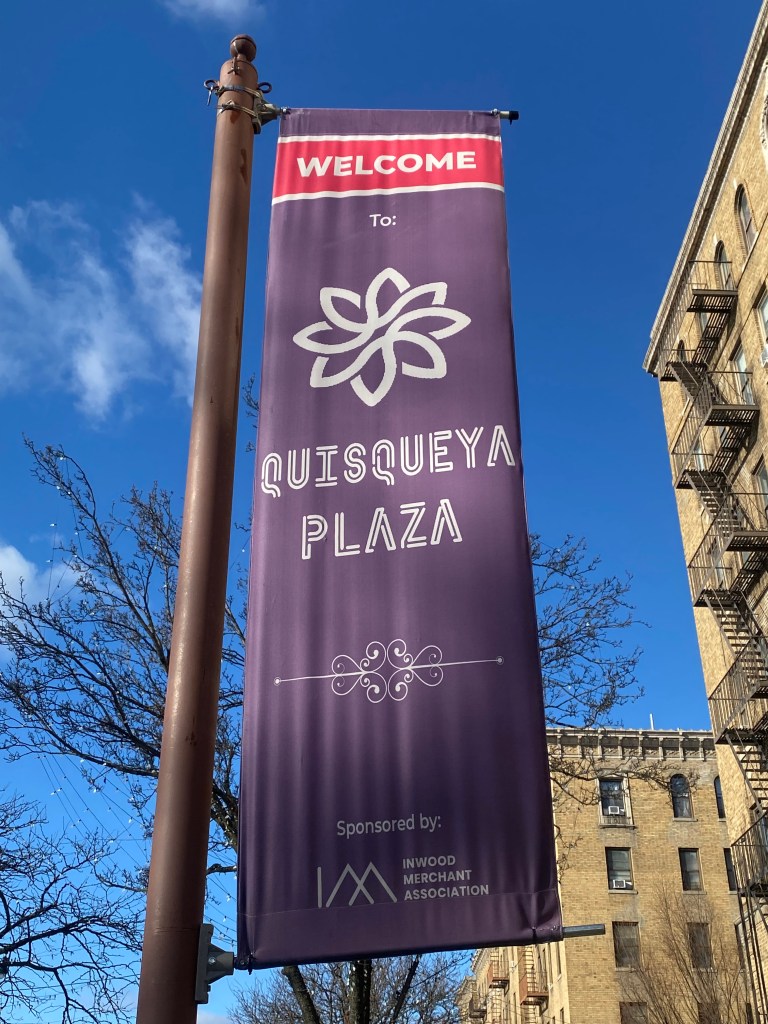
Due to the community’s low car ownership rates and significant bike use, the NYCDOT has taken several steps to increase space for pedestrians and cyclists on Dyckman St. This included the permanent addition of protected bike lanes in 2019 and the opening of Quisqueya Plaza(formerly known as Dyckman Plaza) in 2021. Quisqueya Plaza is a pedestrian only space on Dyckman St between Broadway and Seaman Ave. The plaza has become a place for people to walk, dine, or take in recreational and cultural events.
Now, the NYCDOT is attempting to expand upon those projects and continue to enhance cycling connections in Upper Manhattan.
One significant project set to begin soon is an extension of the Dyckman St Protected Bike Lane(PBL) from Seaman Ave to the Hudson River Greenway. This will connect the greenways on both sides of Manhattan and make it possible for cyclists to fully cross Dyckman Street using PBLs. These lanes will go a long way to improving cyclists safety on the corridor. Safety improvements here have been a long time coming as NYCDOT numbers show that this portion of the street has seen 28 injuries in crashes including six cyclist injuries between 2019 and 2023. A study from the NYCDOT in 2021 showed that cyclist injuries slightly increased by 3% on corridors with PBLs despite dramatic increases in the number of cyclists. The safety enhancements from PBLs also reach far more road users besides those on bikes. This same study showed that total injuries on streets with PBLs decreased by 20%. Pedestrian and car occupant injuries declined by 22 and 25 percent respectively. PBLs likely achieve these results due to a combination of car-bicycle separation, shorter pedestrian crossing distances and a narrower road reducing car speeds. These numbers would be a great improvement for Dyckman St given how people traverse the corridor through various modes.
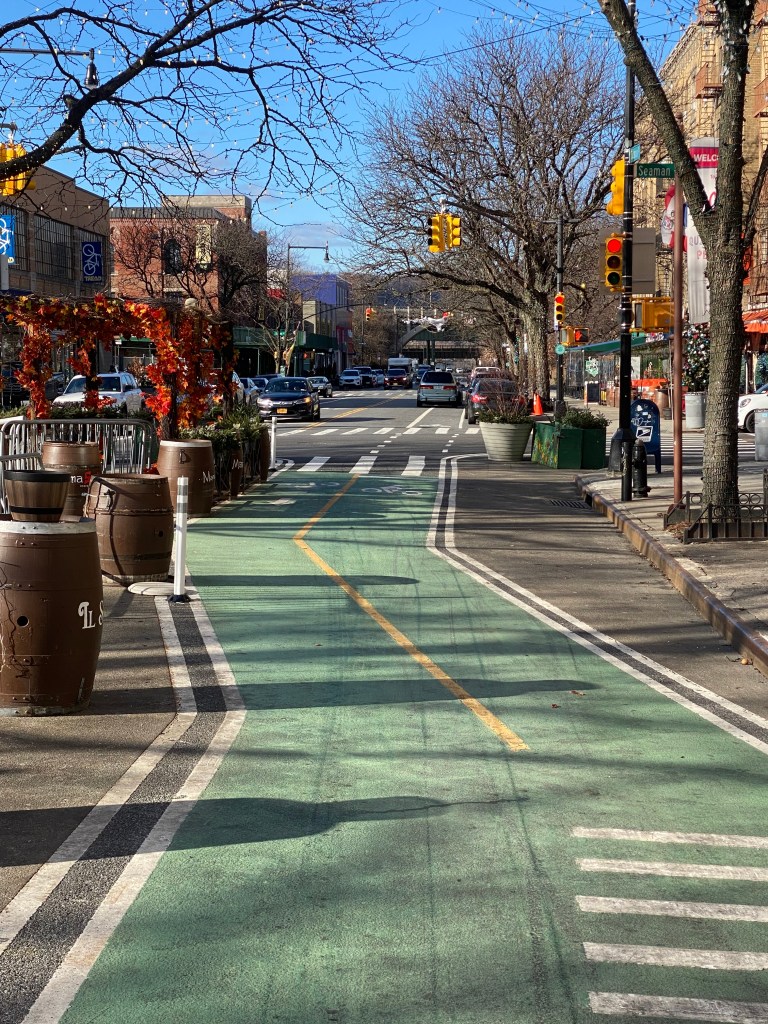
Hudson River Greenway will begin.
In addition to improving safety, the PBL extension should lead to more cyclists which could be a benefit to local businesses. A Business Insider article discussed that many businesses near protected bike lanes see sales increases. In fact, one study mentioned in the article suggests that the physically smaller businesses that make up most of Dyckman St benefit from the lanes the most. It is also worth noting that the studies did not appear to consider streets with PBLs, which are known to attract more cyclists than standard bike lanes. Outside of businesses, PBLs may also lead to increases in travel to community destinations such as Dyckman Park.
The impact of the PBL will not just be felt along Dyckman St, but across Upper Manhattan. As previously mentioned, the PBL will connect both the Harlem and Hudson River Greenways for the first time. The PBL’s connection to the Harlem River Greenway will in turn make it easier for people to get to various areas including Manhattan’s East Side and The Bronx via the Harlem River Crossings. Overall, the PBL will link the neighborhoods of Inwood, Washington Heights and Harlem in a way it has never been connected before. It will also allow cyclists to more easily access Inwood Hill Park, which is a regional recreation destination. This new PBL will also connect directly to a new greenway being constructed on 10th Ave between W 201st and W 218th Sts. With these connections, the Dyckman St PBL will be a critical connection for cyclists traversing various parts of the city in addition to Inwood.
The only possible drawback to the project could be the loss of parking. This is because the plan is to maintain the number of vehicular travel lanes to avoid an adverse impact on traffic flow. Currently, it is expected that a total of 40 parking spots on Dyckman St will be lost as a result of the PBL extension. There are multiple reasons why the NYCDOT likely felt the positives to the project outweighed this downside. One is that while these are 40 parking spaces, a cyclist count from a 12 hour period in July 2024 showed 731 cyclists riding where the PBLs are set to be installed. It is also worth noting that July is likely not even the most popular time for cycling in the city; volumes may be even higher during spring and fall months. In addition, as stated earlier, only 23% of households in the community district where the project is located have access to a vehicle. Hence, there are clearly more people that can benefit from the PBL than who have from the parking spaces. A way to mitigate any residential parking concerns if they arise could be found in a bill proposed by area Councilwoman Carmen De La Rosa to establish a residential parking permit program in Manhattan north of 60th St. The bill has yet to be voted on by the City Council’s Committee on Transportation and Infrastructure.
The extension of the Dyckman St PBL stands to bring immense safety, mobility and economic benefits to Upper Manhattan. This project is set to be an example of how street design that reflects the modal share in a community can be a great boon for road users. Construction of the PBL extension is set to take place this spring. Hopefully, Upper Manhattan residents and visitors alike will take advantage of the many new cycling connections the extended PBLs will offer.
Works Cited
Duggan, Kevin. “River to River! DOT Will Close Dyckman Protected Bike Lane Gap.” Streetsblog, 3 December 2024, https://nyc.streetsblog.org/2024/12/03/river-to-river-dot-will-close-dyckman-protected-bike-lane-gap. Accessed 7 January 2025.
The New York City Council. “The New York City Council – File #: Int 0674-2024.” The New York City Council – Legislation, https://legistar.council.nyc.gov/LegislationDetail.aspx?ID=6584130&GUID=E0FEDF18-2A5C-4F8A-B725-9EF93EDD562C. Accessed 7 January 2025.
New York City Department of City Planning. “Car Ownership in NYC.” Tableau, 24 November 2022, https://public.tableau.com/app/profile/dcptransportation/viz/ACSProfiles/Dashboard1. Accessed 7 January 2025.
New York City Department of Transportation. “DOT Press Releases – Dyckman Plaza Transforms Inwood Open Street.” NYC.gov, 16 December 2021, https://www.nyc.gov/html/dot/html/pr2021/dyckman-plaza-transforms-inwood-open-street.shtml. Accessed 7 January 2025.
New York City Department of Transportation. “Hudson River Greenway Connector-Dyckman St.” NYC.gov, 2 December 2024, https://www.nyc.gov/html/dot/downloads/pdf/dyckman-st-seaman-ave-hudson-river-greenway-dec2024.pdf. Accessed 7 January 2025.
New York City Department of Transportation. “Open Streets: DOT to Make Permanent Upgrades to Quisqueya Plaza.” NYC.gov, 27 February 2023, https://www.nyc.gov/html/dot/html/pr2023/open-streets-quisqueya-plaza.shtml. Accessed 7 January 2025.
New York City Department of Transportation. “Safe Streets For Cycling-How Street Design Affects Bicycle Safety and Ridership.” NYC.gov, October 2021, https://www.nyc.gov/html/dot/downloads/pdf/safe-streets-for-cycling.pdf. Accessed 7 January 2025.
Rogers, Adam. “Bike lanes are good for business.” Business Insider, 7 March 2024, https://www.businessinsider.com/bike-lanes-good-for-business-studies-better-streets-2024-3?utm_campaign=insider-sf&utm_medium=social&utm_source=linkedin. Accessed 7 January 2025.
 Transit Central