By Joseph Morales
First started in 2013, CitiBike has grown immensely popular throughout New York City since its inception. The bikeshare program, owned by Lyft, serves over 1,000 cyclists daily with 25,000 bikes from over 1,500 stations across four boroughs and parts of New Jersey. CitiBike has been substantially used everywhere it has been implemented with many using it to go to work, run errands or just have fun. Lyft even has an “Explore NYC” page on its website where it has the names of some popular spots to ride and includes the phrase “See the sights. All of ‘em.” This indicates just how much CitiBike can truly be used for recreation.
Now, CitiBike will expand once again. Phase 3.5 of expansion will include various parts of The Bronx, Brooklyn and Queens that have been left out of previous phases. The new territories will combine to serve more than 900,000 new residents across the three boroughs. After this phase, 64% of New Yorkers will live within a five-minute walk of a CitiBike station. Bikeshare should start to arrive to areas in Phase 3.5 beginning in the Fall of 2025.
CitiBike will undoubtedly bring immense micromobility benefits to all of the neighborhoods the program is expanding to. However, nowhere will the benefits be more profound than in the Brownsville and East New York sections of Brooklyn. These neighborhoods are home to roughly 300,000 residents or one-third of those who are covered under the expansion. Additionally, these neighborhoods have various conditions that could lead to them being among CitiBike’s more significant customer bases.
CitiBike is likely to be a hit in Brownsville/East New York since residents here have substantially less quality surface transportation resources than many other communities. For starters, these residents have some of the slower buses in the city. Data from Transportation Alternatives and MIT’s Spatial Equity Tracker shows that Brownsville and ENY’s city council district(District 37) ranks poorly in multiple bus metrics. Bus speed statistics show District 37 ranking 33rd out of 51 districts citywide. Unfortunately, the district ranks near the bottom with nearly the lowest amount of bus lanes in the city at just 0.1 of a mile districtwide. For reference, 0.1 of a mile is approximately one city block.
Residents also lack many alternatives. According to data from the NYC Department of City Planning, only 30% of Brownsville residents have access to a car. This is also the car ownership rate on the Upper East Side, where the population is much more dense and residents have access to substantially more amenities near their homes. Brownsville also has a poverty rate of 39.1% which is the highest in the city according to the NYU Furman Center. East New York has a car ownership rate of 42% and a poverty rate of 24.6%. Though the poverty rate in ENY is not as high as Brownsville, it is still higher than the city average of 18.3%. High poverty rates means that in addition to owning less cars, residents are also less likely to have access to other surface travel modes such as rideshare or personal bikes.
This scarcity of options will likely lead to many residents flocking to CitiBike once the docks start hitting the streets. With 25.7% of Brownsville housing units and 15.9% of ENY units being in NYCHA, thousands of residents will qualify for $5/month fares for being NYCHA residents. Many more will qualify for the same discount as SNAP recipients.
In addition, Brownsville and ENY both have plenty of destinations that people could get to by bike. These places are suitable for short trips yet not directly served by a single bus for many residents. For instance, both neighborhoods are home to major parks such as Betsy Head Park in Brownsville, along with Sutter Ballfields and Linden Park in ENY. The areas also have major commercial centers such as the busier parts of Pitkin Ave and the Gateway Center Mall in ENY. It’s worth noting that the Gateway Center Mall is one of the only outdoor malls of its kind in NYC. A CitiBike rack somewhere like that would be a first and would likely be popular amongst those from surrounding communities. Other major trip generators in the community will likely include many high schools including the nearly 1,000 student Thomas Jefferson Campus in Brownsville. Outside of these places, many are likely to use CitiBike for other trips or for recreational purposes.

CitiBike will also likely be of significant use to get to mass transit. While mass transit is plentiful in Brownsville/ENY, it is likely that not everyone is near the transit lines they need the most. For instance, if someone lives closest to the Saratoga Ave subway station on the 3 train and works in Far Rockaway, Queens, they might prefer to take a CitiBike to the A Train rather than a combination of other transit routes. Many others might also want to take CitiBike to get to the East New York LIRR station as opposed to buses. With Brownsville/ENY’s plethora of mass transit routes, it is likely many will use CitiBike to fulfill last mile connections to many of them.
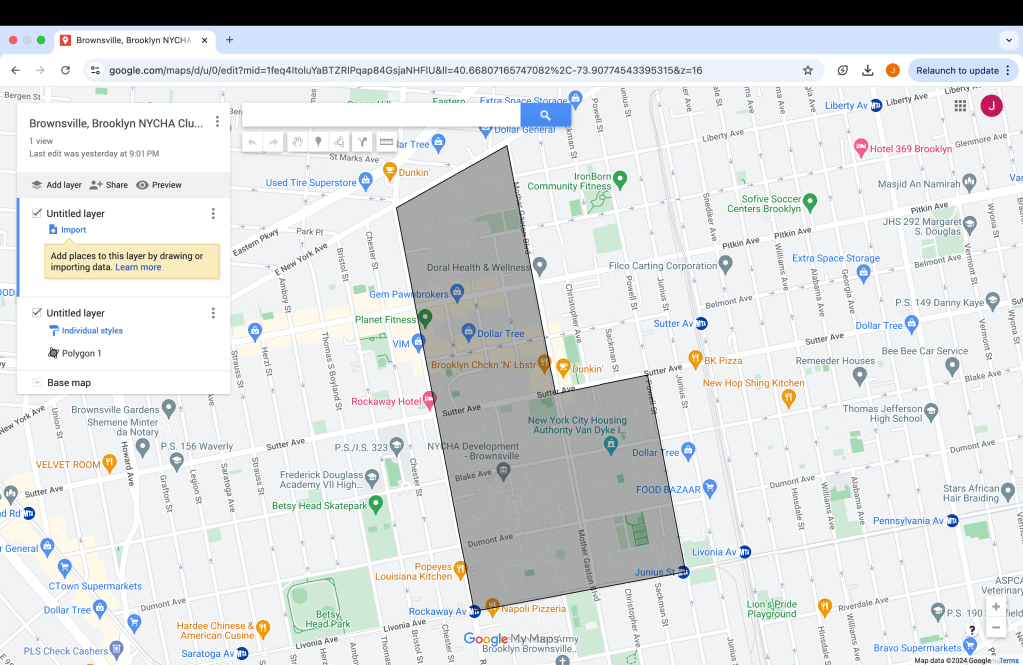
Not only is CitiBike likely to be a boon for riders, but implementing the program is likely to be simpler here than it has been in other places. It is often that choosing locations for CitiBike racks has been a challenge since they often take up parking spots, leading to opposition from car owners. With lower car ownership rates, less mixed land use, and a high number of driveways, this issue will likely be much less prevalent in Brownsville/ENY. The cluster of NYCHA developments in Central Brownsville that includes the Howard, Brownsville, and Van Dyke Houses will be especially prime for CitiBike racks due to the low car ownership rates coupled with an abundance of green space. The Gateway Center should also be good for racks given the sheer amount of parking and outdoor space on its premises. These factors will all make CitiBike easy to implement and thus, easy for residents to take on.

The expansion of CitiBike into Brownsville and East New York will provide residents with a new option for micromobility that they can depend on. CitiBike’s discount programs along with neighborhood conditions make the program prime for success in this part of Eastern Brooklyn. Hopefully, residents are able to take advantage of bikeshare for seamless travel and a cool form of recreation for years to come.
Works Cited
“Brownsville BK16 Neighborhood Profile.” NYU Furman Center, 21 May 2024, https://furmancenter.org/neighborhoods/view/brownsville#demographics. Accessed 23 December 2024.
“East New York/Starrett City Neighborhood Profile – NYU Furman Center.” NYU Furman Center, 21 May 2024, https://furmancenter.org/neighborhoods/view/east-new-york-starrett-city#demographics. Accessed 23 December 2024.
Kiran Herbert, Communications Manager. “Citi Bike’s 2023 Ridership Numbers Are Impressive.” Better Bike Share Partnership, 30 May 2023, https://betterbikeshare.org/2023/05/30/citi-bikes-2023-ridership-numbers-are-impressive/. Accessed 23 December 2024.
Lyft. “About Citi Bike: Company, History, Motivate.” Citi Bike, 2022, https://ride.citibikenyc.com/about. Accessed 23 December 2024.
Lyft. “Citi Bike Membership & Pass Options | Citi Bike NYC.” Citi Bike, 2024, https://citibikenyc.com/pricing. Accessed 23 December 2024.
Lyft. “Explore NYC on Citi Bike.” Citi Bike, 2024, https://citibikenyc.com/explore. Accessed 23 December 2024.
Lyft. “How protests and bad press nearly sank Citi Bike.” Lyft, 1 June 2023, https://www.lyft.com/blog/posts/how-protests-and-bad-press-nearly-sank-citi-bike. Accessed 23 December 2024.
Lyft. “NYC’s Most Popular Bike Rental Program | Citi Bike NYC | Citi Bike NYC.” Citi Bike, https://citibikenyc.com/how-it-works. Accessed 23 December 2024.
New York City Department of City Planning. “Car Ownership in NYC.” Tableau, 24 November 2022, https://public.tableau.com/app/profile/dcptransportation/viz/ACSProfiles/Dashboard1. Accessed 23 December 2024.
New York City Office of the Mayor. “Mayor Adams Announces Major Expansion of Citi Bike Service in Outer Boroughs.” NYC., 13 December 2024, https://www.nyc.gov/office-of-the-mayor/news/920-24/mayor-adams-major-expansion-citi-bike-service-outer-boroughs-ridership-continues. Accessed 23 December 2024.
New York City Public Schools. “FDNY – Captain Vernon A. Richard High School for Fire and Life Safety (19K502).” MySchools NYC, https://myschools.nyc/en/schools/high-school/?dbn=19K502. Accessed 23 December 2024.
New York City Public Schools. “High School for Civil Rights (19K504).” MySchools NYC, https://myschools.nyc/en/schools/high-school/?dbn=19K504. Accessed 23 December 2023.
New York City Public Schools. “Performing Arts and Technology High School (19K507).” MySchools NYC, https://myschools.nyc/en/schools/high-school/19K507/. Accessed 23 December 2024.
New York City Public Schools. “World Academy for Total Community Health High School (WATCH) (19K510).” MySchools NYC, https://myschools.nyc/en/schools/high-school/?dbn=19K510. Accessed 23 December 2024.
Transportation Alternatives, and Massachusetts Institute of Technology. “City Council District 37-Community Profile.” Spatial Equity NYC, https://www.spatialequity.nyc/?c=3&b=council&md=f&v=histogram&pm=%5B9,11,3%5D&dt=f&pq=37&pc=%5B-73.896,40.685%5D&cm=f&ct=tttttt. Accessed 23 December 2024.
 Transit Central