By Joseph Morales
The 68th St-Hunter College station on the 6 train is one of the busier subway stations on Manhattan’s Upper East Side(UES). The station is the primary station serving its namesake Hunter College and its tens of thousands of students and faculty. Outside of the college, the station is within walking distance of several important destinations such as the Central Park Zoo, the Asia Society and Museum and the Hospital for Special Surgery. The station is also located in one of NYC’s most populated and congested residential communities. In addition, data from the NYC Department of City Planning shows that only 30% of UES residents own cars. This coupled with the various destinations the station serves leads to 20,000 riders relying on it daily based on MTA figures.
As a result, it is no surprise that this is one of the 100 “key stations” that the MTA started choosing in 1994 to make ADA-accessible. Station accessibility is especially important here due to the high number of disabled and elderly residents on the UES. Data from the NYU Furman Center shows that 5.3% of UES residents(11,000) are disabled and 22.9%(47,400) are ages 65 or older. All figures were rounded to the nearest hundred.
The project to make 68th St-Hunter College fully accessible included one new street to mezzanine elevator and two new mezzanine to platform elevators. A larger mezzanine was created likely to increase capacity and make it easier for riders with mobility disabilities to get around. The MTA also added new lights/tiles and repaired paint, steel and concrete defects. In addition, the platforms were redone to include ADA-boarding areas so that riders with disabilities can have designated spaces to board the train. Outside of accessibility, the MTA added six new staircases to increase capacity along with a concession stand, fire alarm system and CCTV security cameras. They also improved communication systems and signage.


In addition, the MTA added three mosaics from artist and professor of art at Hunter College, Lisa Corrine Davis. The mosaics are designed to demonstrate the cultural, racial and economic diversity of the community around the station.
The work was a long time in the making and the MTA encountered numerous hurdles along the way. Though the issues may be complicated, they were rooted in what the agency refers to as the three S’s, Space, Subsurface and Structure. These are constraints for building elevators at stations citywide. Due to how dense the city is, subway stations have often been built directly attached to buildings. In addition, decades of unmapped infrastructure underground have made it difficult to find suitable spaces to add elevators. Structure is also an issue because elevators and necessary supporting structures must be built in a way that does not compromise safety or convenience for residents and visitors. These constraints are all prevalent at 68th St-Hunter College and there is plenty of overlap. This played a large role in the project taking 14 years and being among the last of the 100 key stations to become accessible.
Space, subsurface and structure concerns led the MTA to initially consider an elevator inside a building on the northwest corner of Lexington Ave and E 68th St. While this could not be certainly determined, it appeared that the building being considered was Thomas Hunter Hall. This likely would have been a difficult project with long term effects on the college given that it is a historic structure and is home to several school functions. These include the Dance Department, Student Union and an auditorium. In fact, the building just had a renovation completed in August 2024. The sheer density of buildings and plethora of underground infrastructure in an old NYC neighborhood is what likely drove the MTA to consider an elevator here. An elevator being built to the subway might have complicated things for the building’s eventual renovation. The MTA also ran into “‘structural engineering challenges’” when considering an elevator on the Southeast corner of the same intersection. Fortunately, the MTA found that it could relocate the elevator directly across the street from Thomas Hunter Hall at the northeast corner in a feasible manner.
The MTA also faced fierce criticism from residents of the Imperial House Apartment Building on E 69th St for attempting to build new staircases earlier in the project. While these are not elevators, the staircases were being added in order to increase capacity, which would in turn make it easier for disabled passengers to navigate the station. The residents opposed the staircases as they feared it would adversely affect the quality of their residential street. More specifically, people felt that it could lead to reduced property values or did not fit with the historic architecture on the block. In a NY Times article on the matter, architectural historian Andrew Alpern argued that while the entrances indeed did not fit into the block aesthetically, compromises had to be made. He told the NY Times in 2012, “‘Does it belong there? No. But if we start saying we’re not going to allow subway entrances where there’s an architecturally or socially distinctive block, of course not — we can’t do that. That’s elitism of the worst sort.’” He also stated, “‘But you can certainly take feelings into account, of how you put it in there. That’s a balancing-out that New York is famous for.’”
Ultimately, the MTA was able to find locations for staircases around E 68th St. These locations likely made more sense for riders anyway as they are closer to more Hunter College Buildings and other important destinations.
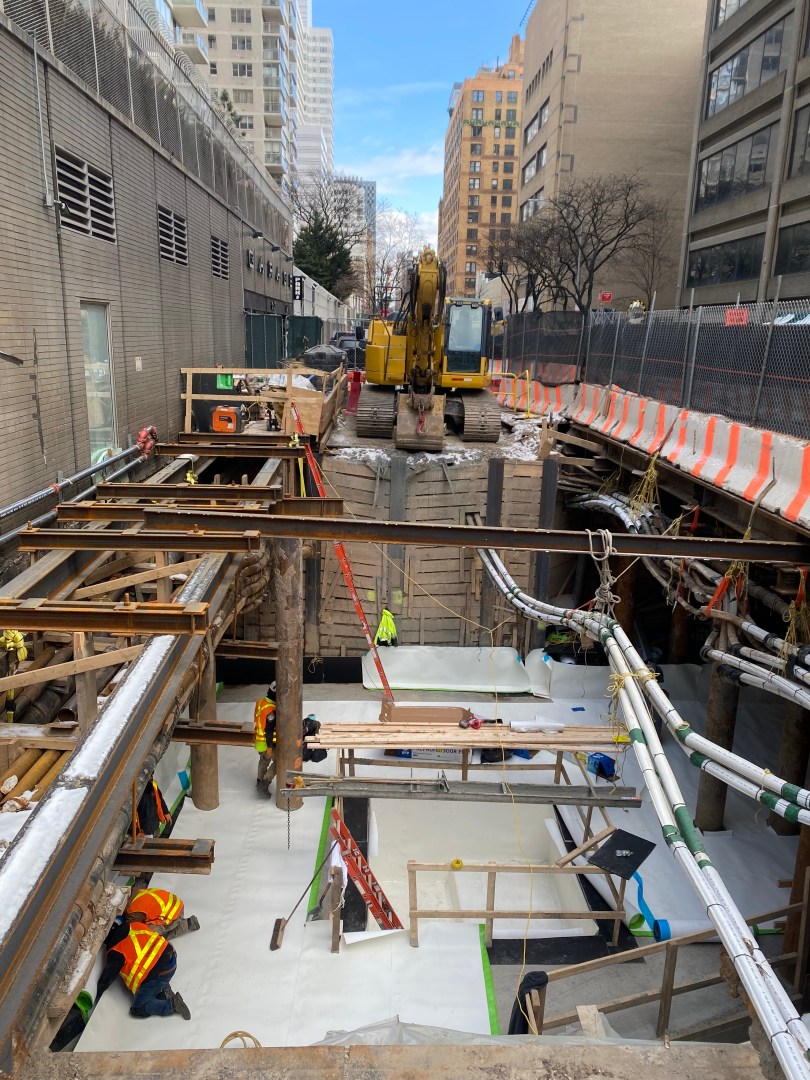
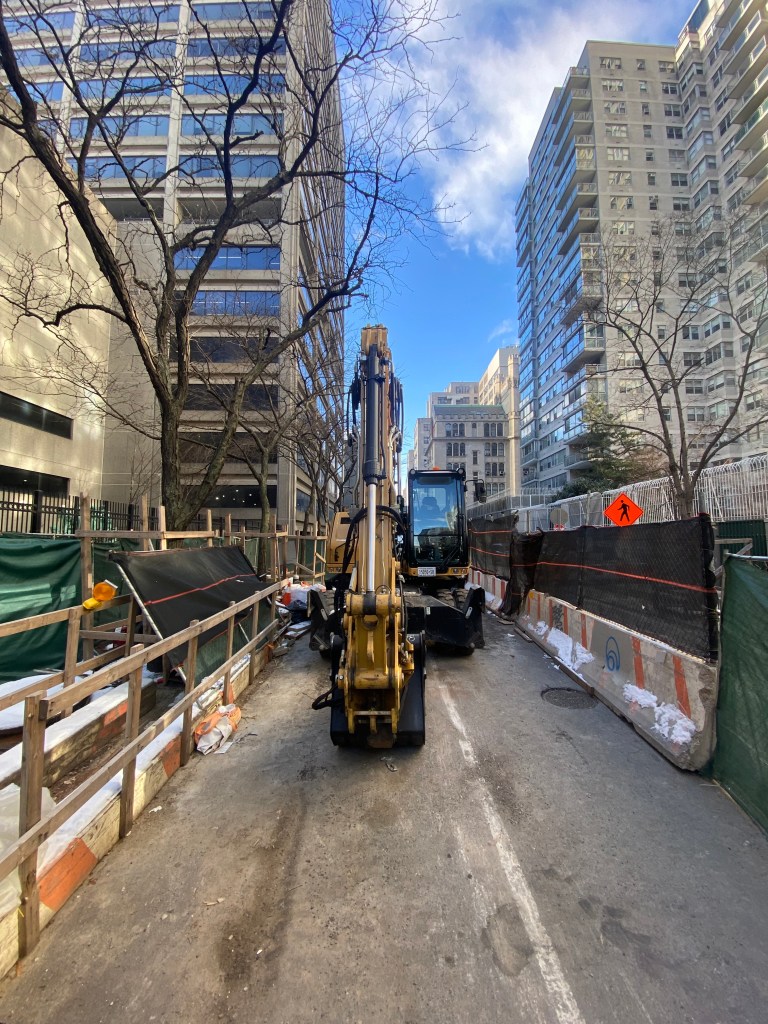
The project cost $177 million to complete and $140 million was covered from the Biden Administration through the USDOT and NYC’s congressional delegation. The delegation includes Senate Minority Leader Chuck Schumer and House Democratic Leader Hakeem Jeffries. It was good that the federal government covered so much of the costs as the project expenses escalated over the years. This was because more architectural, electrical, structural, and utility relocation work was required over the years due to the complexities of building the elevators at the station. The MTA also faced the added challenge and costs of having to keep the street open to cars and pedestrians during construction.
The accessibility project at 68th St-Hunter College has made the station an option for a large number of new riders. Many will be able to take the subway directly to Hunter College or the other major destinations in the station’s vicinity for the first time. For some, this means they will be able to finally use the subway station nearest their home, something millions of New Yorkers take for granted. Hopefully, the MTA continues to overcome the challenges associated with these projects so that even more New Yorkers can reap the benefits of accessible subway stations.
Works Cited
Hunter, 19 August 2024, https://hunter.cuny.edu/news/hunter-college-goes-green-with-renovations-of-its-oldest-buildings/#:~:text=Thomas%20Hunter%20Hall%20was%20erected,Loewe%20Theatre%2C%20among%20other%20spaces. Accessed 21 December 2024.
Bradley, Austin. “The History of the Upper East Side.” The Agency Journal, 22 September 2014, https://blog2.theagencyre.com/upper-east-side-history/. Accessed 21 December 2024.
Buckley, Cara. “Upper East Side Residents Protest Proposed Subway Entrances.” The New York Times, 25 February 2012, https://www.nytimes.com/2012/02/26/nyregion/upper-east-side-residents-protest-proposed-subway-entrances.html. Accessed 21 December 2024.
Garber, Nick. “Upper East Side Subway Stop Finally Becoming Accessible For $101M.” Patch, 14 December 2021, https://patch.com/new-york/upper-east-side-nyc/upper-east-side-subway-stop-finally-getting-elevator-101m. Accessed 21 December 2024.
Martinez, Jose. “Going Up: Long Fight Over Subway Elevators Doubles Price Tag.” THE CITY, 22 April 2019, https://www.thecity.nyc/2019/04/22/going-up-long-fight-over-subway-elevators-doubles-price-tag/. Accessed 21 December 2024.
Martinez, Jose. “MTA Crosses Street With Long-Delayed Hunter College Station Elevator.” THE CITY, 6 October 2020, https://www.thecity.nyc/2020/10/06/mta-crosses-street-with-long-delayed-hunter-college-station-elevator/. Accessed 21 December 2024.
mtainfo. “What does it take to install an elevator in a subway station?” YouTube, 21 October 2019. Accessed 21 December 2024.
New York City Department of City Planning. “Car Ownership in NYC.” Tableau, 24 November 2022, https://public.tableau.com/app/profile/dcptransportation/viz/ACSProfiles/Dashboard1. Accessed 21 December 2024.
New York City Transit. “MTA Announces 68 St-Hunter College Station Now Fully Accessible.” MTA, 20 December 2024, https://new.mta.info/press-release/mta-announces-68-st-hunter-college-station-now-fully-accessible. Accessed 21 December 2024.
“Upper East Side Neighborhood Profile – NYU Furman Center.” NYU Furman Center, 21 May 2024, https://furmancenter.org/neighborhoods/view/upper-east-side#demographics. Accessed 21 December 2024.
 Transit Central