By Joseph Morales
Church Avenue is one of the busiest commercial corridors in Central Brooklyn. The street is lined with a plethora of retailers and restaurants. They include everything from large national chains to ethnic offerings from around the world. The corridor also sits just two blocks away from Prospect Park and its largest cluster of sports fields in the Prospect Park Parade Grounds.
A lot of its hustle and bustle could be attributed to the plethora of transit options on and around Church. Church Avenue is served by six different subway lines at three stations which is the most lines of any one street outside of Manhattan. The street also has stops on the B44 and B46-SBS routes that serve the entirety of the Nostrand and Utica Avenue corridors respectively. Additionally, the Church Avenue corridor is served by the B35/B35-LTD buses, which connects the corridor to communities across Brooklyn. This route is heavily relied on as MTA data shows the B35 was the city’s eleventh busiest bus route in 2023.
With the number of people who take mass transit to Church Avenue, the MTA and NYC DOT have taken on a plethora of initiatives to improve mass transit here. The MTA added elevators to the other Church Av stations on both the Nostrand Ave Line(2,5) and the Culver Line(F,G) to make them fully accessible in 1999 and 2008 respectively. In 2019, the NYCDOT added bus lanes to portions of the corridor to speed up buses. The MTA also plans to add a Select Bus Service route to Church Avenue as part of the Brooklyn Bus Network Redesign.
Now, the MTA is working to make the last subway station on Church Ave fully accessible through elevators. The Church Avenue Station on the Brighton Line(B,Q) provides riders with connections to neighborhoods along Flatbush Ave to the north as well as Ocean Ave to the south. The subway here also connects riders to numerous parts of Manhattan and The Bronx. Without this station being accessible, people must take crosstown buses from another Church Ave station on a different line in order to get to this area of the community. In many cases, some may even take multiple buses, one to get to an accessible station at the start of their trip and another to get to the area around the Brighton Line once they get off the train. This makes it substantially harder for many people to experience everything that Church Avenue has to offer.
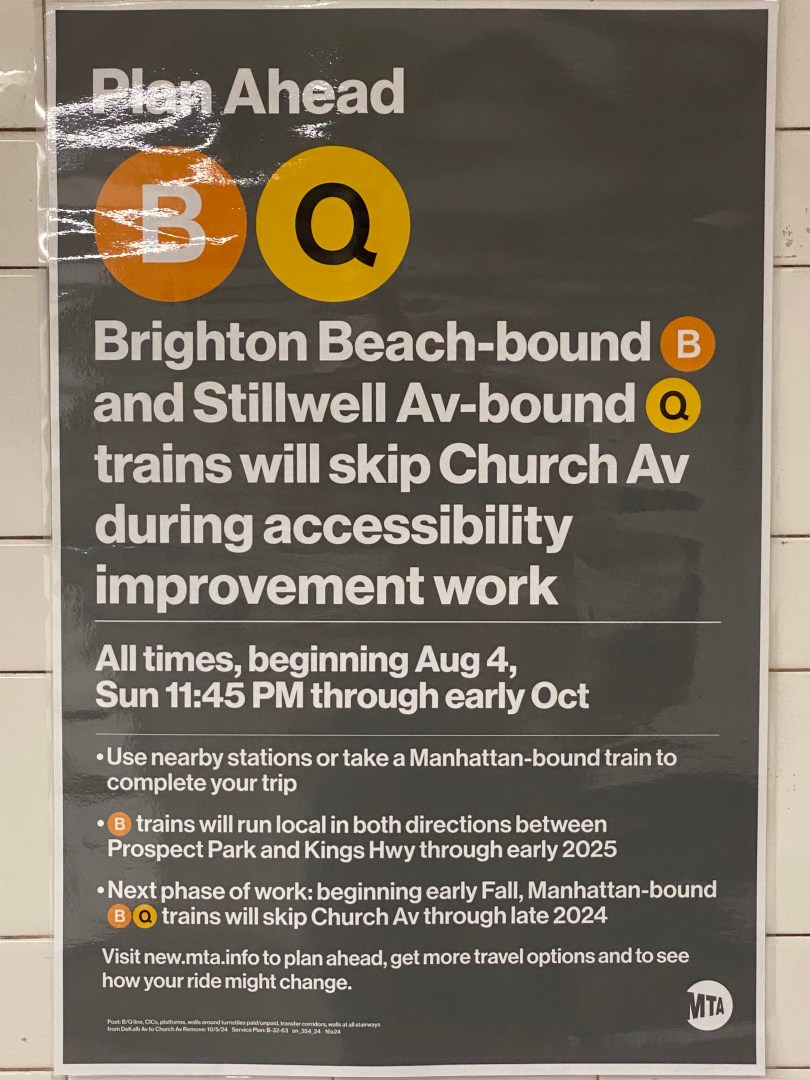
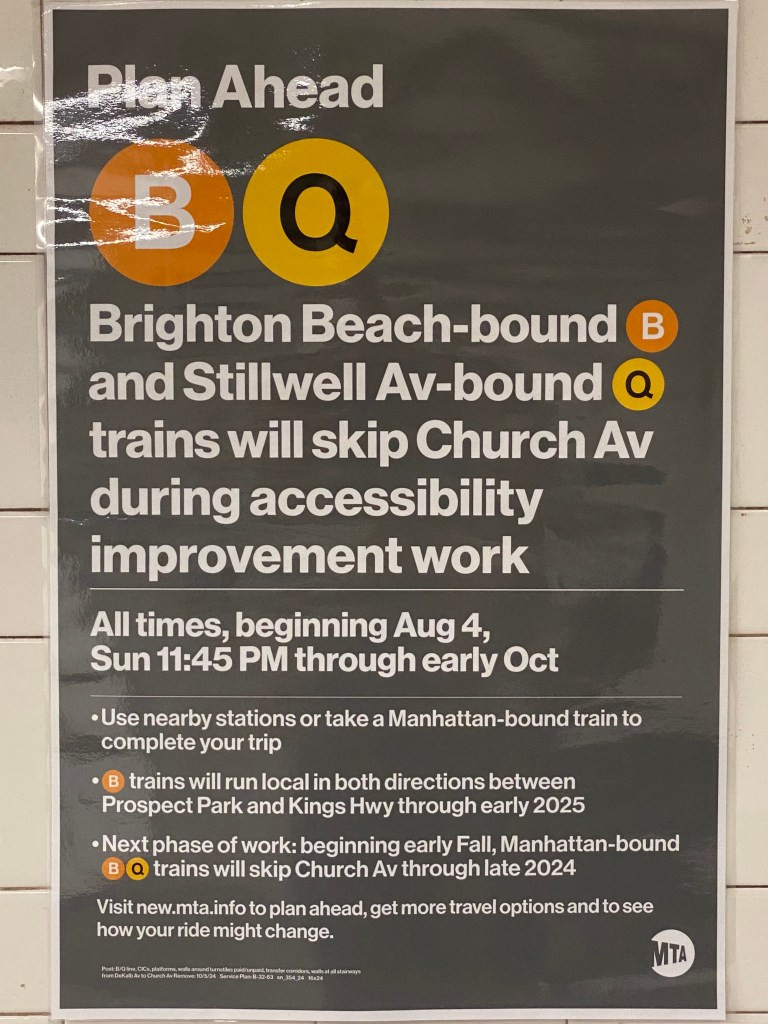
Unlike some accessibility projects, the MTA is making service changes in order to make an accessible station possible. Through early October, there will be no southbound service at the station and riders will have to take a Manhattan-bound train and transfer at Parkside Ave for southbound service. In the beginning of the fall, the closure will be reversed with Manhattan-bound trains skipping Church Av through early 2025. Also, the B Train will run local on the Brighton Line for the duration of both closures.
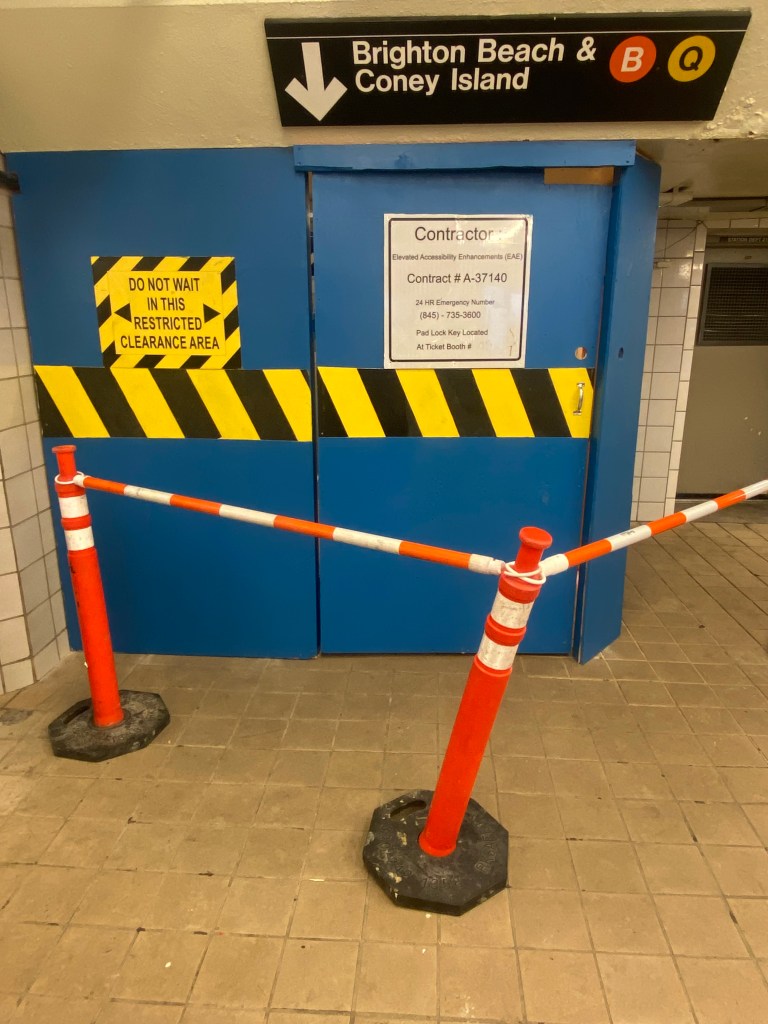
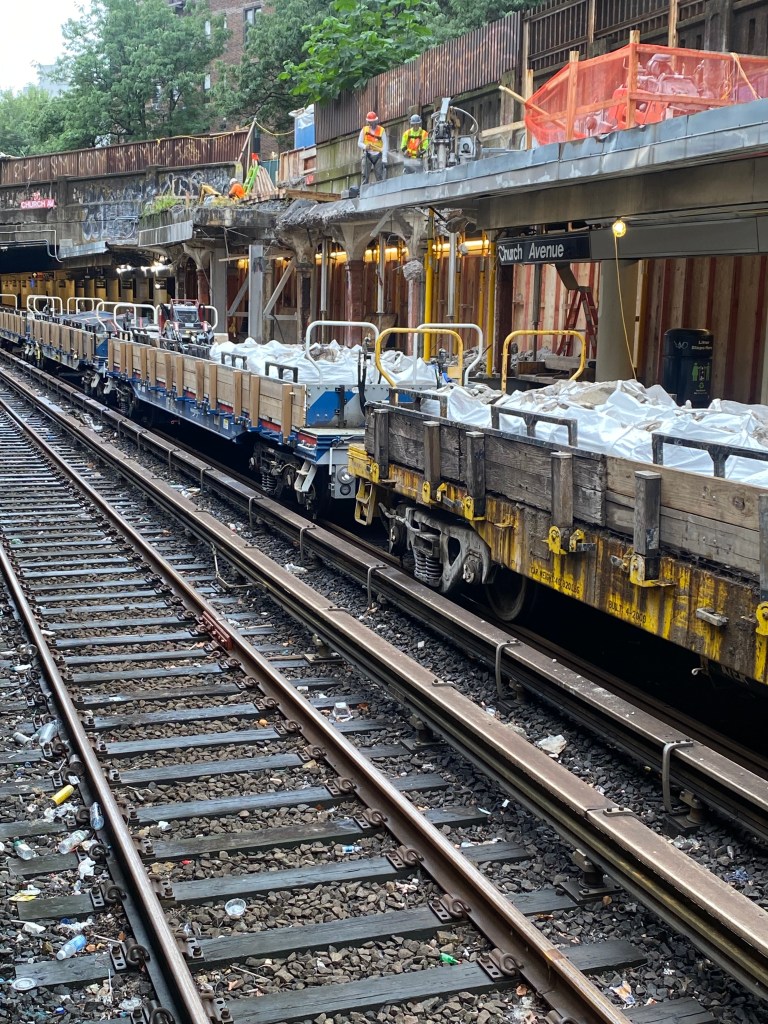
The closures are because the MTA needs access to the entirety of the platforms in order to do much of the work. On my visit on Thursday, it seemed like work was substantially underway. The platform was filled with a combination of plywood and a white covering in different areas. On the canopy and street level, workers appeared to be preparing the area above the station to be able to fit an elevator. Whether the canopy is being fully demolished or there will be a cut for an elevator remains to be seen. Also present on the site was a work train visibly full of supplies, a rare sight in the subway system.
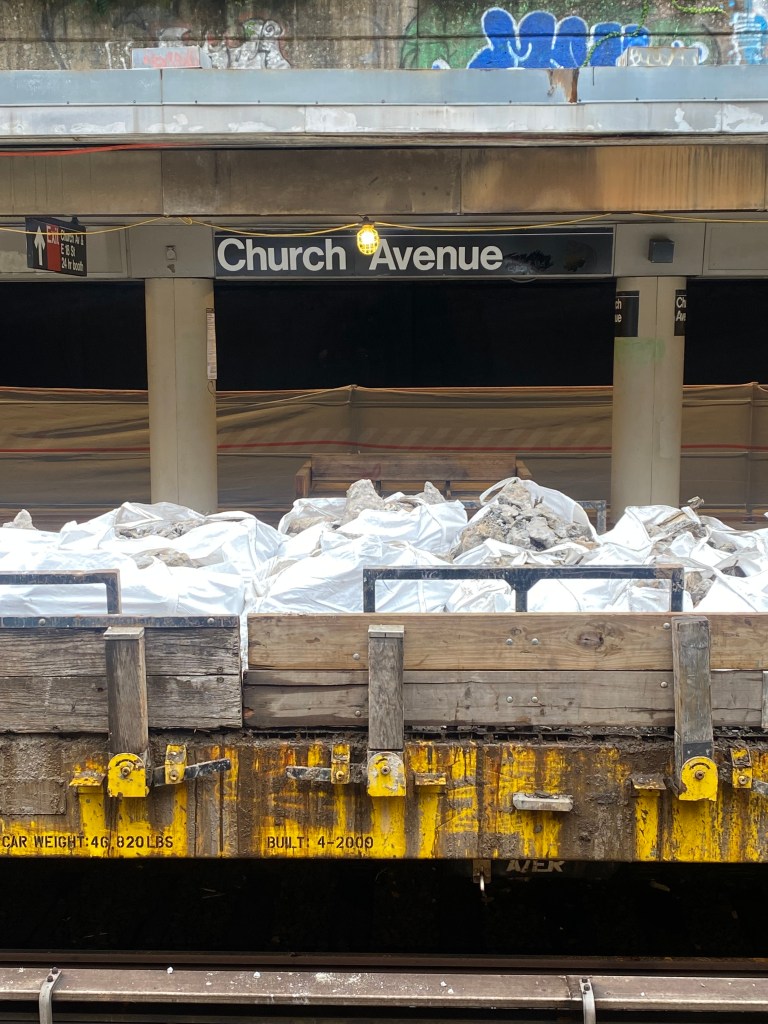
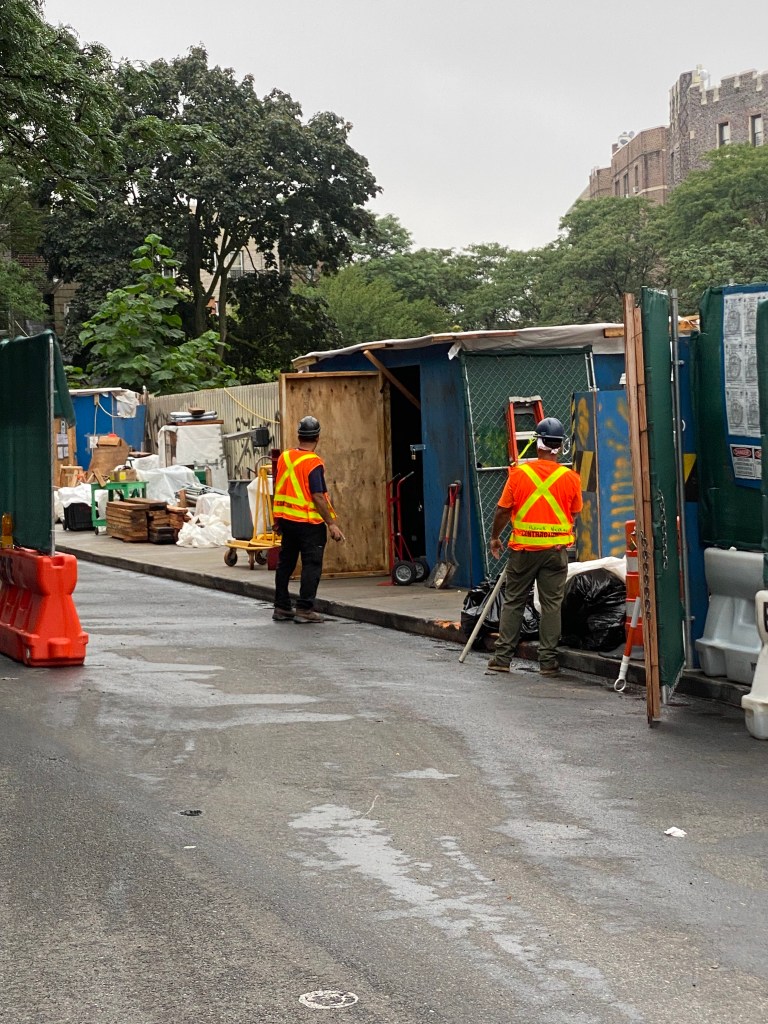
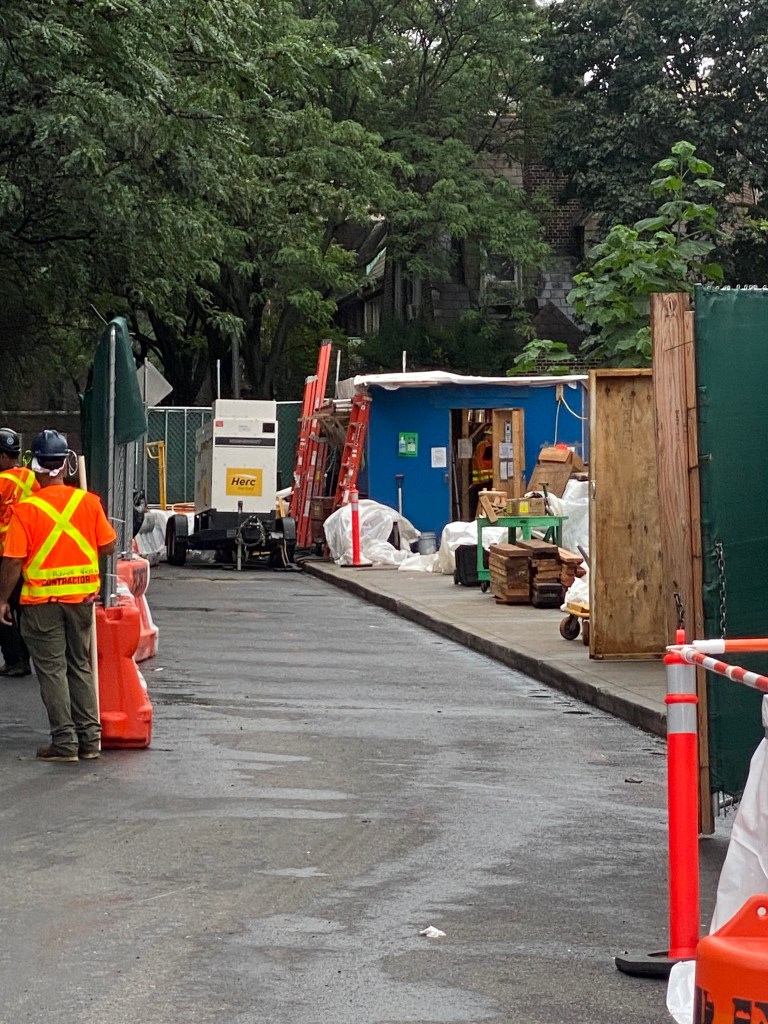
The project is unique due to the level in which the station is built. This station is set to be one of the few open cut or at-grade subway stations fully accessible in NYC. There are 27 of these subway stations in the system and making them accessible may require a different approach from their more common elevated and underground counterparts. Typically, adding elevators to a station requires consideration of the surrounding space and subsurface. Both of these constraints are completely different when the station includes a street-level stationhouse and the elevator must function in a completely different environment.
To make construction more affordable, the project is part of a design-build bundle contract. Design-build is a contracting method where a team of one or more companies bear the full responsibility for the design and construction of a project. This is different from the traditional contracting method which involves separate contracts for different areas of work. The design-build method reduces costs for the MTA in part by consolidating project responsibilities and reducing the number of contractors the MTA has to oversee on a project. In addition, bundling allows the MTA to get more projects done with the same contract, further increasing efficiency. In this bundle, the MTA is also making seven other stations fully accessible and replacing elevators at five other stations throughout the city. They are also building a connector between the Junius St(3) and Livonia Ave(L) stations in Brownsville in order to eliminate an out of system transfer.
You might be wondering how this project was able to commence due to the pause of congestion pricing back in June. Back then, the MTA said that they were prioritizing state of good repair projects and deferring other work due to a lack of funding. Also, 23 subway stations had accessibility projects deferred with two LIRR stations in Queens being on the hook for project cancellations. The Church Ave project likely stood afloat for one of not two reasons. One is that while the MTA’s ADA settlement had provisions for downsizing accessibility goals when funding was not available, it did not waive the MTA’s requirements entirely. In addition, the MTA is still receiving a substantial amount of funds from federal discretionary grants particularly from the Bipartisan Infrastructure Law passed in 2021. These grants are non transferable and must be used in a certain time period. Hence, the MTA committed to utilizing this funding as much as they can even without congestion pricing regardless of how the project would be prioritized otherwise.
When Church Ave(B,Q) gets elevators, all subway stations on Church Ave will be fully accessible. This will make it so that more people can take full advantage of what one of Brooklyn’s most vibrant commercial corridors has to offer. It will also change the commutes of many residents and visitors alike by allowing many to utilize the station for the first time in its 117-year history. Hopefully, more projects like this will allow commuters with disabilities everywhere to use New York’s mass transit system to the fullest extent possible.
Works Cited
Calcagno, Michael. “nycsubway.org: Subway FAQ: Facts and Figures.” NYCSubway.org, https://www.nycsubway.org/wiki/Subway_FAQ:_Facts_and_Figures. Accessed 11 August 2024.
Dragonello World Wiki. “Church Avenue station (IRT Nostrand Avenue Line).” Fandom, https://dragonello-world.fandom.com/wiki/Church_Avenue_station_(IRT_Nostrand_Avenue_Line). Accessed 11 August 2024.
Jack, Dominique. “Subway service changes on B and Q trains through 2025.” PIX 11, 6 August 2024, https://pix11.com/news/local-news/brooklyn/subway-service-changes-on-b-and-q-trains-through-2025/#:~:text=NEW%20YORK%20(PIX11)%20%E2%80%94%20Major,Brooklyn%2C%20according%20to%20the%20MTA. Accessed 11 August 2024.
Metropolitan Transportation Authority. “Brooklyn Bus Network Redesign Draft Plan.” MTA, 1 December 2022, https://new.mta.info/document/101521. Accessed 11 August 2024.
Metropolitan Transportation Authority. “Capital Program Committee Meeting-June 2024.” MTA, 24 June 2024, https://new.mta.info/document/143601. Accessed 11 August 2024.
Metropolitan Transportation Authority. MTA NYC Transit Opens ADA Elevators at Church Avenue F Station in Brooklyn. 7 July 2008. MTA, https://new.mta.info/press-release/archive. Accessed 11 August 2024.
Metropolitan Transportation Authority. 2023 NYCT Bus Tables. 2024. MTA, https://new.mta.info/agency/new-york-city-transit/subway-bus-ridership-2023. Accessed 11 August 2024.
MTA Construction and Development. “Impact of Congestion Pricing on the Capital Program-Presentation to MTA Board.” MTA, 26 June 2024, https://new.mta.info/document/144141. Accessed 11 August 2024.
mtainfo. “What does it take to install an elevator in a subway station?” YouTube, 21 October 2019, https://www.youtube.com/watch?v=DveunMW9_bU. Accessed 11 August 2024.
MTA Live. “MTA Joint Committee Meeting 1/30/2023.” YouTube, 30 January 2023, https://www.youtube.com/watch?v=nK0EBkwC1_o&t=8043s. Accessed 11 August 2024.
MTA Live. “MTA News Conference – 8/5/24.” YouTube, 5 August 2024, https://www.youtube.com/watch?v=0eXKJTxar6E&t=295s. Accessed 11 August 2024.
New York City Department of Transportation. “Church Avenue Transit & Traffic Improvements – CB 14 – May 2022.” NYC.gov, 14 May 2022, https://www.nyc.gov/html/dot/downloads/pdf/church-ave-cb14-may2022.pdf. Accessed 11 August 2024.
New York City Department of Transportation. “NYC DOT – Design-Build.” NYC.gov, 2024, https://www.nyc.gov/html/dot/html/about/design-build.shtml. Accessed 11 August 2024.
Wikiwand. “Church Avenue station (BMT Brighton Line).” Wikiwand, https://www.wikiwand.com/en/Church_Avenue_(BMT_Brighton_Line). Accessed 11 August 2024.
 Transit Central