By Joseph Morales
WELCOME TO THE SERIES
This series is meant to take a look at some of the most pressing issues in the NYC area and analyze how they impact people from a transportation point of view. Oftentimes, current events include situations where certain groups lack access to resources, such as quality education or healthcare. In other instances, they include policies and circumstances that affect people’s way of life. Regardless of the issue, transportation plays a substantial role in its impact as it determines how people can get to places to access any of their needs or wants. Here, we will break down this role in different issues and conceptualize solutions for issues that heavily factor in transportation. Join me for the ride as we explore the role of transportation in many of the issues we care about as New Yorkers.
MT SINAI BETH ISRAEL SET TO CLOSE ITS DOORS
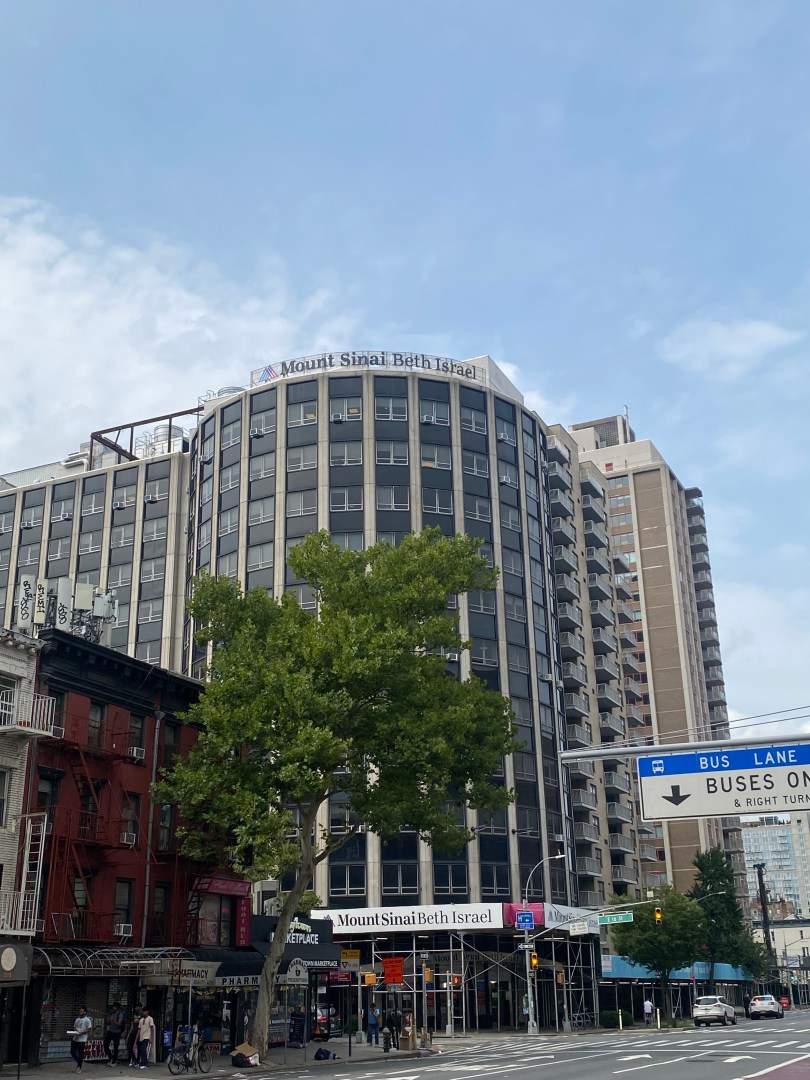
In September 2023, Mt. Sinai formally announced that it would be closing Mt Sinai Beth Israel at 1st Av/E 16th St due to smaller inpatient volumes and massive financial losses. According to a statement obtained by NY1, the hospital has lost over $1 billion since 2013 despite “‘massive improvements and upgrades’”. Mt. Sinai has even expressed that they cannot continue to safely provide care for patients at Beth Israel given its financial state. This was not the first time the hospital had planned to close. In 2016, Mt Sinai had plans to close Beth Israel in favor of a smaller hospital at the corner of 2 Av/E 14th St. However, the hospital reversed this decision in 2021 due to the need for hospital beds in New York State amidst the pandemic.
Now after many legal challenges and community pushback, Mt. Sinai now plans to close Beth Israel as soon as legally feasible. This will undoubtedly make it harder for people to access medical care for several reasons.

ACCESS TO CARE DIMINISHED
At a glance it does not appear that the closure of MSBI will lead to Lower Manhattan residents being deprived of healthcare access. After all, the next closest hospital, Bellevue, is only a 15-min walk or one-stop bus ride from MSBI. Nationally recognized NYU Langone is just a few blocks north of Bellevue. However, the challenge the closure poses is far more complicated than this.
Many patients who go to MSBI rely on specialized services that they could only get at that hospital. One Midtown resident, Justin Jones, who uses a wheelchair, talked to investigative reporter Tim McNicholas of CBS New York about the inconvenience of having to commute to Cobble Hill, Brooklyn to see a doctor. He said, “‘Do I want to go to Brooklyn? Well, not really. But at this point, I don’t really have a choice.’” When asked why he was going to Brooklyn, he said “‘Because everybody I know is not accepting new patients, or they don’t have everything that is critical for me and what I need. It is worth noting that not only is he going so far despite other nearby hospitals, but he’s going to another NYU Langone Campus despite one being located in Midtown on 1st Ave/E 32nd St.
Justin is likely not alone. According to the site HealthcareSuccess, only 60% of people choose a doctor based on a convenient location. This indicates that many people choose doctors not for convenience, but for the prospect of quality medical care. Given Manhattan’s high population density, it is likely that many people have a variety of medical needs and need hospitals that can fit those needs. The closure of MSBI will greatly reduce their options and make it harder for Manhattanites to receive medical care close to home. A 2022 study shows that the average wait time for a physician in the NY area was 17.4 days. It is likely that this period is longer in Manhattan with its population density and all the people who go to Manhattan to seek care.
Unfortunately, the reduction of medical resources can mean that Manhattanites have to travel substantially further for medical care. Even more worrisome is that the distance many residents will have to go may deter them from getting the healthcare they need at all. A study from the National Institute of Health showed that 15.6% who do not receive medical care don’t due to time constraints. In Manhattan where traveling can take longer, this number is likely higher. Exasperating the problem is that four of the next five closest hospitals to MSBI in Manhattan are on the Far East Side. These hospitals are far from subway stations and require residents to utilize the busy M15-SBS or other crosstown routes to have access. The bus routes here tend to be among the slowest in the city, which can make reaching the hospitals tedious.
AMBULANCE RESPONSES TIMES COULD INCREASE
In a medical emergency, every second counts. Not many people know that better than Arthur Schwartz, who was treated at MSBI for a heart attack back in 2017. He told Tim McNicholas of CBS 2 New York, “I feel like this hospital being here saved my own life.” Schwartz is the lead attorney in a lawsuit that claims Mount Sinai is closing MSBI for illicit reasons. You can learn more about his suit and the broader issue of hospital closures in NYS here: https://www.youtube.com/watch?v=3gZ0zQkGcbo
Schwartz is likely not alone. It says on Mt. Sinai’s website provides care in many emergency situations such as heart attacks, strokes and other “critical care” issues. Many of these situations are life-threatening and require immediate care.
The closure of MSBI will undoubtedly mean that it takes ambulances longer to transport patients to life-saving care at other hospitals. According to an analysis by the Gothamist, it took EMS 12.81 minutes on average to get to life-threatening emergencies in NYC during Memorial Day week. In Manhattan, those times were likely longer due to the borough by far being the city’s most congested particularly in the areas surrounding MSBI.

This can result in the likelihood of death or more serious illness or injury increasing significantly after medical emergencies that occur near MSBI. A Saudi Arabian study from 2020 showed that the chance of death after cardiac arrest doubled if the ambulance response time was more than eight minutes. There are a plethora of other situations where seconds can make all the difference as well. An article from the LIFE Corporation says that the average person suffers brain damage after four minutes without oxygen and death can occur after 8-10 minutes without oxygen.
WHAT CAN BE DONE?
It is clear that the planned closure of MSBI has the potential to have a detrimental impact on the health of Manhattanites and possibly put lives at risk. This is in large part due to the transportation constraints of accessing other hospitals in numerous situations. Therefore, many are likely wondering, what can be done to address the issue?
The best course of action for the people would be to keep MSBI open and for Mt. Sinai to ensure it is financially equipped to serve the medical needs of Manhattan residents. However, the debate over closing the hospital includes multiple contradicting perspectives. As stated earlier, Mt. Sinai claims that operating MSBI is leading to insurmountable financial losses and is not safe for patients. However, many community members argue that the hospital is vital for the wellbeing of those in Lower Manhattan. This is because it is only one of two hospitals below 23rd St, an area with a population of about 400,000. The former patient mentioned earlier and attorney in a case against MSBI, Arthur Schwartz, even argues that Mt. Sinai is attempting to close MSBI in order to be able to sell the land that the hospital sits on. Mt. Sinai has denied the allegation. Given this course of events, the issue of whether MSBI closes will likely be decided in court.
So, if Mt. Sinai cannot continue to safely operate MSBI, how can they mitigate the impact of the hospital’s closure? This would largely entail ensuring that as many medical services can be provided in the community as possible that were provided at the hospital. To a significant extent, Mt. Sinai already plans on doing this. Their plan includes opening a new urgent care center at the New York Eye and Ear Infirmary a short walk away. Additionally, Mt. Sinai plans to invest in the emergency department at Bellevue and add a new ambulance Downtown to support the FDNY. All of these initiatives should help to alleviate the burden caused by the closure and maintain at least some nearby health care access for community members. However, it is likely not enough to replace MSBI’s services and prevent all of the consequences of its closure should it ultimately occur.
A PATH FORWARD
It is evident that the closure of Mt Sinai Beth Israel has led to uncertainty for many Manhattanites and can be detrimental to their access to medical care. Hopefully, solutions are reached so that Mt Sinai can be financially sound while Manhattan residents get the health care they need and truly deserve.
Works Cited
Adcroft, Patrick. “Mount Sinai Beth Israel hospital to close amid financial losses.” NY1, 14 September 2023, https://ny1.com/nyc/all-boroughs/news/2023/09/14/mount-sinai-beth-israel-hospital-to-close-amid-financial-losses. Accessed 29 July 2024.
Ahern, Jack. “Locals Rail as Mt. Sinai Revises Push To Shutter Beth Israel By Mid-July.” Our Town Downtown, 2 June 2024, https://www.otdowntown.com/news/locals-rail-as-mt-sinai-revises-push-to-shutter-beth-israel-by-mid-july-XE3402606. Accessed 29 July 2024.
Anderson, Lincoln. “Court orders a halt on Beth Israel Hospital closure plan, de-staffing.” The Village Sun, 17 February 2024, https://thevillagesun.com/court-orders-a-halt-on-beth-israel-hospital-closure-plan-de-staffing. Accessed 29 July 2024.
Brachfeld, Ben. “NYC Buses at Slowest Speed Since 2019.” amNewYork, 26 November 2023, https://www.amny.com/transit/nyc-buses-running-slowest-speeds-since-2019/. Accessed 29 July 2024.
CBS New York. “CBS New York investigates number of hospital closures across New York state.” YouTube, 17 July 2024, https://www.youtube.com/watch?v=3gZ0zQkGcbo. Accessed 29 July 2024.
Jennifer M. Taber, Ph.D., et al. “Why do People Avoid Medical Care? A Qualitative Study Using National Data.” NCBI, 12 November 2014, https://www.ncbi.nlm.nih.gov/pmc/articles/PMC4351276/. Accessed 29 July 2024.
Katz, Matt, et al. “Wait time for ambulances in NYC is the longest since the start of COVID-19.” Gothamist, 1 July 2024, https://gothamist.com/news/wait-time-for-ambulances-in-nyc-is-the-longest-since-the-start-of-covid-19. Accessed 29 July 2024.
Kaufman, Maya. “Major NYC hospital warns of safety risks from delayed closure.” Politico, 18 July 2024, https://www.politico.com/news/2024/07/17/mount-sinai-beth-israel-delayed-closure-00169116. Accessed 30 July 2024.
Kharraz, Oliver. “Doctor appointment wait times are getting worse | STAT.” STAT News, 2 May 2023, https://www.statnews.com/2023/05/02/doctor-appointment-wait-times-solutions/. Accessed 29 July 2024.
“Mount Sinai Beth Israel Emergency Department.” Mount Sinai, https://www.mountsinai.org/locations/beth-israel/care/emergency. Accessed 29 July 2024.
Stewart Gandolf, Chief Executive Officer. “Location Matters: 60% Choose Doctors Based on Convenience.” Healthcare Success, 2024, https://healthcaresuccess.com/blog/hospital-marketing/6-10-people-choose-doctor-based-convenient-location.html. Accessed 29 July 2024.
 Transit Central