By Joseph Morales
Queens is New York City’s largest borough by land area and second largest by population. Like other parts of the city, many residents rely on public transportation to get around. According to data from the NYC Department of City Planning, 37% of Queens’ households do not have access to a vehicle. This does not reflect the thousands of teens who do not drive and also rely on mass transit to get to school and other activities.
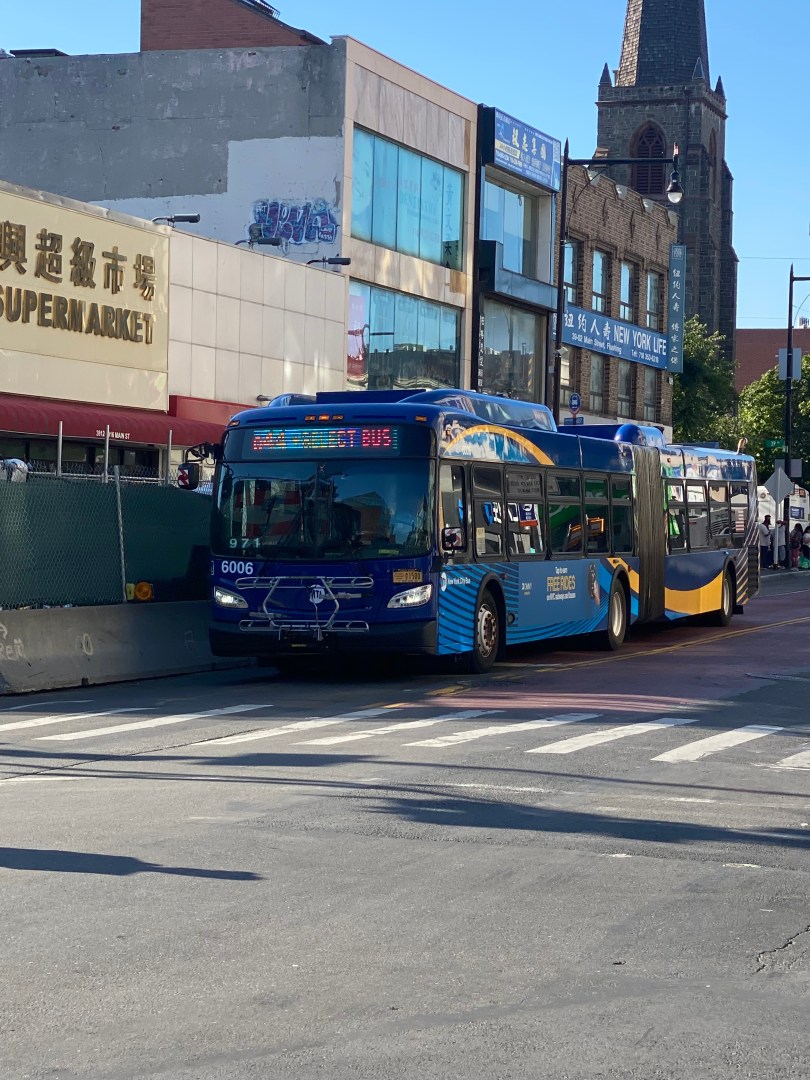
To improve bus service in the borough, the MTA has redesigned the entire Queens Bus Network. The goal of the redesign is to improve bus service by increasing speeds and reconfiguring bus routes to connect riders to more places. This was done through numerous means such as removing bus stops and making bus routes more direct. The MTA also plans to run more routes through the downtowns of Flushing, Jamaica and Long Island City to reduce the need to transfer for intraborough trips.
In order to finalize their plan, the MTA is holding a hybrid public hearing on Wednesday at the Helen Marshall Culture Center at Queens Borough Hall in Kew Gardens. You can find more information on the hearing and register to speak here: https://new.mta.info/transparency/public-hearings/2024-qbnr-hearing If you can’t attend, the hearing will be livestreamed on the MTA’s YouTube Channel. You can even submit written public comments here by July 26th at 8PM: https://contact.mta.info/s/forms/public-hearing-form?Id=a0g8z000000KcfP
After the hearing, the MTA then plans to implement the plan in phases beginning in mid-2025. This phased implementation is likely due to the size of the borough and the high number of riders who would need to readjust to altered routes.
Despite the MTA’s best efforts, the new map may not make everyone happy. Here are the themes you should expect to hear about throughout Wednesday’s meeting.
LONGER WALKS VS FASTER TRIPS
The MTA plans to remove low-ridership stops on most routes in order to increase bus speeds. The idea is that the less buses have to stop, the faster they will run. They even plan to add rush routes that only stop at key transfer points in order to get riders to the subway faster. This can especially be helpful for riders during peak hours when every minute counts in making it to work on time.
However, many are not in favor of bus stops being removed due to the longer distance they would have to walk. Indeed, NYU Furman Center data shows that 7% of Queens residents have a disability and 18% are senior citizens. This shows that increased bus stop spacing may place a substantial burden on a significant number of residents who may have difficulty walking further. Northeastern Queens resident Barbara Linden told Qns.com in reference to bus stop spacing, “‘I think it shows an astounding lack of vision on the part of the MTA to fail to consider this growing demographic in their redesign plan for Queens.” The “‘growing demographic’” refers to the increasing senior citizen population in Northeastern Queens.
During the Bronx Bus Network Redesign, about 18% of bus stops were removed. Of the stops that were removed, 22 stops or 9% were restored after continued community feedback. Therefore, you should expect discourse from people upset over bus stop removals at the hearing.
The MTA will face various advantages and disadvantages when planning bus stop removal in Queens in comparison to The Bronx. Since this redesign attempt has had no pandemic interruptions, the MTA is able to hold a hybrid final hearing which should make it easier to receive more feedback. Not only that, but the fact that more bus riders have returned to the system now means that more are likely to be aware of the hearing and attend. The hybrid access is especially important when attempting to hear from those without internet access and those who cannot attend in-person. The hybrid-format will also enable access for those in many communities that have lower rates of internet connectivity and are heavily bus dependent. On the flipside, bus stop planning can be made harder due to Queens’ having by far the largest land area out of any borough. Therefore, diligence on the part of the MTA will be key to a successful initiative.
MORE DIRECT ROUTES VS LOSS OF CERTAIN CONNECTIONS
In addition to bus stop spacing, the MTA plans to make some bus routes straighter and direct. This will allow riders to get to more places faster. However, it may eliminate on-seat rides to certain destinations.
For instance, in Southern Queens, a resident expressed frustration to CBS2 New York, saying that a reroute of the Q10 would force people to make more transfers. This is despite the redesigned route being straighter and providing residents with better access to multiple subway stations and the Lefferts Blvd commercial corridor.
You can expect to hear a lot from riders whose trips may require additional transfers as most routes have at least one change planned. In some cases, people may be upset over potentially having to pay an additional fare if their new trip will require more than one transfer. Ultimately, the MTA will need to balance these concerns with the benefits of straighter routes to ensure that more people can get to the places they need to go conveniently.
EXTEND THE Q44 FURTHER INTO THE BRONX?
The MTA addressed 23 out of 25 of the most frequent comments on its most recent draft plan in the final plan. However, one of the two proposals outright rejected was a request to extend the Q44-SBS to the Bronx High School of Science in the Bronx’s Bedford Park neighborhood. According to data from the Bronx Science Alumni Foundation, 57% of the school’s roughly 3,000 students reside in Queens. Unfortunately, the MTA rejected a request to extend the route there from West Farms as they claimed the added distance would adversely affect bus reliability.
In addition, the agency also backtracked from a smaller, yet even more impactful extension from both draft plans that would have sent the route to Fordham Plaza in The Bronx. From here, riders could have transferred to a plethora of Bronx bus routes and multiple Metro-North lines. They would also have access to the third largest commercial corridor in the city in Fordham Rd.
The MTA electing not to extend the Q44 further due to reliability concerns does make sense. After all, the route’s existing alignment from Downtown Jamaica to West Farms in The Bronx makes the route one of the city’s longest at roughly 13 miles. It also already goes through congested areas such as Downtown Flushing and Jamaica and the Bronx-Whitestone Bridge, Given how the route carries thousands daily, it’s likely the MTA does not want cascading delays to impact everyone to save time for the minority of riders. However, there are still likely to be some folks that want to see stronger Queens-Bronx connections and want to have their voice heard on Wednesday.

EXTEND THE Q52 TO JACKSON HEIGHTS?
The other comment that went unaddressed was actually a compliment on the most recent draft plan. Riders liked a proposed extension of the Q52-SBS from Elmhurst to Jackson Heights. However, the MTA now no longer plans to move forward with it due to service already being provided by the Q53-SBS. They also claim that the resources needed for an extension would be better allocated in other parts of the bus system.
The MTA likely feels this way because while the Q53-SBS frequently provides service where the Q52-SBS would have, while other routes do not have this level of existing service. Riders might still advocate for the extension as those from parts of the Rockaways would have easier access to more of Western Queens. Additionally, they would be able to more seamlessly make transfers to the E and F express trains along with a plethora of bus routes and the Q70-SBS LaGuardia Link. Whether or not the MTA changes anything likely depends on how riders would value a Q53-SBS extension as opposed to the other service additions being made.

WHAT’S NEXT
After the public hearing is complete, the MTA will take into account the feedback before presenting the Final Plan to the MTA Board for a vote. As stated previously, the new routes would begin to take effect in phases starting in mid-2025 pending board approval. Considering how many bus stops were restored in The Bronx, it is likely that the MTA will still be open to minor changes after the redesigned routes begin to run. Hopefully, the process ends with a bus network that will make travel faster and more convenient for the world’s borough.
Works Cited
Google Maps, https://www.google.com/maps/dir/Bronx+Zoo,+Southern+Boulevard,+The+Bronx,+NY/Jamaica+Center+-+Parsons%2FArcher,+Queens,+NY/@40.7763702,-73.9009852,12z/data=!4m15!4m14!1m5!1m1!1s0x89c2f483516ad28b:0x56eb41c9795102e!2m2!1d-73.8767217!2d40.8501415!1m5!1m1!1s0. Accessed 20 July 2024.
“Bronx High School of Science, The (10X445).” NYC MySchools, https://myschools.nyc/en/schools/high-school/10X445. Accessed 20 July 2024.
Colon, Dave, and Kevin Duggan. “MTA’s Queens Bus Redesign: $30M in Service, 8 More Routes, Skepticism from Brooks-Powers – Streetsblog New York City.” Streetsblog NYC, 12 December 2023, https://nyc.streetsblog.org/2023/12/12/mtas-queens-bus-redesign-30m-in-service-8-more-routes-skepticism-from-brooks-powers. Accessed 20 July 2024.
“Current Student Body — Bronx Science Alumni Foundation.” Bronx Science Alumni Foundation, https://alumni.bxscience.edu/current-student-body. Accessed 20 July 2024.
McLogan, Elle. “Queens bus route redesign proposal sees pushback in Ozone Park.” CBS News, 21 March 2024, https://www.cbsnews.com/newyork/news/queens-bus-network-redesign-pushback-ozone-park/. Accessed 20 July 2024.
Metropolitan Transportation Authority. “Bronx Bus Network Redesign-Six Month Evaluation.” MTA, 20 February 2023, https://new.mta.info/document/135681. Accessed 20 July 2024.
Metropolitan Transportation Authority. “Public Hearing Comments.” MTA, https://contact.mta.info/s/forms/public-hearing-form?Id=a0g8z000000KcfP. Accessed 20 July 2024.
Metropolitan Transportation Authority. “Queens Bus Network Redesign-Draft Plan.” MTA, December 2019, https://new.mta.info/document/12701. Accessed 20 July 2024.
Metropolitan Transportation Authority. “Queens Bus Network Redesign-New Draft Plan.” MTA, 29 March 2022, https://new.mta.info/queens-bus-redesign-draft-plan-hi-res. Accessed 20 July 2024.
Metropolitan Transportation Authority. “Queens Bus Network Redesign Proposed Final Plan.” MTA, 12 December 2023, https://new.mta.info/document/128476. Accessed 20 July 2024.
Metropolitan Transportation Authority. “Queens Bus Network Redesign Public Hearing.” MTA, 2 July 2024, https://new.mta.info/transparency/public-hearings/2024-qbnr-hearing. Accessed 20 July 2024.
Metropolitan Transportation Authority. “Subway and bus ridership for 2021 – New York City Transit.” MTA, 2022, https://new.mta.info/agency/new-york-city-transit/subway-bus-ridership-2021. Accessed 20 July 2024.
Metropolitan Transportation Authority. “Subway and bus ridership for 2023 – New York City Transit.” MTA, 2024, https://new.mta.info/agency/new-york-city-transit/subway-bus-ridership-2023. Accessed 20 July 2024.
New York City Department of City Planning. “Car Ownership in NYC.” Tableau, 24 November 2022, https://public.tableau.com/app/profile/dcptransportation/viz/ACSProfiles/Dashboard1. Accessed 20 July 2024.
New York City Department of City Planning. “Sustainable Communities In The Bronx: Leveraging Regional Rail For Access, Growth and Opportunity.” nyc.gov, May 2014, https://www.nyc.gov/assets/planning/download/pdf/plans-studies/sustainable-communities/bmn/bronx_metro_report/full_report.pdf. Accessed 20 July 2024.
New York State. “Queens | The State of New York.” ny.gov, https://www.ny.gov/counties/queens. Accessed 20 July 2024.
“Queens.” NYU Furman Center, 21 May 2024, https://furmancenter.org/neighborhoods/view/queens#demographics. Accessed 20 July 2024.
“QuickFacts.” United States Census Bureau, 1 July 2023, https://www.census.gov/quickfacts/fact/table/kingscountynewyork,richmondcountynewyork,newyorkcountynewyork,bronxcountynewyork,queenscountynewyork/PST045223. Accessed 20 July 2024.
Shkurhan, Iryna. “CB11 tells MTA to ‘go back to drawing board’ with bus network redesign proposal – QNS.” QNS, 4 April 2024, https://qns.com/2024/04/cb11-tells-mta-to-go-back-to-drawing-board-with-bus-network-redesign-proposal/. Accessed 20 July 2024.
 Transit Central