
By Joseph Morales
There are about 915,000 students in NYC public schools. According to data from the State Education Department, about 45% of these students are in elementary school not including Pre-K and 3K students. Most of the time, students attend elementary school within walking distance of their home. Based on data from NYU, the average NYC kindergarten student lives only 10 minutes away from their school by foot or mass transit.
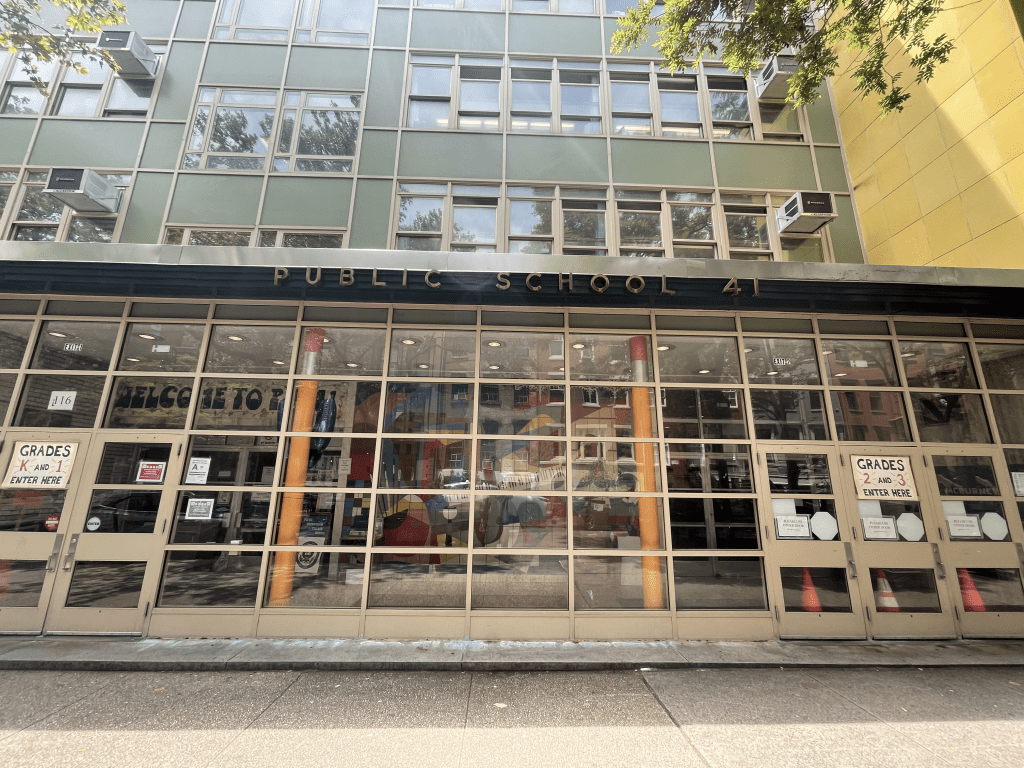
License Details:https://creativecommons.org/licenses/by-sa/4.0/
As convenient as this may seem for families, the proximity of elementary schools to their homes may actually be a significant burden. While most students can walk to their schools, only 10% of New Yorkers walk to work according to the NYC Department of City Planning. Even in Midtown Manhattan, where jobs are plentiful, only 33% of residents get to their jobs via a walk. Since most schools in NYC start at 8AM, many parents are forced to remain with their kids until a certain time until the kids can enter school. This then requires many parents to start their commutes later, leading them to have slower, less reliable and more stressful commutes. The later and longer commute times can also lead to them being frequently late to work or simply having less job opportunities as they can only commute a certain distance from their child’s school. To avoid the commuting troubles, many parents pay for childcare which can be expensive. For dismissal, many parents simply have no choice but to leave work early to make a trip to pick up a child or rely on childcare or after-school programs.
To resolve these all too common issues, why not allow parents to send their children to elementary schools near their jobs in addition to near their homes? This would be called employment-based zoning. Employment-based zoning would substantially improve parents’ commutes as they can drop their kids off on their way to work at the school closest to their workplace. For those who ride buses, being able to ride earlier should make trips faster and more reliable as they will travel at less busy times. The proximity of parents to their child’s school can also give them more peace of mind in case of emergencies, especially if they rely on mass transit. Employment-based zoning can also increase job opportunities for parents and reduce childcare costs. While parents may still have to address afternoon childcare depending on work hours, they would still need childcare for less time than they would otherwise.
In addition to helping with commute and childcare issues, employment-based zoning can help address many of the issues in our education system. For one, many families would have up to three options of where to send their children to school. This would make a major difference for families who live closest to schools that are lower-performing or if a school near a parent’s workplace better fits their child’s educational needs. According to a New York Post article, 142 elementary and middle schools in NYC had 90% or more of their students fail the State ELA and Math exams in 2019. Hence, there is likely a substantial number of families that would utilize their extra options for the purpose of school quality.
Outside of academics, students would likely be exposed to a more diverse group of peers as more students attend schools outside of the neighborhoods they reside. This would result in students making more friends with different cultures, socioeconomic statuses and life experiences than them. Not only is this positive within itself, but it can also help boost students’ academic achievement. A study from UCLA showed that on average, standardized test scores, academic engagement and grades did not differ among students whose parents had a high school vs college diploma if they had at least one cross-class friend. Class in this study refers to social class. On the contrary, they found that academic achievement was lower for for students whose parents did not have a college degree if the student did not have a cross-class friend. For reference, class in the UCLA study refers to social class. Additionally, according to the non-profit Globe Smart Kids, kids with friends from other cultures have increased well-being, resilience and self-esteem.
This may seem ideal for many individual families, but a policy change may be complicated. For one, it may not be feasible for all parents to have the option for their child to attend school closer to their jobs if they work in one of the city’s busier business districts such as Midtown Manhattan. This may also be true in other areas in the outer boroughs with high employment densities such as Fordham Plaza in The Bronx, Long Island City and Jamaica in Queens, and Downtown Brooklyn and Williamsburg in Brooklyn. Additionally, whether this is something the city can implement is likely dependent on how many parents would take advantage of the new policy and which schools more parents would want to send their children. Before a policy is made, there may need to be some sort of study to determine who would utilize employment-based zoning and which schools it would effect.
If demand is significant but not enough for universal employment based zoning, the NYCDOE can pursue a number of solutions to accommodate those who would benefit. Solutions would likely be based on demand and could include, an application system to send children to schools’ near either parents’ place of employment if space exists. This would be a system where parents rank their preferences and then are placed in to a lottery for seats. Priority can be given for families who live near lower-performing schools or whose regular zoned school is further from either parents’ workplace. The city can also consider allowing parents to contact schools directly that they would be zoned for based on employment location.
The most prevalent hurdle for employment-based zoning would undoubtedly be the length of time parents spend at a given job. According to the Bureau of Labor Statistics, the average tenure for employees at a job was 4.1 years with variations in different industries. If students are in elementary school from 6-8 years including Pre-K, this poses an obvious issue if parents enroll children near their workplace when they start kindergarten. This would require parents to make informed decisions whether or not to send their kid to school near their workplace based on how long the parent will continue working within a practical travel distance to that school. For this reason, the NYCDOE might want to consider limiting employment-based zoning to parents who have held jobs for a certain amount of time or who work in industries where tenures are typically longer.
As the current school zoning system adversely effects families’ time and money, employment-based zoning as an option for families is a potential solution to those issues. Additionally, employment-based zoning can change the dynamics of our school system in many ways that can substantially benefit New York’s children. Hopefully, whether its through employment-based zoning or something else, more could be done to improve commute times for all and provide childcare to families that need it. This will lead to stronger and more economically stable families in New York City for years to come.
Works Cited
Algar, Selim. “Over 140 NYC schools have grades with 90 percent state exam failure rate.” New York Post, 17 December 2019, https://nypost.com/2019/12/17/over-140-nyc-schools-have-grades-with-90-percent-state-exam-failure-rate/. Accessed 9 June 2024.
Brand, David. “See Which NYC Schools Eat Lunch Before 10 a.m.” City Limits, 11 June 2019, https://citylimits.org/2019/06/11/see-which-nyc-schools-eat-lunch-before-10-a-m/. Accessed 9 June 2024.
Glick, Anne. “Diverse friendships are good for kids (and require confidence!) – Part 1/2 • Globe Smart Kids.” Globe Smart Kids, 10 October 2017, https://globesmartkids.org/research/diverse-friendships-require-confidence/. Accessed 9 June 2024.
Lessard, Leah M., and Jaana Juvonen. “Why it’s good for kids to have friends from different socioeconomic backgrounds.” The Conversation, 20 April 2021, https://theconversation.com/why-its-good-for-kids-to-have-friends-from-different-socioeconomic-backgrounds-157386. Accessed 9 June 2024.
New York City Department of City Planning-Transportation. “Car Ownership in NYC.” Tableau, 24 November 2022, https://public.tableau.com/app/profile/dcptransportation/viz/ACSProfiles/Dashboard1. Accessed 9 June 2024.
New York City Office Of The Mayor. “Mayor Adams, Chancellor Banks Celebrate First Increase In NYC Public School Enrollment In Eight Year.” NYC.gov, 15 November 2023, https://www.nyc.gov/office-of-the-mayor/news/870-23/mayor-adams-chancellor-banks-celebrate-first-increase-nyc-public-school-enrollment-eight. Accessed 9 June 2024.
“NYC PUBLIC SCHOOLS ENROLLMENT (2022 – 23).” New York State Education Department, https://data.nysed.gov/enrollment.php?year=2023&instid=7889678368. Accessed 9 June 2024.
Rumage, Jeff, and Hal Koss. “How Long Should You Stay at a Job?” Built In, 10 October 2023, https://builtin.com/articles/how-long-should-you-stay-at-a-job. Accessed 9 June 2024.
 Transit Central