
By Joseph Morales
The Nostrand Avenue Line is a busy subway line in Brooklyn. The line runs from Franklin Ave-Medgar Avenue College and Flatbush Av-Brooklyn College and is served by the 2 and 5 lines. The Nostrand Avenue Line connects several densely populated neighborhoods in Central Brooklyn, such as Midwood, Flatbush, and Prospect Lefferts Gardens. Additionally, the line provides connections to both local and express service on the Eastern Pkwy Line(2,3,4,5), which provides access to even more destinations across Brooklyn and Manhattan. Overall, the line served over 35,000 riders per day in 2022 according to MTA statistics.
When the line was first built in 1920, Flatbush Av-Brooklyn College was not intended to be the last stop. In fact, this station was not built like a typical terminal station in order to allow for the line to be extended in the future. Flatbush Av-Brooklyn College is the only terminal station in the system to not have an island platform but instead have two side platforms like a typical subway station. This is why there are two tracks, and riders must know which track their train is leaving from when they get to the station. This setup limits the station’s train capacity and is the reason why some 2 and 5 trains go to New Lots Ave and Crown Hts-Utica Av, respectively, during rush hours.

Initially in 1918 and 1919, the city proposed extending the line south via the now abandoned LIRR Manhattan Beach Branch to Kingsborough Community College. Then in 1920, NYC Mayor John Hylan proposed extending the line instead straight down Nostrand Avenue to Sheepshead Bay where it would intersect with the BMT Brighton Line(B,Q). As this was part of a larger series of proposals by Mayor Hylan, many urban planners disapproved of it. There were then other extension proposals to Sheepshead Bay that made it as far as the design phase between 1929 and 1968. However, a combination of the Great Depression, World War II, and the city’s financial troubles ultimately led to no extension being built. More recently in 2016, the MTA was considering extension plans to the Kings Plaza Mall in Marine Park, but this evaluation did not go very far.

Now, the Nostrand Avenue Line stands out as one of the smaller fingers on the Brooklyn subway hand. Besides the L Train, the Nostrand Avenue Line has the northernmost terminus out of all Brooklyn subway lines despite the many plans for its extension. If it was to be extended, where should it go? To answer this question, we need to consider population density in Southern Brooklyn and where people want to go. This in large part because of the number of proposals for a Notsrand Ave Line extension and the need to consider the needs of today’s subway riders.
Several extension proposals including recent ones have been for trains to run further down Nostrand Ave to Avenue U or Voorhies Ave in Sheepshead Bay. These extensions would serve the densely populated communities of Midwood, Madison and Sheepshead Bay. Currently, riders in this area must rely on the B44-SBS in order to access trains at the Flatbush Ave-Brooklyn College station. Unfortunately like many Brooklyn bus routes, the B44-SBS is not always dependable. According to MTA statistics, the Customer Journey Time Performance on the route was 70.4% between February 2023 and February 2024. This means that only 70.4% of buses completed their trips within five minutes of their scheduled time during this one-year period. Additionally, in the two community districts along the B44-SBS route, only 44-62% of residents own cars. Hence, a subway extension connecting riders to the core business districts of Brooklyn and Manhattan would undoubtedly be a boon for residents.
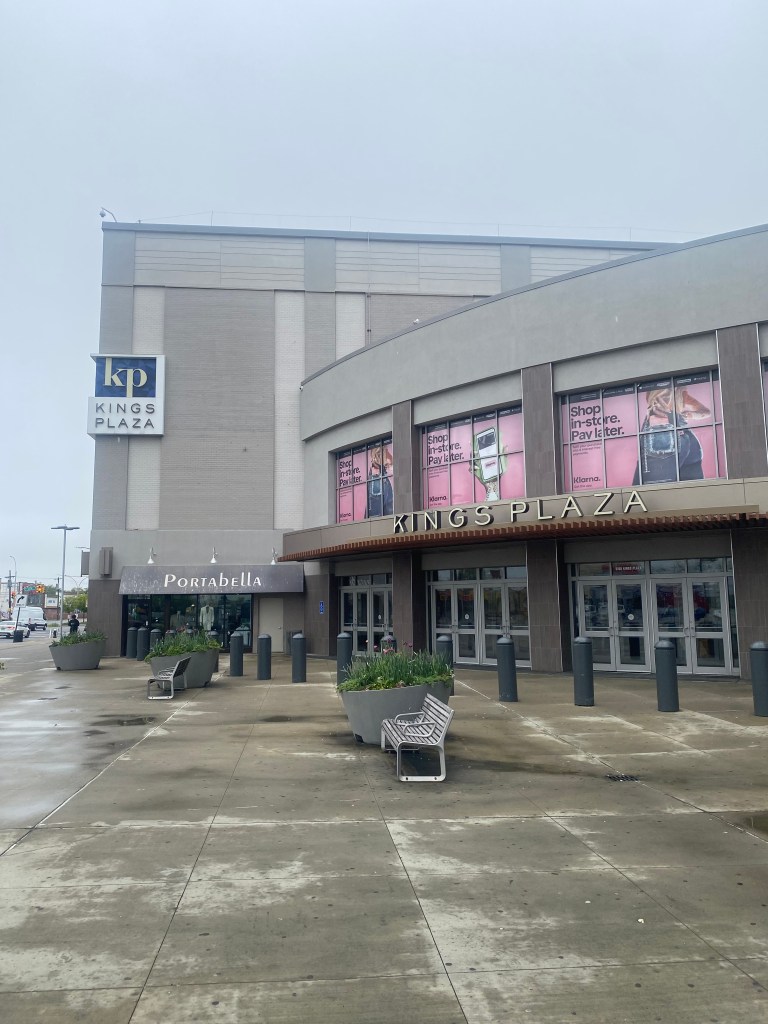
Outside of Sheepshead Bay, other proposals in both 1968 and 2016 have called for trains to be extended down Flatbush Ave to the Kings Plaza Mall. Besides the mall, this extension would also help to serve areas that currently lack subway service such as parts of East Midwood, Marine Park and the Flatlands. The Kings Plaza Mall is one of Brooklyn’s only major malls serving chain retailers and the only one outside of Downtown Brooklyn. Hence, the mall is a major destination for both shopping and employment destination in the borough. Unfortunately, mass transit to both the mall and surrounding communities is even less reliable than transit serving Nostrand Avenue with the B41 bus making more stops and being a slower route than the B44-SBS.
If a Nostrand Ave line extension were being considered, it would likely be hard for the MTA to decide where to extend the line, given the vitality of both options. Some may see the Kings Plaza extension as being more valuable due to it serving the mall, while others may find a Nostrand Ave extension more important due to a slightly greater population density. However, the likelihood of either extension occurring would also likely come down to cost compared with the ridership each extension would receive.
The cost of a subway extension anywhere could be exorbitantly high for several reasons. For one, recent MTA subway extensions such as the 7 train extension to Hudson Yards and Phase I of the Second Avenue Subway have both cost $2.4 billion and $4.5 billion, respectively. For Nostrand Avenue, where the extension would be longer, the cost will undoubtedly be substantially higher. This is before considering the fact that building a Nostrand Ave line extension would be made more difficult by the fact that much of Southern Brooklyn has a high water table. The water table is also likely to increase due to rising sea levels that could lead to even tougher construction conditions. Hence, any subway extension here would be a massive undertaking, and the selected proposal may be the extension that costs the least due to technical constraints in a given area.
Another substantial barrier to a Nostrand Avenue subway extension is the MTA’s current priorities for expansion projects. In October 2023, the MTA released its 20-Year Needs Assessment with a comparative evaluation of possible transit expansion projects to complete. This included projects such as further extensions of the Second Avenue Subway beyond East Harlem and a Metro-North connection to Stewart International Airport in Orange County. Unfortunately for would-be Nostrand Avenue line riders, an extension of the Nostrand Avenue Line was not on the list. The MTA evaluated chosen projects for factors such as cost, equity and the new connections a project would offer. While it’s unclear why a Nostrand Ave extension was not evaluated, it likely would not score well due to its potential high cost and limited ridership compared to other subway extensions. For instance, an extension of the Second Avenue Subway to Broadway/W 125th St serving an estimated 239,700 riders is expected to cost $7.5 billion. On the other hand, an extension along Utica Avenue, which is similar to Nostrand Ave, could cost almost the same amount to serve way less than half of the riders as the SAS extension. Hence, a Nostrand Ave line extension would likely not be seen as cost-effective compared to other subway extension proposals the MTA is considering.
If a Nostrand Ave subway line extension is unfeasible, how else could transit be improved in Southern Brooklyn? The main way to improve transit here would undoubtedly be to improve the existing bus service. As it stands, the MTA and NYCDOT already have several plans to do so. As part of the Brooklyn Bus Network Redesign, the MTA plans to convert the B41 on Flatbush Ave into a Select Bus Service route with fewer stops and more direct routing in Downtown Brooklyn. In addition, the NYCDOT and MTA are also exploring bus improvements on Flatbush Ave, which could include bus lanes and transit signal priority. All of these initiatives should work to greatly enhance bus service and make transit more reliable and convenient for riders. As for the B44 and the rest of Nostrand Ave, the MTA is proposing extending the route down Avenue Z to connect with the Sheepshead Bay(B, Q) station. This should provide additional subway connections to those near the southern end of the bus route and provide an alternative to a longer bus ride to the 2 and 5 trains.
The Nostrand Ave line has a long history of extension plans not coming through as riders wanted for over a century. While history cannot be changed, the MTA and NYCDOT can and is leveraging their resources to improve transit in the Southern Brooklyn communities that a Nostrand Ave line extension would have served. Even if a subway extension is not in the cards, smaller changes, such as bus service improvements the MTA is planning, can still go a long way in improving mobility for residents and visitors. As the area continues to grow, public transit will play a major role in the prosperity of Southern Brooklyn as it does in communities across New York City. Transit improvements in areas with less reliable options will go a long way in transit serving communities as well as it can.
Works Cited
Jaffe, Eric. “The New York City Subway’s New 7 Train Extension Opens This Sunday.” Bloomberg, 11 September 2015, https://www.bloomberg.com/news/articles/2015-09-11/the-new-york-city-subway-s-new-7-train-extension-opens-this-sunday. Accessed 17 April 2024.
Maldonado, Samantha. “Rising Groundwater Threatens New York City — Researchers to Study How Much.” THE CITY – NYC News, 18 January 2023, https://www.thecity.nyc/2023/01/18/rising-groundwater-threatens-new-york-city/. Accessed 17 April 2024.
Metropolitan Transportation Authority. Average Weekday Subway Ridership. 2023, New York, NY, United States. Accessed 17 April 2024.
Metropolitan Transportation Authority. “Brooklyn Bus Network Redesign Draft Plan.” MTA, 1 December 2022, https://new.mta.info/document/101521. Accessed 17 April 2024.
Metropolitan Transportation Authority. “Bus Customer Journey Time Performance.” MTA Metrics, 2024, https://metrics.mta.info/?bus/customerjourneytimeperformance. Accessed 17 April 2024.
Metropolitan Transportation Authority. “Bus Speeds.” MTA Metrics, 2024, https://metrics.mta.info/?bus/speeds. Accessed 17 April 2024.
Metropolitan Transportation Authority. “Overview of Comparative Evaluation.” MTA 20-Year Needs Assessment, 2023, https://future.mta.info/documents/20-YearNeedsAssessment_ComparativeEvaluation.pdf. Accessed 17 April 2024.
New York City Department of City Planning-Transportation. “Car Ownership in NYC.” Tableau, 24 November 2022, https://public.tableau.com/app/profile/dcptransportation/viz/ACSProfiles/Dashboard1. Accessed 17 April 2024.
New York City Department of Transportation. “Flatbush Avenue Bus Priority – Brooklyn Community Board 14 Committee – January 5, 2023.” NYC.gov, 14 January 2023, https://www.nyc.gov/html/dot/downloads/pdf/flatbush-ave-cb14-jan2023.pdf. Accessed 17 April 2024.
Pope, Raphael, et al. “The Insanely Expensive Second Avenue Subway Explained.” Gothamist, 29 December 2016, https://gothamist.com/news/the-insanely-expensive-second-avenue-subway-explained. Accessed 17 April 2024.
Tech Transit Association. “Nostrand Ave Extension | Lines That Never Were.” YouTube, 28 November 2022, https://www.youtube.com/watch?v=WvDwS1w1jic. Accessed 17 April 2024.
 Transit Central