By Joseph Morales
*In this article, West Bronx will refer to communities in The Bronx west of Webster/Melrose Ave from 161st St to 238th St. This includes parts of Bronx Community Districts 4, 5, 7 and 8.
MOBILITY CONTEXT
Like most of New York City, the West Bronx is full of vibrancy and diversity. Neighborhoods range from the bustling areas of Highbridge and Mount Eden to the quaint suburban-like communities of Spuyten Duyvil and Riverdale. The West Bronx is known for several of its most famous locations, including Yankee Stadium and the official birthplace of hip-hop at 1520 Sedgwick Avenue in the Morris Heights neighborhood.
In the West Bronx, most people get around through non-vehicular modes such as walking and public transit. According to the NYC Department of City Planning, only 25%- 54% of households in any given West Bronx community district have access to a car. Many West Bronx communities also have high poverty rates, with rates ranging from 18.6% to 33.7% in different community districts based on data from the NYU Furman Center. Hence, many residents here have fewer transportation options than those in other community districts citywide.
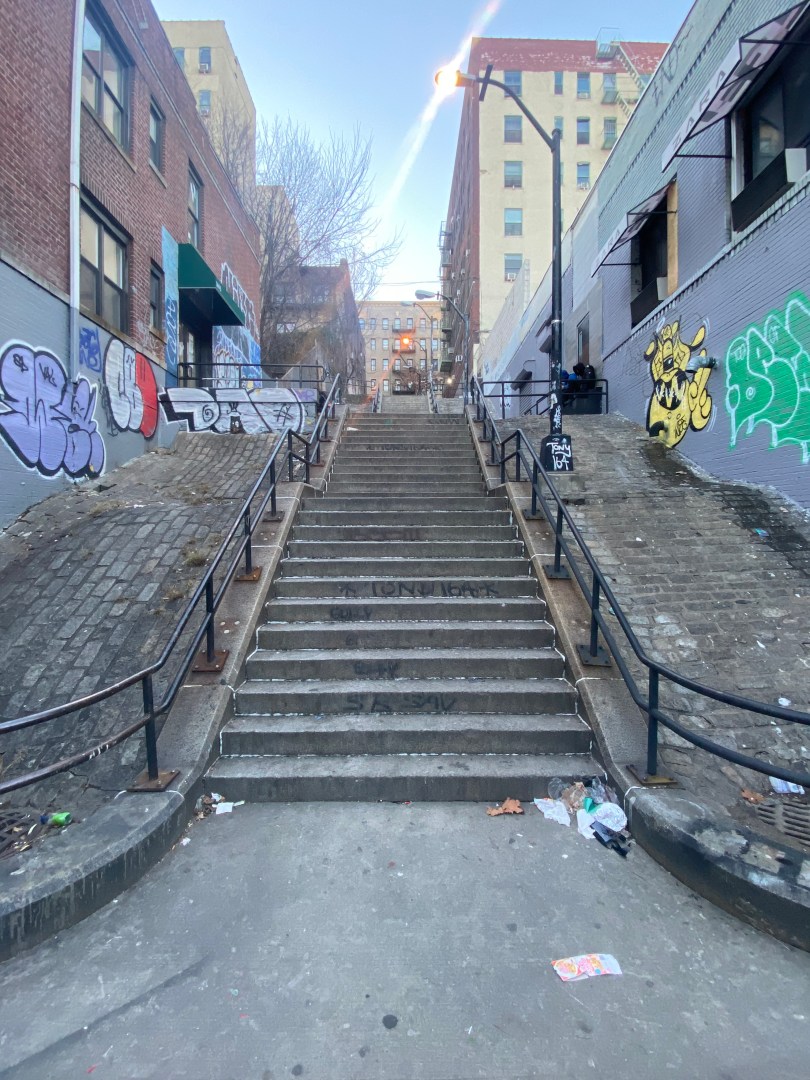
As a result, most residents walk and take transit in their daily lives. In fact, 7-10% of residents in respective West Bronx community districts walk to work, according to data from the NYC Department of City Planning. As most residents commute by mass transit, many walk to subway stations and bus stops. For many residents, this means using step streets that connect blocks separated by hills. Step streets were built to connect areas across slopes the city considered too steep for traditional streets. For Highbridge and Morris Heights residents, step-streets save them at least 5 minutes to get to subway stations on the 4 between 167th St and 176th St, as well as many bus routes. These residents also benefit immensely from access to commercial streets such as Jerome Ave and 170th St, given their neighborhoods are almost exclusively residential. Residents of other communities throughout the West Bronx also realize similar benefits because of step-streets.

ISSUES WITH STEP STREETS
While these step streets are instrumental for mobility, they have several downfalls. For one, they are completely inaccessible to those with mobility disabilities. According to data from the NYU Furman Center, between 9.9 and 16.4% of residents in West Bronx community districts have some sort of disability. Additionally, between 9.7 and 21.2% of residents in these community districts are senior citizens. Hence, step streets are hard to near impossible to navigate for many residents. As many residents are also low-income, using a personal vehicle, taxi, or rideshare to fill these mobility gaps is not an option. While many can use the MTA’s Access-A-Ride paratransit system, trips must be booked at least 24-48 hours in advance, and riders can be offered pick-up times up to an hour earlier or later than requested.
In addition to being inaccessible to some, step streets may not offer the best sense of safety for many. This is because they tend to be located directly between dimly-lit buildings like alleyways. While critical to mobility, the step streets also do not have particularly high foot traffic at any point in the day, sometimes leading to desolate conditions. Additionally, most of the West Bronx’s step-streets tend to be in the Morris Heights and Highbridge neighborhoods, which are known to be among the more dangerous areas of the city. This combination of factors may make many residents and visitors feel unsafe using step streets and prevent them from fully taking advantage of these critical mobility assets. Outside of crime, structural disrepair and cleanliness tend to be key concerns when it comes to step street usage.
As step-streets can pose several challenges, there are many solutions the city has utilized and others they can implement to make them safer and better for all community members. Any widespread effort to improve step streets would be unique in New York City since they are only prevalent in a handful of communities. However, ensuring the safety, security, and state of good repair on step streets is critical to ensuring the mobility of residents and visitors alike in the densely populated West Bronx.
IMPROVING SAFETY
To improve safety on step streets, the city can implement many initiatives that have been used to combat crime in other areas. On the subway system, NYC Mayor Eric Adams has added many police officers to patrol stations on several occasions amid numerous increases in subway crime. The mayor also created new “Neighborhood Safety Teams” to reduce gun violence and take guns off the streets citywide in 2022. Given the much smaller scope of step streets, there is no reason why more officers cannot be assigned to step streets in communities of need. Outside of more police officers, building owners can install surveillance cameras on the sides of buildings facing step streets so that pedestrians know that the street is being recorded and that any crimes are on video. Cameras similar to those found in areas with private houses that announce things like “camera recording” to passers-by may also be effective. Other investments, such as in the state of good repair of step streets, cleanliness, and even public art can increase foot traffic and lead to more safety in numbers. This would lead to a cycle that makes step streets substantially safer and better for community mobility.
QUALITY STAIRCASES
As for the state of good repair, the city has already taken numerous steps to address the issue. In 2019, the city completed a $9.4 million restoration of the Clifford Pl Step Street in the Mt Eden neighborhood that connects Walton Ave to the Grand Concourse along with the 174-175th St(B, D) subway station. In 2018, the city also completed an $8 million restoration of the E 168th St Step Street in the Claremont section. Other notable step-street reconstructions have included one on W Tremont Ave in Morris Heights and one on W 229th St in Kingsbridge Heights. In these reconstructions, the city has emphasized public realm improvements such as new lighting, trees, seating, and more to make the step streets more inviting. Outside of reconstructions, the W 168th St Step Street in Highbridge was recently painted to include a beautiful and colorful mural. Most of these reconstructions have been a partnership between the NYC Department of Transportation(NYCDOT) and the NYC Department of Design and Construction(NYCDDC). In these cases, the NYCDOT funds the project while the NYCDDC performs the construction work on the step street.
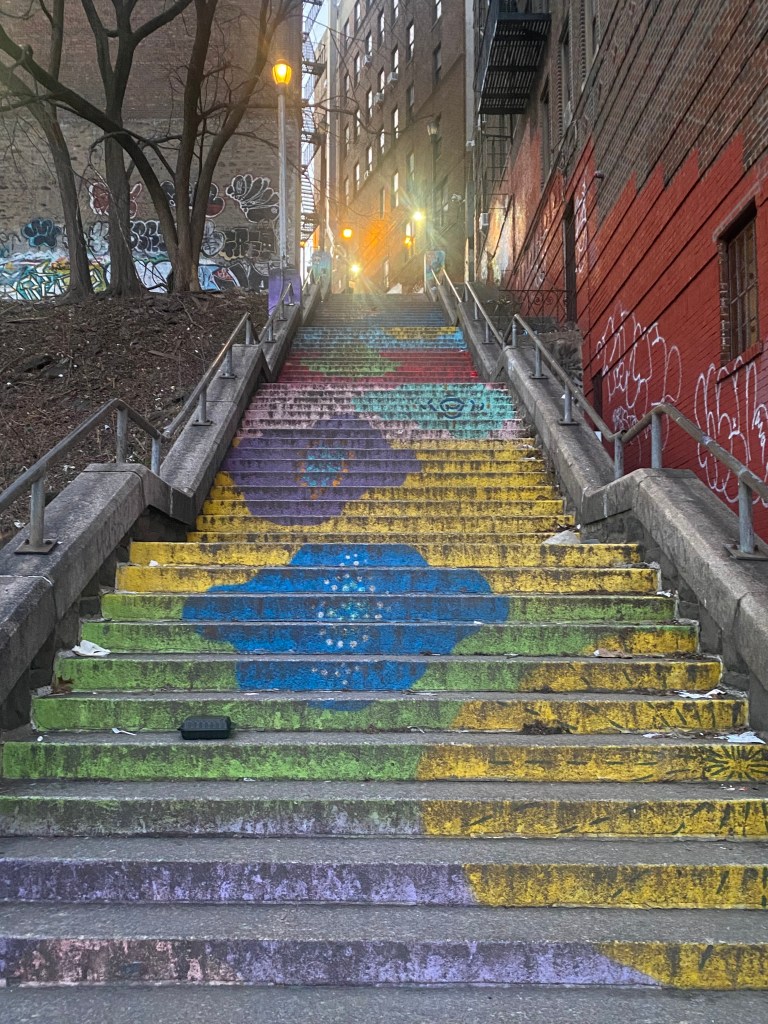
To keep step streets in good shape, the city may want to consider more robust plans to maintain step streets rather than to solely reconstruct step streets when it is absolutely necessary. While step streets are extremely old and reconstruction is likely essential in some cases, more may be able to be done to make sure these step streets can function better before reconstruction is needed. Maintenance is also vital as reconstructions can be hard to do over time if the city does not have funding or the wear and tear on a step street increases. For instance, the city had once promised residents it would restore the W 215th St step street in Inwood, Manhattan, in 2005 after improvements had been requested since the 1990s. Not only was a restoration not completed until 2016, but a woman had injured herself when she tripped on a hole in the staircase in 2007. This injury may have been preventable had staircase maintenance occurred before the complete restoration.
To maintain step streets, the NYCDOT’s Sidewalk Inspection and Management Unit routinely checks on the streets and responds to maintenance requests from 311 calls and community boards. They then determine which steps to take, sometimes including a complete reconstruction. Unfortunately, this unit has not always been prompt to fix sidewalks, as the city had a backlog of 50,000 cases as of September 2019. As the city is still coping with a fiscal crisis, there is a chance that backlogs could now get longer. While it’s unclear how many complaints the agency has gotten as a result of step streets, it is likely that any backlog that applies to sidewalks also applies to step streets in some way. It also does not help that step streets are particularly hard to maintain due to the granite material used to construct them. In 2018, NYCDOT Civil Engineering Intern Marion Torres told Spectrum News NY1 regarding step streets, “Most of them are granite, so its hard to maintain them considering the amount they are used by pedestrians.” Hence, the city may want to consider innovative solutions and investments to maintain these critical structures.
MAKING STEP STREETS ACCESSIBLE FOR ALL
Even though maintenance requires innovation, the toughest issue involving step streets is undoubtedly accessibility. This is simply because step streets are stairs on hills, prohibiting access for those with mobility disabilities. While ramps may sound like a practical solution here, the steepness of some slopes may make a ramp too dangerous for those who would use it. Any solution here would involve creativity and would likely be something New York City has never seen before.
One idea is a funicular wheelchair lift. This would include a diagonal incline similar to the elevators at the 34th St-Hudson Yards Subway station but be a wheelchair lift similar to the one at the Conservatory in the NY Botanical Garden. Such a lift does not exist in New York City, and building it would be a feat of engineering. However, as the cost of the elevator at 34th St-Hudson Yards was constructed for $2.7 million, there is a chance such a lift could be built for a similar or cheaper cost adjacent to certain step streets. Possible constraints could include impact on the staircase or surrounding structures and any other physical or environmental constraints. The price could also make a project harder depending on the different constraints under which the project would have to be built.
Suppose there are prohibitions to making step streets fully accessible. In that case, the city can consider working with the MTA to offer free Access-A-Ride trips to those with disabilities who would otherwise use a step street. If necessary, they can also form similar partnerships with Uber and Lyft to provide rideshare trips. Not only do those with disabilities face longer trips, but they almost always have to traverse a slope eventually via a sidewalk to get to the same destination as the step street. While nearly none of the subway stations nearest step streets are accessible, the MTA’s priorities for making stations accessible are almost all met in West Bronx communities. These include a high population of people with disabilities, growing neighborhoods as well as a lack of existing accessible stations. Hence, those who live near step streets will have to have an accessible route to the subway stations to utilize them should they become accessible.
Access-A Ride already offers regular fare trips to riders they deem only require Access-A Ride to get to subway stations/bus stops and/or inaccessible subway stations. Given the high population density in the West Bronx, it should be simple to find a large number of riders who would benefit from the free service to implement a pilot program. If NYC and/or the MTA can find the funding, this can be a major game changer for many in the West Bronx.
THE IMPORTANCE OF IMPROVING STEP STREETS
As step streets are few and far between in NYC, they are often overlooked for their importance to many of the city’s residents. Step streets offer communities access to retail, parks, and more in addition to subway stations and bus routes. Several projects over the years have shown that the city recognizes this and is willing to upgrade step streets to meet the needs of the neighborhoods they serve. Hopefully, this work will continue and even expand to ensure that step streets help people get to where they are going for years to come.
Works Cited
1520 Sedgwick Ave – The Birthplace of Hip Hop, https://birthplaceofhiphop.nyc/. Accessed 18 March 2024.
Aaron, Brad. “Eyes on the Street: The New 215th Step-Street Officially Opens Today.” Streetsblog, 3 February 2016, https://nyc.streetsblog.org/2016/02/03/eyes-on-the-street-the-new-215th-step-street-officially-opens-today. Accessed 18 March 2024.
Clark, Roger. “NYC’s ‘Step Streets’ Have Their Ups and Downs.” NY1, 12 November 2018, https://ny1.com/nyc/all-boroughs/news/2018/11/13/step-streets. Accessed 18 March 2024.
Evans, Dave. “New York City to take responsibility for sidewalk damage caused by city trees.” ABC7 New York, 10 September 2019, https://abc7ny.com/new-york-city-tree-trees-mayor-bill-de-blasio/5528776/. Accessed 18 March 2024.
Fan, Christina, and Marcia Kramer. “NYPD working extended shifts after latest numbers show rise in subway crimes, Adams says.” CBS News, 21 February 2024, https://www.cbsnews.com/newyork/news/police-officers-working-12-hour-shifts-to-combat-subway-crime-mayor-adams-says/. Accessed 18 March 2024.
“Fordham/University Heights Neighborhood Profile – NYU Furman Center.” NYU Furman Center, https://furmancenter.org/neighborhoods/view/fordham-university-heights. Accessed 18 March 2024.
“Highbridge/Concourse Neighborhood Profile – NYU Furman Center.” NYU Furman Center, https://furmancenter.org/neighborhoods/view/highbridge-concourse. Accessed 18 March 2024.
“Kingsbridge Heights/Bedford Neighborhood Profile – NYU Furman Center.” NYU Furman Center, https://furmancenter.org/neighborhoods/view/kingsbridge-heights-bedford. Accessed 18 March 2024.
Lampane, et al. “West 230th Step Street – Bronx, New York.” Atlas Obscura, 3 June 2022, https://www.atlasobscura.com/places/west-230th-step-street. Accessed 18 March 2024.
Metropolitan Transportation Authority. “Making a reservation and managing trips – NYC.” MTA, 12 March 2024, https://new.mta.info/accessibility/access-a-ride/making-a-reservation-and-managing-trips. Accessed 18 March 2024.
Metropolitan Transportation Authority. “Selecting subway stations for accessibility upgrades.” MTA, https://new.mta.info/accessibility/selecting-subway-stations-for-upgrades. Accessed 18 March 2024.
Michaels, Ian, and Alana Morales. “City Completes Reconstruction of Historic East 168th Street Step Street in the Bronx.” NYC.gov, 30 August 2018, https://www.nyc.gov/site/ddc/about/press-releases/2018/pr-083018-BronxE168StepSt.page. Accessed 18 March 2024.
Morales, Alana, and Ian Michaels. “City Completes Reconstruction of Clifford Place Step Street in Morris Heights.” NYC.gov, 28 August 2019, https://www.nyc.gov/site/ddc/about/press-releases/2019/pr-082819-Reconstruction-Clifford-Place-Step-Street.page. Accessed 18 March 2024.
New York City Department of City Planning-Transportation. “Car Ownership in NYC.” Tableau, 24 November 2022, https://public.tableau.com/app/profile/dcptransportation/viz/ACSProfiles/Dashboard1. Accessed 18 March 2024.
Office Of The Mayor. “Mayor Adams and Governor Hochul Announce Major Actions to Keep Subways Safe.” NYC.gov, 22 October 2022, https://www.nyc.gov/office-of-the-mayor/news/773-22/mayor-adams-governor-hochul-major-actions-keep-subways-safe-address-transit. Accessed 18 March 2024.
“Riverdale/Fieldston Neighborhood Profile – NYU Furman Center.” NYU Furman Center, https://furmancenter.org/neighborhoods/view/riverdale-fieldston. Accessed 18 March 2024.
Westbrook, Elijah, and Marcia Kramer. “NYPD debuts Neighborhood Safety Teams aimed at getting guns off streets: “A new corner we are turning in policing and public safety.”” CBS New York, 16 March 2022, https://www.cbsnews.com/newyork/news/adams-sewell-nypd-neighborhood-safety-teams/. Accessed 18 March 2024.
“West Tremont Avenue Step Street Reconstruction.” Columbia Consulting Engineers, https://ccengrs.com/portfolio/west-tremont-avenue-step-street-reconstruction/. Accessed 18 March 2024.
Young, Michelle, and Nicole Saraniero. “Daily What?! Hudson Yards Subway has an Inclined Funicular Elevator! – Untapped New York.” Untapped Cities, 4 April 2018, https://untappedcities.com/2018/04/04/daily-what-hudson-yards-subway-has-an-inclined-funicular-elevator/. Accessed 18 March 2024.
 Transit Central