
By Joseph Morales
Washington Heights near 181st St is arguably one of the busiest and most vibrant areas of Upper Manhattan. The area is home to variety of chain retailers, small businesses and restaurants along with a high residential density. The area also has ample access to mass transit, with 181st St having stations for both the 1 and A trains. Several Bronx bus routes also serve 181st St and provide access to destinations throughout The Bronx. As a result, many Bronxites from areas with little access to subway service use these buses to get to stations on 181st St. All forms of public transit on 181st St are also important to Washington Heights residents, as only 24% of households in the community district in which Washington Heights is located in own a car.
Unfortunately, only the 181st St(1) station was accessible to mobility disabilities before Thursday. Thus, riders who needed the A train would have to walk or take a short bus ride to the nearby 175th St(A) station. While this does not seem like a long distance, it may be difficult for those with mobility disabilities to walk this length in addition to the distance between 181st St(A) and their destination. It may also be difficult for those with disabilities to cross the busy intersection of Fort Washington Ave/W 178th St, where pedestrians must cross the exit from the George Washington Bridge. While these riders could also use the 1 train for most destinations in Manhattan, it is a local line as opposed to an express and may require a longer walk for those whose trips would be more easily completed by the A Train.
Fortunately for these riders, the MTA has recently finished installing two new elevators from the mezzanine at the platform at this station. They have also regraded the ramp to make the Overlook Terrace entrance to the station accessible, providing access from the broader residential community and the verdant Bennett Park. This also allows riders who live in the area to get to the station without walking onto the busy 181st St, which could be a major convenience for those with disabilities as well as senior citizens. In addition, the MTA added tactile boarding strips and a marked boarding area on the platforms for people with mobility disabilities to use, making it easier for them to board when the platform is crowded. The MTA also rebuilt two mezzanine to platform staircases, improving their state of good repair for all riders.


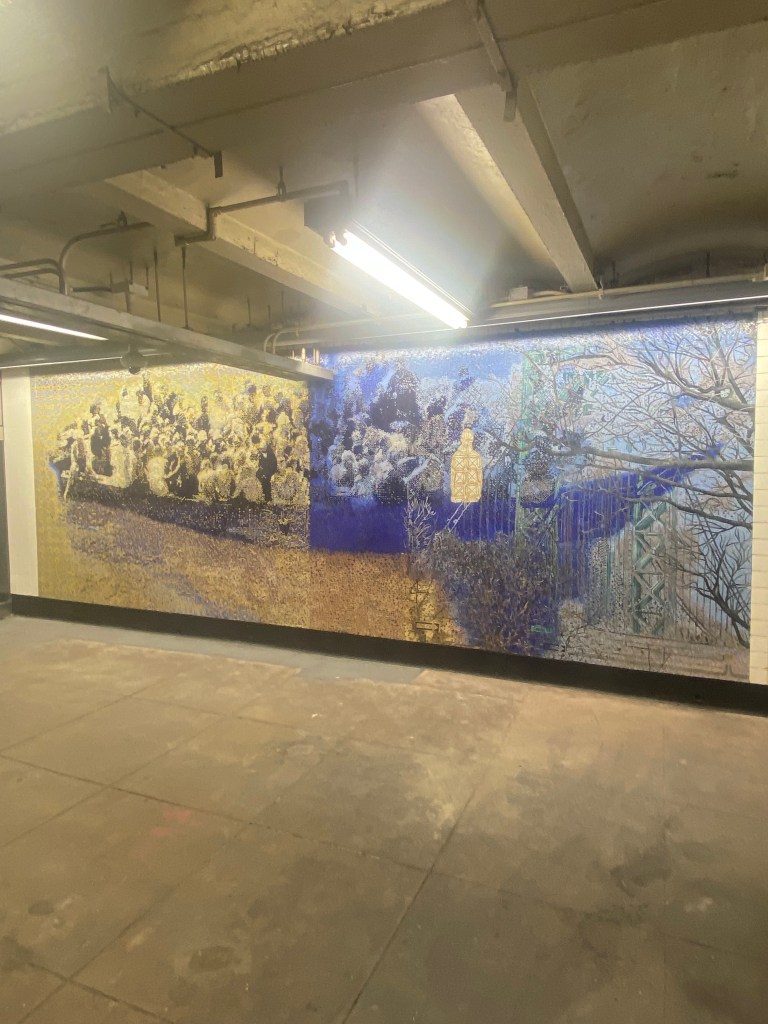
In addition to accessibility upgrades, a brand new fire alarm system and surveillance cameras were installed in both the elevators and the station for the safety of riders. Like in other new elevators in the system, the MTA has also implemented a new two-way communication system that allows riders to communicate with dispatchers in emergencies through on-screen questions in addition to traditional methods. This will make receiving emergency assistance easier for those those with speech and hearing disabilities. The project also included a new piece of artwork from Dominican born artist Carmen Lizardo, titled Great Waves of Immigration, designed to encourage riders to reflect on the importance of immigration to the fabric of the Washington Heights community.
While accessibility projects are always a challenge for the MTA given the complexities of building elevators in over 100-year old subway stations, this one posed a unique challenge as this station is on the National Register of Historic Places. While there is nothing on the National Park Service website dedicated to subway stations, the site does mention that state or local preservation laws that could impact one’s ability to renovate or modify a historic house. Therefore, similar laws likely apply in some capacity to subway stations and it likely made the MTA’s three S’s to building elevators, Space, Subsurface and Structure, even more complex. For context, space refers to the space where shafts can be built, subsurface refers to what is beneath, and structure refers to adding supporting structures to a station without compromising rider safety and convenience. These structures include things such as walkways and mechanical rooms that support the elevator’s operations and make it useful for riders. Hence, preservation laws that impacted what the MTA was allowed to modify and how they could do so likely led to increased challenges on top of the one’s already posed by the three S’s. The MTA has a more in-depth YouTube video that explains the three S’s that you can find here:https://www.youtube.com/watch?v=DveunMW9_bU.
In addition, to the elevators at the 181st St(A) station making travel more accessible, these elevators hold a special meaning for the Washington Heights community. In addition to the strong community advocacy behind the elevators, the station would have been the home station of disability advocate Edith Prentiss, who passed away in 2021. A leader both in the fight for disability equality both in and out of the subway system, she served as President for Disabled In Action of Metropolitan New York City and was the founder of the Advisory Committee for Transit Committtee(ACTA). The ACTA is a volunteer group that advises the MTA on issues related to accessibility. Outside of here work for disability justice, she was also a longtime member of Manhattan Community Board 12. This would have been her home station if it was accessible, and a plaque is dedicated to her at the 175th St(A) that she would use instead due to her asthma which left her wheelchair bound. This station being accessible is truly a continuation of her incredible legacy and the difference her work continues to make to this day.
The station is also a representation of the MTA’s renewed commitment and efforts to make stations more accessible, something Prentiss would have been proud of. This station is the eighth station accessibility project the MTA has completed this year as the agency is at a record pace for making stations accessible. MTA Chairman Janno Lieber said in a press conference at the station that the agency is now completing these types of projects at 3-4 times as fast as it ever has in MTA history. This jump in project completion times provides hope for a day when the subway is mostly or fully accessible to those with mobility disabilities.
The project at the 181st St(A) station is part of a Design-Build Contract that includes eight total stations, including other newly accessible stations such as Court Sq(G), 8 Av(N), and 7 Av(F, G). Design-build has definitely been a major part of why the MTA has been able to move so rapidly on making stations accessible. This is because design-build consolidates design and construction tasks to one team of one or more companies, versus multiple. The consolidation of major project tasks allows the MTA to better manage contractors along with any issues or delays that arise during a project. In 2022, design-build saved the MTA $244 million and shaved four months off of project durations. The MTA’s completed projects in 2023 continue to speak volume to the success of design-build, and how design-build can lead to better projects of all types in the future.
As the MTA continues to make subway stations accessible at an unprecedented speed, there is hope that one day, the vast majority if not all NYC subway stations would be fully accessible. Accessibility features including such as elevators, ramps and other forms of infrastructure, can go a long way to ensuring that everyone can take advantage of the fastest travel mode for getting around the city. The completion of accessibility upgrades at each station represent important steps toward a vision of having an equitable transit system for all New Yorkers regardless of disabilities.
Works Cited
“FAQs – National Register of Historic Places (U.S.” National Park Service, 19 May 2023, https://www.nps.gov/subjects/nationalregister/faqs.htm. Accessed 9 December 2023.
Green, Penelope. “Edith Prentiss, Fierce Voice for Disabled New Yorkers, Dies at 69 (Published 2021).” The New York Times, 3 April 2021, https://www.nytimes.com/2021/03/28/nyregion/edith-prentiss-dead.html. Accessed 9 December 2023.
Metropolitan Transportation Authority. “Bronx Bus Network Redesign-Existing Conditions Report.” MTA, February 2019, https://new.mta.info/sites/default/files/2019-03/77_19_BBNRExisting_Working%20File_Final_Low%20Rez.pdf. Accessed 9 December 2023.
Metropolitan Transportation Authority. “MTA Announces 181 St A Station in Washington Heights Now Fully Accessible.” MTA, 7 December 2023, https://new.mta.info/press-release/mta-announces-181-st-station-washington-heights-now-fully-accessible. Accessed 9 December 2023.
Metropolitan Transportation Authority, and MTA Live. “MTA Joint Committee Meeting-1/30/2023.” YouTube, 30 January 2023, https://www.youtube.com/watch?v=nK0EBkwC1_o&t=8005s. Accessed 9 December 2023.
mtainfo. “What does it take to install an elevator in a subway station?” YouTube, 21 October 2019, https://www.youtube.com/watch?v=DveunMW9_bU. Accessed 9 December 2023.
New York City Department of City Planning. “Car Ownership in NYC.” Tableau, 24 November 2022, https://public.tableau.com/app/profile/dcptransportation/viz/ACSProfiles/Dashboard1. Accessed 9 December 2023.
Saltonstall, Gus. “Edith Prentiss, Wash Heights Disability Advocate, Dead At 69.” Patch, 17 March 2021, https://patch.com/new-york/washington-heights-inwood/edith-prentiss-wash-heights-disability-advocate-dead-69. Accessed 9 December 2023.
 Transit Central