By Joseph Morales
New York City’s public buses are a core part of its public transportation network. While the city is known for its subways, its bus network still serves over a million riders daily among its 327 bus routes. The city’s buses are also particularly helpful in helping people get to areas where the subway just does not go.
Whether people are riding the bus to the subway, to work or school, or traveling a long distance across their borough, everyone undoubtedly wants a fast and reliable trip to their destination. In many instances, however, it is hard for the MTA to provide for the simple fact that buses have to share road space with vehicles and, thus, they routinely run in congested traffic. A report from the state comptroller’s office in March 2023 showed that MTA buses in the five boroughs rarely averaged speeds above 9 mph. In comparison, an average man runs 8 mph. On many of the MTA’s slowest routes, speeds do not average much more than 3 mph, which is the average speed of a human walk. This issue is made worse by the fact that buses tend to make a good number of stops, and thus, they must merge back into traffic every time they do, slowing travel times.
To most, it may be hard to think of what more the MTA can do to improve speeds. Bus lanes tend to help, but motorists and business owners generally disapprove due to what usually results in a loss of driving and/or parking space. Busways, which generally prohibit most motorists from entering a street such as 14th Street in Manhattan, usually are even more vehemently opposed for these reasons.
Hence, one significant improvement the MTA/NYCDOT(New York City Department of Transportation) has worked on is Transit-Signal Priority(TSP), which mainly provides buses priority at intersections by either holding a green light longer or shortening the amount of time a bus will spend at a red light. This form of TSP is found at about 1,382 intersections across the city and can speed up buses on average by 18 percent, according to the latest NYCDOT statistics.
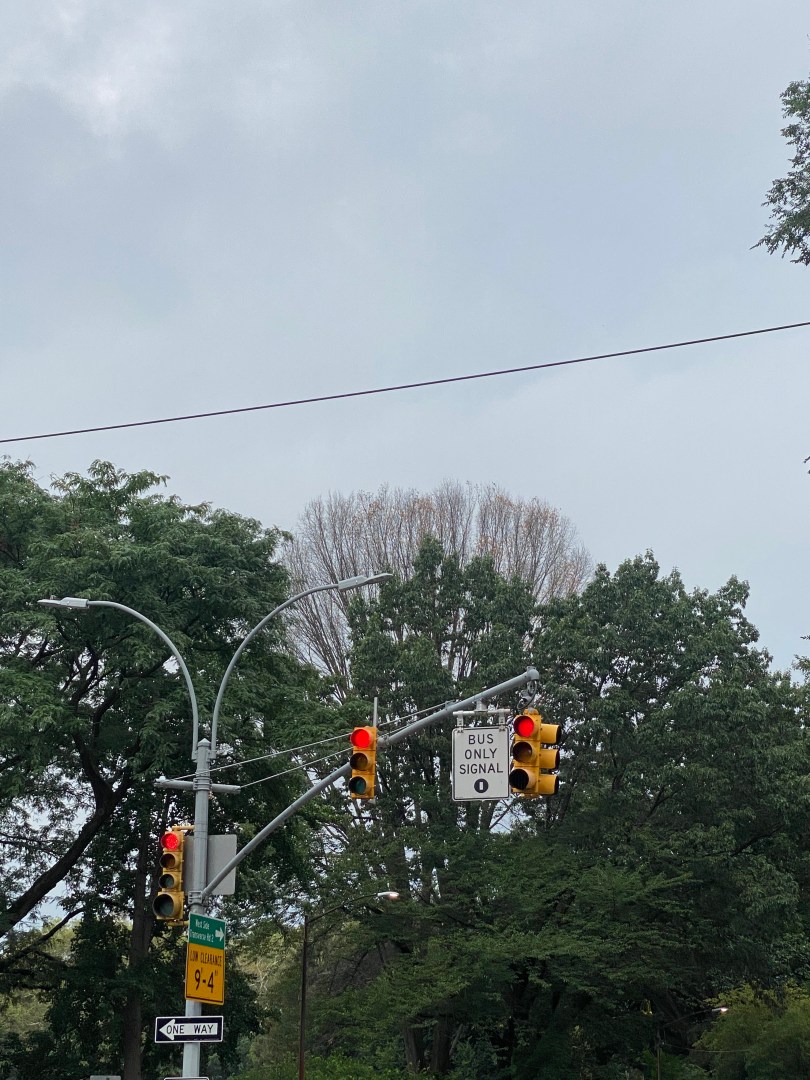
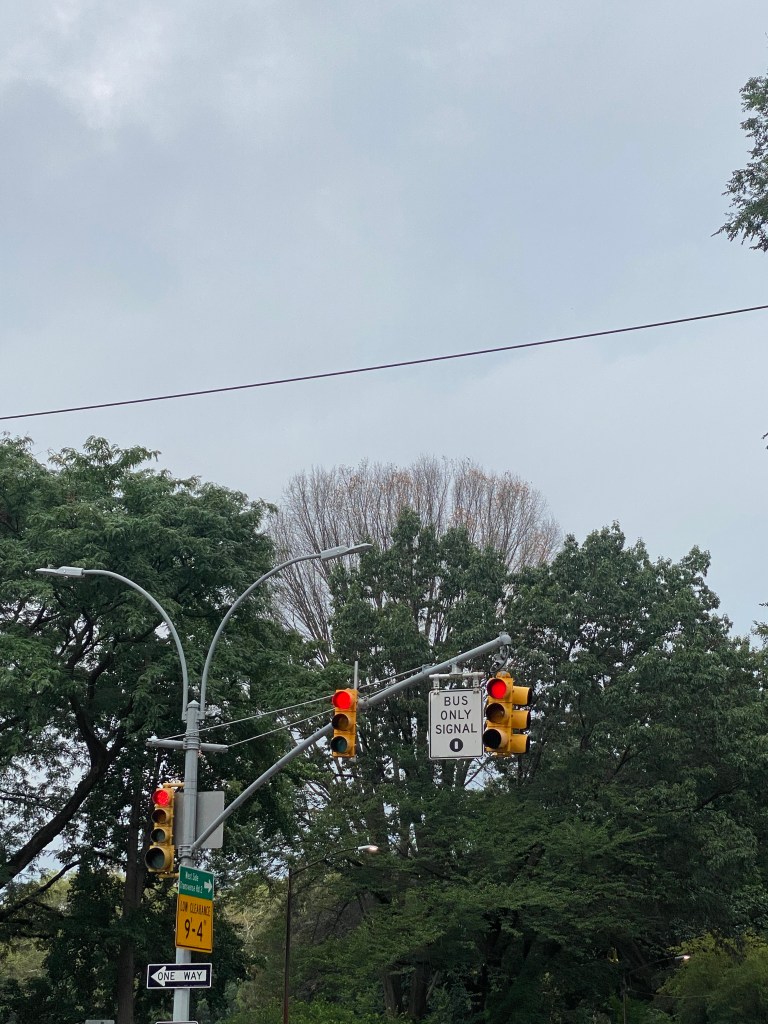
However, one form of TSP that is more visible to bus riders but is not as common throughout the city is bus-only traffic signals. These signals allow buses to pass through an intersection just a few seconds before cars in so that they can move without being congested with the other vehicles. These signals are generally located on the right side of the street, are marked as bus-only signals, and flash white strips for buses to go rather than green lights. This is so that motorists do not confuse a bus-only signal with a signal for them to proceed through the intersection. As these signals are designed for buses to bypass traffic after making a stop, there are usually no bus-only signals for buses in both directions at a single intersection.
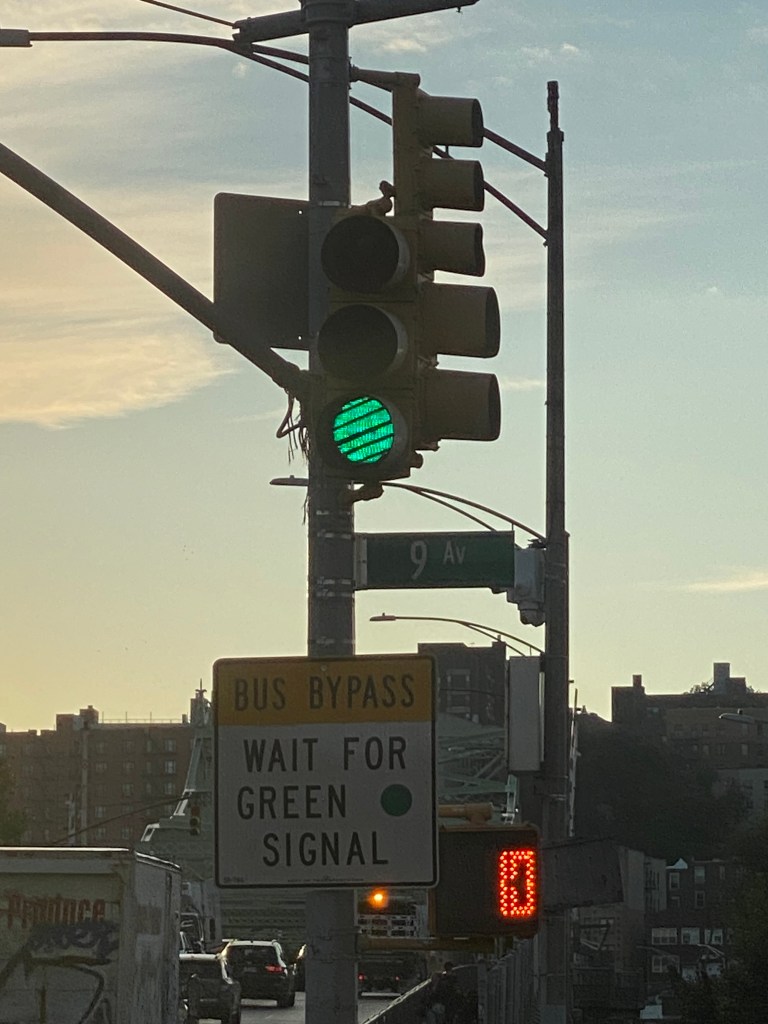
These signals are present at two locations in Manhattan at E 79th St and 5 Av on the M79-SBS and W 207th St and 9th Av on the Bx12-SBS. At both of these intersections, buses enter both the 79th St Transverse and the University Heights Bridge, respectively; both locations are known for traffic congestion. A bus-only signal can also be found in Astoria, Queens, at the intersection of Hoyt Ave N and 29th St just before M60-SBS buses enter the RFK Bridge(Triboro Bridge).
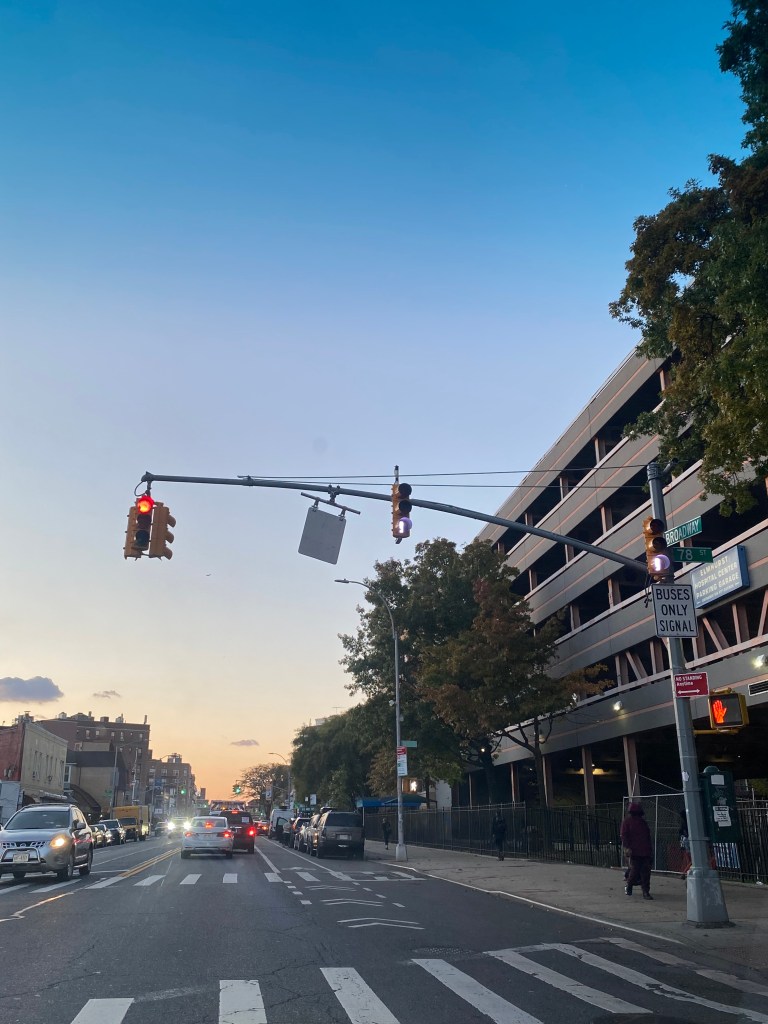
These types of signals also exist in Queens along Broadway between 78th St and Whitney Ave in the busy Jackson Heights and Elmhurst neighborhoods. Here, the signals are located at traditional intersections but with bus lanes so that buses can jump the traffic queue after stopping.
There is limited data as to how successful these signals are or can be. However, for the Bx12-SBS on the University Heights Br between Manhattan and The Bronx, bus speeds tend to be less than 2 mph in the Manhattan-bound direction where there is no bus-only signal, but 6-8 mph in the Bronx-bound direction where the bus does get a head start thanks to the bus-only signal at W 207th St/9th Av. While 6-8 mph, may not seem fast, this speed improvement saves Bronx-bound riders a decent amount of time compared to if the signal did not exist considering the bridge is known to be congested at nearly all times of the day. One thing to note in recent months, however, is that this signal may have become less helpful due to construction on W 207th St that is blocking the bus lane.
So if they can help increase bus speeds without making a significant adverse impact on cars and pedestrians, why do they not exist more? After all, the NYCDOT has made a full-speed effort since 2020 to install traditional TSP in more places. In October 2020, TSP in NYC reached a breakthrough when traffic engineers at the NYCDOT started using the MTA’s live “bus time” feed and were able to use computer simulations to determine how different signal timing cycles would affect traffic flow. Before they began using this feed, the engineers had to use multiple computer simulations in ways that could take days to get a result should they make a slight adjustment to a simulation to determine its potential effect on traffic.
The one plus side of traditional TSP over a bus-only signal is that traditional TSP can help to move traffic flow in its entirety while bus-only signals help to move buses only. While this ideology may seem odd if the purpose of TSP is to improve bus speeds, in many moving traffic in its entirety faster will also speed up buses more than a bus-only signal will. While a bus-only signal in these situations can help speed up a bus marginally, if the corridor as a whole is congested, eventually, that bus will slow down. Hence, this may be why you generally only see bus-only signals before a bus is set to enter a particularly congested area rather than when the bus is already in one.
Another reason why bus-only signals might be rare is that they require buses to be near the front of the traffic queue to be effective. At the locations of almost all bus-only signals in NYC, bus lanes tend to lead up to the signal along with a bus stop in which the bus picks up and drops off passengers before proceeding through the intersection. Since this is not always the case and most bus lanes permit right turns, it may be hard for these types of signals to be helpful to buses in most instances. Locations that might be able to benefit from bus-only signals if they had a bus lane leading buses to the curb are the include Allerton Av/Bronx Park E on Allerton Ave west and at W Fordham Rd/Cedar Ave in The Bronx near the University Heights Br in the Manhattan-bound direction.
As NYC buses are among the slowest in the nation, the NYCDOT and the MTA have experimented with a plethora of innoavtive solutions such as offset and curbside bus lanes, busways, TSP and bus-only traffic signals in order to speed up bsues and get riders to where they are going faster and more reliably. Hopefully as bus-only traffic signals have made a difference in numerous locations around the city, more innovative solutions can come around that improve bus service for everyone who depends on it.
*To make a request for a bus-only or any other traffic signal in your community, click here:https://portal.311.nyc.gov/article/?kanumber=KA-01404#:~:text=You%20can%20submit%20a%20request,within%2016%20weeks%20of%20receipt.
*The NYCDOT responds to traffic signal requests within 16 weeks.
Works Cited
Metropolitan Transportation Authority. “Subway and bus ridership for 2021 – New York City Transit.” MTA, 2022, https://new.mta.info/agency/new-york-city-transit/subway-bus-ridership-2021. Accessed 8 October 2023.
Siff, Andrew. “Average Speed of NYC Buses Rarely Tops 9 MPH, Report on MTA Finds.” NBC New York, 24 March 2023, https://www.nbcnewyork.com/news/local/nyc-average-bus-speeds-rarely-top-9-mph-heres-how-the-mta-plans-to-improve-that/4180396/. Accessed 8 October 2023.
Debra Rose Wilson, Ph.D., MSN, R.N., IBCLC, AHN-BC, CHT, Debra Rose, and Jenna Fletcher. “Average walking speed: Comparisons by age, sex, and walking for health.” Medical News Today, 16 November 2022, https://www.medicalnewstoday.com/articles/average-walking-speed. Accessed 8 October 2023.
Metropolitan Transportation Authority. “MTA Metrics-Bus Speeds.” MTA, https://metrics.mta.info/?bus/speeds. Accessed 8 October 2023.
Kuntzman, Gersh, and Kevin Duggan. “EXCLUSIVE: Despite COVID, DOT Really Stepped Up Transit Signal Priority This Year – Streetsblog New York City.” Streetsblog NYC, 9 October 2020, https://nyc.streetsblog.org/2020/10/09/exclusive-despite-covid-dot-stepped-up-transit-signal-priority-this-year. Accessed 8 October 2023.
New York City Department of Transportation, and Metropolitan Transportation Authority. “Fordham Road – Inwood Bus Priority – Community Board 6 – June 2023.” NYC.gov, 6 June 2023, https://www.nyc.gov/html/dot/downloads/pdf/fordham-rd-inwood-cb6-jun2023.pdf. Accessed 8 October 2023.
“Traffic or Pedestrian Signal Request · NYC311.” NYC 311, 2023, https://portal.311.nyc.gov/article/?kanumber=KA-01404. Accessed 8 October 2023.
 Transit Central