
By Joseph Morales
The Court Square subway station complex in Long Island City, Queens, is one of the busiest station complexes in the NYC Subway system located outside of Manhattan. With its location in one of Queens’ most densely populated neighborhoods and just minutes from Manhattan, many people from across New York City and the region travel to Court Square for work, school, recreation, and many other purposes. The activity density in Long Island City is so great that many even consider it one of New York City’s satellite downtowns, along with Downtown Brooklyn. In addition to being a popular neighborhood now, Long Island City is also considered to be one of Queens’ fastest-growing neighborhoods, with the number of residential developments surging and office jobs in the area increasing at about double the citywide average in the last ten years despite the disruption caused by the pandemic. Hence, even more commuters will likely use the Court Square complex in the future. In addition, its connectivity to five subway lines makes it a popular transfer hub with connections to many other densely populated sections of Queens, Manhattan, and Brooklyn.
Unfortunately, not all of the subway lines in Court Square have been accessible to those with mobility disabilities since the complex was built in 2011 for $47.6 million. Initially, the stations for the G, 7, and E/M trains at Court Sq were separate, forcing riders to exit the subway system and transfer subway lines via a MetroCard transfer. This not only made connections between lines much less convenient, but the need to transfer at another turnstile meant that riders who needed to use a bus to complete their trip or planned to use their transfer to reenter the subway after leaving for a short activity had to pay another fare. However, when the MTA completed the much-needed complex, only the Flushing Line(7 train) station was made fully accessible despite the Americans With Disabilities Act(ADA) of 1990 requiring that if a station is significantly renovated, it must be made fully accessible to those with mobility disabilities unless it cannot be done due to technical constraints. The E and M trains were made accessible with elevators in the Manhattan-bound direction only ten years later, in 2021. As for the G Train, it was made accessible 12 years later in July 2023 with a new elevator opening, making the G Train accessible to Queens residents with mobility disabilities for the very first time. By the end of this year, the MTA will award a contract to “a future developer” to construct elevators for the eastbound E and M train platform, which will finally make the complex fully accessible.
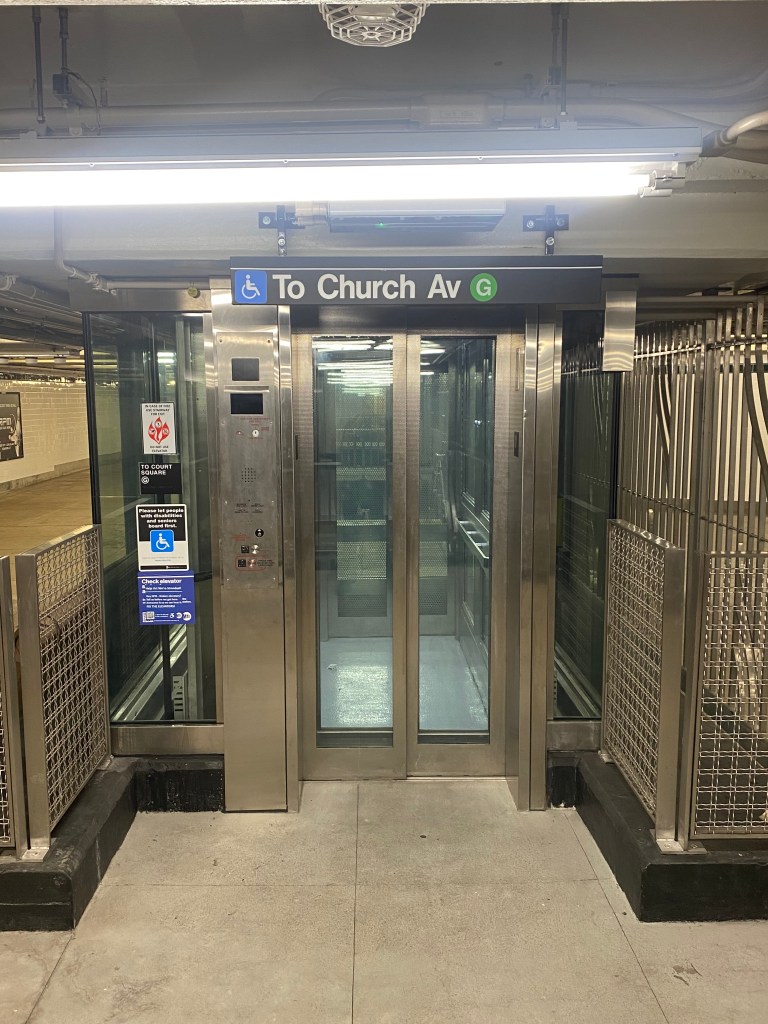

With the construction of the complex, one may wonder why the MTA did not make more of the station ADA-accessible sooner. While no one outside the authority can likely provide a definitive reason for the long wait, there are a few potential reasons why this has been the case.
For one, installing elevators in existing subway stations is a highly complex endeavor. It is important to note that, as stated earlier, the new complex was created to connect three subway stations that had existed since 1916 and had only opened as recently as 1939. These subway stations were not constructed with accessibility in mind, and thus, they may not be conducive to having elevators. Harry Schober, Chief Mechanical Engineer for Capital Program Management for the MTA, explained in a 2019 MTAinfo YouTube video that there are three main challenges to building elevators in subway stations: space, subsurface, and structure.
As for space, Schober explained that space must be found at the street level for an elevator as well as in the mezzanine and platform of the station. He also stated that this can be hard to come by in part because many stations are built directly against or on top of buildings. For a station like Court Square, space may have been plentiful for the latter between the mezzanines and platforms. However, the agency likely faces challenges at the street level, given the number of buildings around the station, including One Court Square, also known as the Altice Building(formerly Citigroup Building), being directly connected to the station. While it is unknown if any of these scenarios fit the Court Square station, it is clear that Long Island City’s spatial conditions likely impacted the MTA’s ability to have elevators constructed at the Court Square complex. Hence, it would make sense that elevators for the 7 train were completed first as those lead from the street level directly to an elevated mezzanine, bypassing concerns over space to dig underground.
Another challenge that was bypassed during the construction of the 7 train elevators was that of subsurface, or what’s located underground that could obstruct the construction of elevators. As New York has a plethora of underground infrastructure, including some that is unmapped, the construction of an elevator requires intensive planning by engineers. This issue is likely even more prevalent in bustling Long Island City as the neighborhood’s growth has led to even more underground infrastructure necessary to sustain that growth in recent years. In addition to the elevators themselves, the MTA would also have to build supporting structures for the elevators, such as mechanical rooms, which can further add complexity to the project as a whole. To top it all off, most construction of any kind would almost certainly have to take place while the station is operating, which may make work more difficult given how busy the Court Square complex can be.
Outside of the challenges posed by the construction of the elevators and supporting structures, projects to install elevators to different subway lines at the complex may have been made more difficult by simply how hard it is to manage transit projects in a major city like New York. Often, the MTA has to hire outside contractors to perform work and must be able to effectively oversee them all for a project to be completed successfully, on time, and on budget. However, with the sheer number of projects the MTA has had coupled with the limited budget that the agency has had over the years, this might have proved to be a significant challenge. Hence, the MTA has recently implemented multiple new approaches to doling out contracts rather than the traditional design-bid-build method. The main two methods, design-build, and A + B(cost-plus-time) contracts, have saved the agency on average about $244 million and $101 million in 2022, respectively, despite inflation. They have also saved the agency 4 and 5 months on project durations compared to MTA estimates.
Multiple MTA executives, including President of MTA Construction & Development President Jamie-Torres Springer, have credited one method, design-build, for significantly improving the capital project process, as it tasks one company for both the design and construction of a project rather than several companies, making it easier for the agency to hold contractors accountable when work is delayed and work out solutions to address unexpected complications with projects as there are less points of contact that need to be made. Design-build has immensely helped the MTA save time and money on recent ADA projects, including when an elevator shaft had to be shifted at the nearby Queensboro Plaza station and when an entire new mezzanine had to be constructed at the 149th St-Grand Concourse station in The Bronx.
The MTA has also implemented more A+B contracts in recent years. A + B contracts, also known as cost-plus time bidding contracts, are a unique form of design-bid-build contracts that incentivize the on-time completion where the A represents the traditional bid and the B is an estimate of the total amount of calendar days in which the project is expected to take. These contracts sometimes include financial incentives and disincentives for early/on-time completion of a project and delayed completion, respectively.
While the MTA has not expressed which if any of these contracts were or will be used to build elevators at Court Square, it would not be surprising if they were used given that the MTA now emphasizes design-build candidates and Court Sq is one of the busier stations in the system, which might make projects here good A + B candidates.
Regardless of which contracts are used, making subway stations fully accessible is an incredibly complex and yet critical endeavor to ensure that all New Yorkers can have an equitable opportunity to access all of what the City and its core business districts have to offer. Hopefully, the MTA and other regional transit agencies can continue to work to make their systems more accessible for all who need it.
Works Cited
Dorgan, Michael. “Long Island City continues to flourish, but office space vacancies are concerning, according to experts at LIC Partnership Annual Breakfast.” LIC Post, 21 April 2023, https://licpost.com/long-island-city-continues-to-flourish-but-office-space-vacancies-are-concerning-according-to-experts-at-lic-partnership-annual-breakfast. Accessed 28 August 2023.
Farrell Fritz Attorneys. “MTA Required To Provide Disability Access In Subway Station Renovation Unless Technically Infeasible.” Farrell Fritz, 3 May 2019, https://www.farrellfritz.com/rss-post/mta-required-to-provide-disability-access-in-subway-station-renovation-unless-technically-infeasible/. Accessed 29 August 2023.
Metropolitan Transportation Authority. “Manhattan-Bound E/M at Court Sq-23 St Station Now ADA-Accessible.” MTA, 2 March 2021, https://new.mta.info/press-release/manhattan-bound-em-court-sq-23-st-station-now-ada-accessible. Accessed 29 August 2023.
Signore, John Del, et al. “New LIC Court Square Subway Station Connects 7 To G, E, M Trains.” Gothamist, 3 June 2011, https://gothamist.com/news/new-lic-court-square-subway-station-connects-7-to-g-e-m-trains. Accessed 28 August 2023.
Kaufman, Maya. “New Accessible Entrance Opens At Court Square Subway Station.” Patch, 2 March 2021, https://patch.com/new-york/astoria-long-island-city/new-accessible-entrance-opens-court-square-subway-station. Accessed 28 August 2023.
Metropolitan Transportation Authority. “MTA Announces Court Square G Station in Queens Fully Accessible With Opening of Elevator.” MTA, 17 July 2023, https://new.mta.info/press-release/mta-announces-court-square-g-station-queens-fully-accessible-opening-of-elevator. Accessed 28 August 2023.
“Court Square (7) – The SubwayNut.” Subway Nut, May 2013, https://www.subwaynut.com/flushing_line/court_square/index.php. Accessed 27 August 2023.
Metropolitan Transportation Authority. “What does it take to install an elevator in a subway station?” YouTube, 21 October 2019, https://www.youtube.com/watch?v=DveunMW9_bU. Accessed 28 August 2023.
Metropolitan Transportation Authority. “C&D Contracting – Construction & Development.” MTA, https://new.mta.info/agency/construction-and-development/contracting. Accessed 28 August 2023.
MTA Live. “MTA Joint Committee Meeting 1/30/2023.” Youtube, 30 January 2023, https://www.youtube.com/watch?v=nK0EBkwC1_o&t=2777s. Accessed 28 August 2023.
Washington State Department of Transportation. “A+B bidding | WSDOT.” WSDOT, https://wsdot.wa.gov/business-wsdot/how-do-business-us/project-delivery-methods/ab-bidding. Accessed 28 August 2023.
 Transit Central