By Joseph Morales
The NYC Subway is the lifeblood of New York City, getting millions of New Yorkers to their destinations across the city on a daily basis. According to MTA statistics, 5.5 million people rode the subway from one of the city’s 472 subway stations in 2019. Even after the COVID-19 pandemic led many to work from home and many office workers still work hybrid schedules, ridership numbers are still consistently in the millions, and the highest recorded ridership on a given day since the start of the pandemic is a record of 4.09 million set on May 17th, 2023. While many American cities have some sort of rail-based transit system, New York’s is especially critical to its residents, as only 46% of NYC households own cars compared to 91.7% of households in the U.S. according to NYC Department of City Planning/Forbes data, respectively. Hence, being able to utilize the subway system allows New Yorkers to travel distances across the city by rail, which would not be as easily traversable by transit in other parts of the country with bus and rail systems that are more limited in scope and coverage.
Unfortunately for the 550,000 New Yorkers who have difficulty walking, according to the New York Times, they are not afforded the same opportunities which the subway provides other New Yorkers. This tally likely does not include the elderly or parents who consistently have to take their children on the subway with strollers. As approximately only 25% of stations are ADA-accessible, many New Yorkers are forced to either rely on slow buses or the Access-A-Ride paratransit system. While being able to utilize a door-to-door transit service sounds convenient, the system is known for being notoriously unreliable and is known for issues such as a 30-minute pickup window, requirements to book trips multiple days in advance, and circuitous routes when an AAR vehicle picks up multiple passengers. It has even gotten to the point where many of its riders call it “Stress-A-Ride.” As AAR requires individuals to have physical mobility disabilities in order to ride, those who transport young children in strollers do not qualify for this service based on that alone.
As for subway station access, while about a quarter of stations are accessible, there are several stations in which only one subway line or even a subway in only one direction is accessible. This makes these types of stations close to impossible for those with mobility disabilities to rely on, as they can access the subway to travel from a station but not to get back or vice versa.
Thus, the MTA just resolved these issues at both the Dyckman St(1) station in the Inwood section of Manhattan and the 8 Av(N) station in the Sunset Park section of Brooklyn by adding new elevators in the northbound and southbound directions, respectively. Until just a few weeks ago, trains were only accessible Downtown toward South Ferry and Manhattan and Queens-bound to Astoria-Ditmars Blvd, respectively, making it practically impossible for those with mobility disabilities to rely on these stations. Full accessibility is especially critical at these stations as only 24 and 39 percent of households have a car in the community districts in which the stations are located, meaning more residents in these communities use mass transit to travel than in other areas.
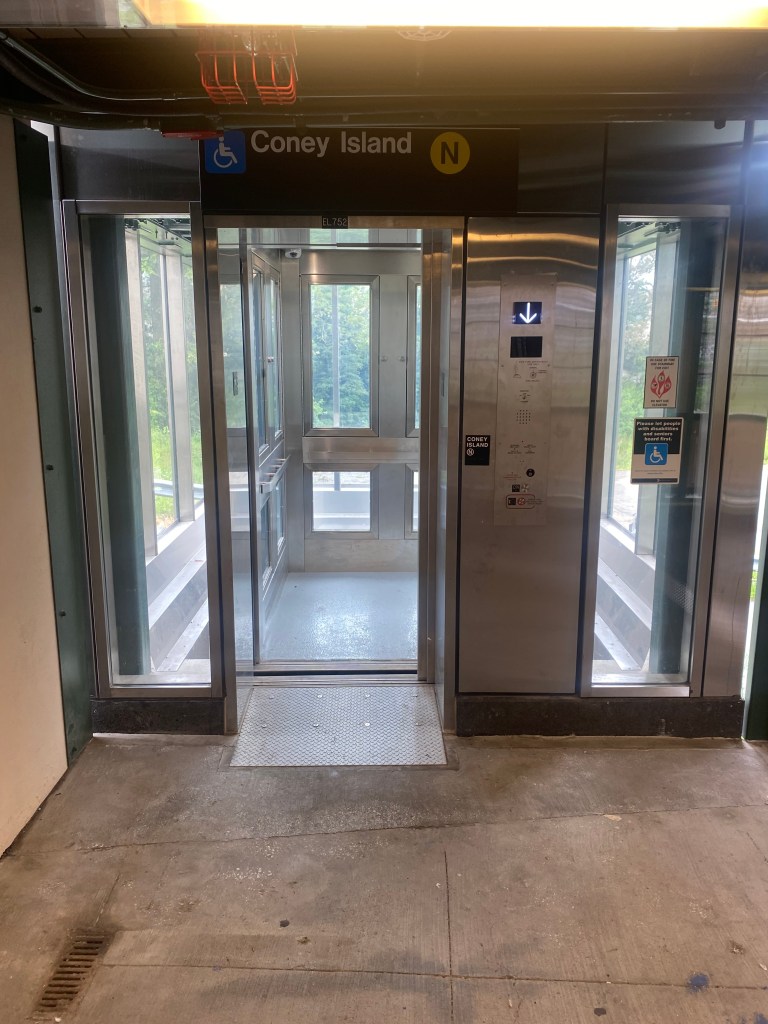
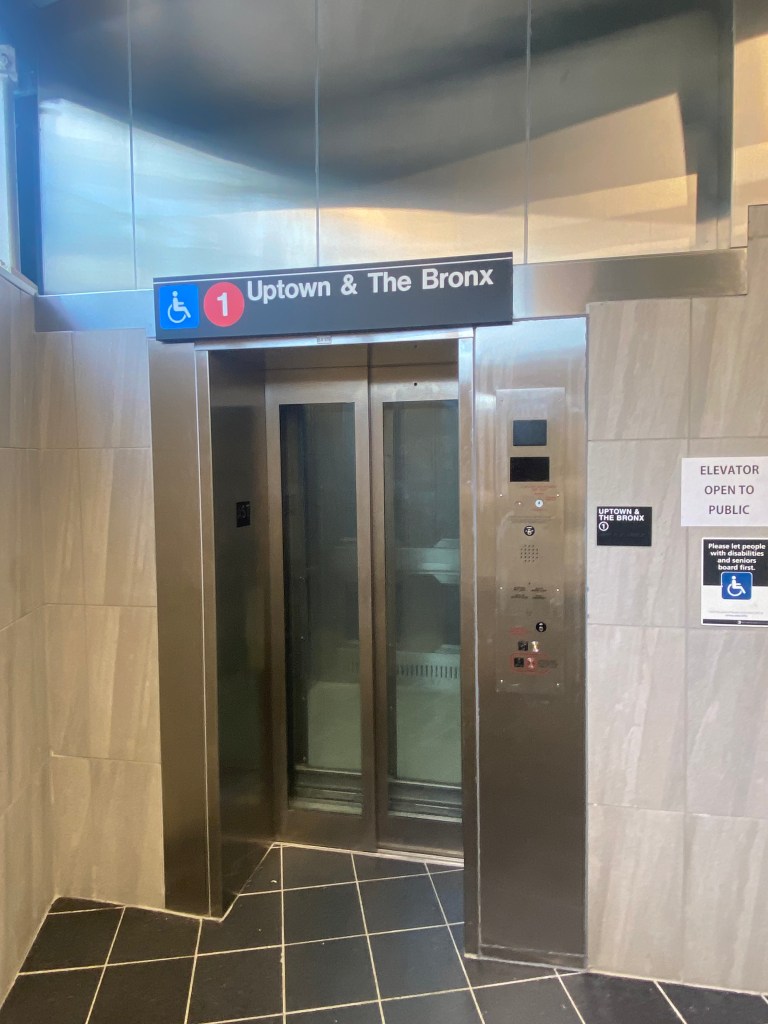

Both of these stations are also critical because they connect to their respective community’s primary commercial strips in Dyckman St and 7th/8th Aves, respectively. In the case of the 8 Av(N) station in Sunset Park, the train here connects riders to the B70 bus, which connects to other areas of Sunset Park along with Bay Ridge and Dyker Heights. Most parts of these areas that are served by the route are far from any form of subway service, let alone accessible stations. As for Dyckman St, the subway here connects to the M100 bus and could be used by 1 train riders to connect with areas of Inwood, Manhattan that are further north along 10th Avenue as the 207th St and 215th St stations are not accessible.
Construction on the Dyckman St elevator has been a long time coming as the MTA was sued by James Weisman of the United Spinal Association in October 2010 as the MTA had planned to proceed with a $24 million renovation of the station but would not make it ADA-accessible. For Weisman, he has spent over 30 years fighting for public transit to be accessible to those with mobility disabilities. In 1984 and 1988, Weisman won lawsuits in both NYC and Philadelphia, respectively, to make public transit accessible to those with disabilities before the ADA was passed in 1990. The transportation provisions of the ADA, which is the main law mandating transit accessibility in the United States, were based on the results of these two lawsuits.
According to Weisman’s lawsuit, the MTA completing the renovation and not making the station accessible would have been against a federal requirement that 20% of the MTA’s renovation budget for the project had to go toward improving accessibility for those with disabilities. The MTA had rebuked the lawsuit at the time, saying that the elevators would have costed $12 million, which would not have mandated them to install the elevators as that would have been 50% of the $24 million renovation budget. They also said at the time that they did not plan to make the station accessible because it was not considered one of its 100 key stations for accessibility upgrades since it is not a terminal point, a transfer point between other subway or bus routes, or near a major activity center.(The M100 did not traverse Dyckman St at the time of the lawsuit.)
Nonetheless, the MTA eventually decided to install an elevator on the southbound side of the station to make it accessible as it completed both the elevator and the renovation in February 2014. However, they still said that an elevator on the northbound side would not be feasible due to the station’s landmark status despite other subway stations of old age throughout the subway system having elevators and being fully accessible. However, as stated earlier, an elevator on the northbound side did wind up being constructed and was opened in July 2023.


While it was an uphill battle to get the Dyckman St station constructed, there is less readily accessible information available on the 8 Av project as it is not included on the MTA’s capital program dashboard as of August 8th, 2023. However, it is safe to say that there is a lot more work being done at the MTA to make stations accessible than there ever has been in history or even as recently as elevators begun to be built at Dyckman St. Since the start of the COVID-19 pandemic, the MTA has successfully managed to make 17 stations ADA-accessible despite pandemic-related budget woes. In addition, the agency has also invested an unprecedented $5.2 billion to make 70 total subway stations newly accessible over the course of the agency’s current 2020-24 Capital Program. Though many are still vying for the agency to move faster and the road to making the subway more accessible will be a long one, efforts like these bring hope that one day, NYC’s subway system can be fully accessible to people of all ages and abilities.
Works Cited
Metropolitan Transportation Authority. “MTA subway and bus ridership for 2019 – New York City Transit.” MTA, 14 April 2020, https://new.mta.info/agency/new-york-city-transit/subway-bus-ridership-2019. Accessed 8 August 2023.
Metropolitan Transportation Authority. “MTA Announces New York City Subway Set Single-Day Ridership Record.” MTA, 18 May 2023, https://new.mta.info/press-release/mta-announces-new-york-city-subway-set-single-day-ridership-record. Accessed 8 August 2023.
New York City Department of City Planning-Transportation. “Car Ownership in NYC.” Tableau, 24 November 2022, https://public.tableau.com/app/profile/dcptransportation/viz/ACSProfiles/Dashboard1. Accessed 8 August 2023.
Tilford, Ashlee. “How Many Vehicles Are There In The U.S.?” Forbes, 8 May 2023, https://www.forbes.com/advisor/car-insurance/car-ownership-statistics/. Accessed 10 August 2023.
Patel, Jugal K. “Where the Subway Limits New Yorkers With Disabilities (Published 2019).” The New York Times, 11 February 2019, https://www.nytimes.com/interactive/2019/02/11/nyregion/nyc-subway-access.html. Accessed 8 August 2023.
Metropolitan Transportation Authority. “Welcome to Access-A-Ride Paratransit Service.” MTA, https://new.mta.info/accessibility/access-a-ride. Accessed 8 August 2023.
Perlman, Claire, and David Brand. “Stress-A-Ride”: NYC Unreliable Paratransit Services Cost $614 Million.” Gothamist, 6 February 2020, https://gothamist.com/news/stress-ride-nyc-unreliable-paratransit-services-cost-614-million. Accessed 9 August 2023.
Zanoni, Carla. “Disability Advocate Sues MTA for Failing to Put Elevators at Dyckman St Station.” Dnainfo, 14 October 2010, https://www.dnainfo.com/new-york/20101013/washington-heights-inwood/disability-advocate-sues-mta-for-failure-put-elevators-at-dyckman-st-station/. Accessed 9 August 2023.
Zanoni, Carla. “$45 Million Dyckman Street Subway Stop Repair Won’t Bring Disability Access.” Dnainfo, 12 July 2010, https://www.dnainfo.com/20100712/washington-heights-inwood/45-million-renovation-of-dyckman-street-station-wont-be-accessible-disabled/. Accessed 10 August 2023.
“James (Jim) Weisman.” NYSILC, https://nysilc.org/inductees/31-2020-21/215-james-jim-weisman. Accessed 9 August 2023.
Metropolitan Transportation Authority. “MTA Station Accessibility Projects.” MTA, 3 August 2023, https://new.mta.info/project/station-accessibility-upgrades. Accessed 9 August 2023.
 Transit Central