By Joseph Morales
The Culver Line is a busy subway line that runs between Downtown Brooklyn and Coney Island. The F Train runs on the entirety of the line, and the G train runs on much of the northern section of the line, providing Culver Line riders with strong connections to various sections of Brooklyn, Manhattan, and Queens, as well as a plethora of other subway and bus lines that traverse the city. In addition, the line connects many of Brooklyn’s most historic, densely populated, and most highly visited neighborhoods together, such as Park Slope, Williamsburg, Bedford-Stuyvesant, Downtown Brooklyn, Flatbush, and Coney Island. Additionally, many households along the line lack access to a car, with car ownership rates in the communities surrounding the line being between 33 and 51 percent, according to data from the NYC Department of City Planning. Thus, the line is essential to many area residents being able to get around on a regular basis reliably.
Unfortunately for riders, a significant section of the line between Church Ave and Coney Island-Stillwell Av was considered by the MTA to have below-average reliability as this stretch had an on-time performance rate of 67% between June and December 2019, according to agency statistics, which was lower than the subway system average of above 81% at the time. As the F and G train both, rely on the line to travel significant distances to other boroughs, delays here might affect not only Culver Line riders but also riders along the entirety of both routes, many of which might not even enter Brooklyn on their trips.
Hence, the MTA is planning to install CBTC(Communications-Based Train Control) to replace existing signal systems on the line, which are among the line’s leading causes of delays. The 70-year-old system currently in use on the line utilizes what is known as fixed-block signaling. This system relies on a block system in which tracks are separated into open, occupied, and buffer blocks, with trains being prohibited from entering occupied or buffer blocks. As the MTA does not know the exact location or speed of the trains under this system, it is harder for them to increase train speeds or frequency of service when ridership on subway lines justifies it. In addition, the infrastructure used to maintain fixed-block signaling is exceptionally complex, and many things can go wrong. Thus, signal-related delays and maintenance-related service changes that all straphangers dread often occur with little to no warning.
On the other hand, CBTC will address all these issues by allowing for the use of a moving-block system, which will allow the MTA to run trains faster, closer together, and hence more frequently as they will know the exact speed and location of trains. In addition, there will likely be substantially fewer signal-related delays as the infrastructure for CBTC is much simpler in nature, and thus, fewer issues are likely to arise. This system has already been highly successful on both the Flushing Line(7 train) and the Canarsie Line(L Train), with on-time performance on the Flushing Line rising from 68.1% in 2018 to 90.5% in 2019, with CBTC having been installed for most of that year, according to MTA figures. As for the Canarsie Line, CBTC has been on the line since, and the monthly performance for the line in 2019 was 92.1%.
To complete the project along the Culver Line, the MTA has already begun to construct much of the vital infrastructure needed for CBTC, and they are also well into the project. The agency has already installed steel and concrete floors at the Ditmas Av facility and completed piling and grade beam installation at the Avenue X facility. Steel has also been installed, and concrete has been poured on both levels of the Bay Pkwy Communication Interface Room. In addition, the new relay room has already been constructed in which the new CBTC equipment will be kept, and the signal cables that will be used have been installed and are in the process of being connected to the necessary equipment for CBTC or in shorter terms, being terminated. Another important note is that 80% of the wayside infrastructure CBTC has also been installed.
Outside of physical infrastructure that needed to be built or installed, one critical piece of infrastructure needed for CBTC that the Culver Line had been utilizing before CBTC plans were announced for the line is the use of subway cars that are already enabled for CBTC as the F train currently utilizes CBTC when it enters the Queens Boulevard line in Queens. In addition, R160 subway cars that can be used for CBTC were also moved to the G train from other subway routes in October 2021. Hence, the MTA likely will not have to retrofit brand-new subway cars like it did to launch CBTC on the Flushing line in 2019.
As for what is left, the MTA is continuing to install signals and construct interlockings throughout the line. An interlocking is when multiple tracks intersect, and when they break, they can cause massive delays on multiple routes as they often exist in places where multiple lines use the interlocking to get from track to track, such as at Dekalb Av and Times Square. While new interlockings are not used as often for these purposes on the Culver Line as they are in those places, they are still critical to the operation of trains on the Culver Line, and newer ones will likely go a long way in making service more reliable.
In order to complete the work, the MTA has and will continue to shut down service along the Culver Line between Church Av and Coney Island-Stillwell Av for most weekends between 9:45 PM on Friday and 5 AM on Monday from August 4th to January 1st, 2024 and shuttle bus service will be provided. While the service changes have been and will likely continue to be an inconvenience, the F train directly running above McDonald Ave provides buses with a direct route in which buses can operate a straight and direct shuttle route between stations on the line. This situation is in contrast to when lines that do not have a street running directly alongside it[Ex: Dyre Avenue Line(5 train)] and when subway service is replaced by shuttle buses, it has to take longer and more indirect routes to make subway stops.
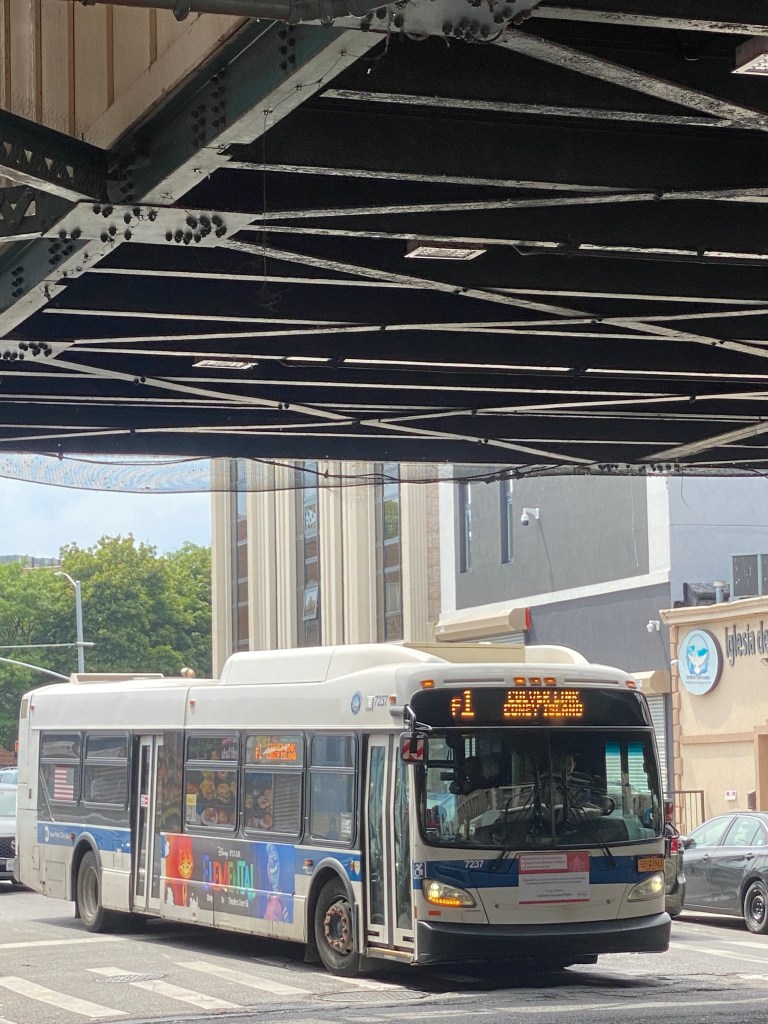
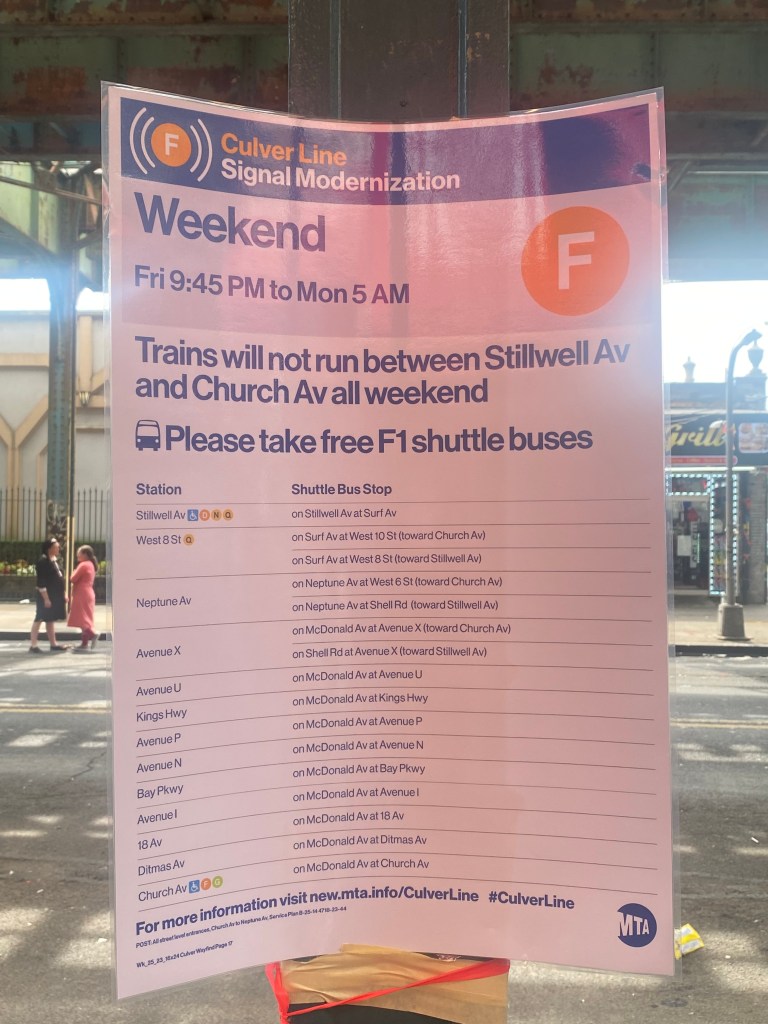

While riders may be adjusting to the changes, they will have much better subway service once the project is all said and done. According to the news site “THE CITY,” as the project is expected to be completed in August 2024. As a result, riders will likely see dramatic improvements to subway service sooner rather than later.
Works Cited
New York City Department of City Planning-Transportation. “Car Ownership in NYC.” Tableau, 24 November 2022, https://public.tableau.com/app/profile/dcptransportation/viz/ACSProfiles/Dashboard1. Accessed 21 July 2023.
Metropolitan Transportation Authority. “Culver Line Signal Modernization: Project Details.” MTA, https://new.mta.info/projects/culver-line-signal-modernization/details. Accessed 21 July 2023.
Metropolitan Transportation Authority. “CBTC: Communications-Based Train Control.” YouTube, 20 July 2015, https://www.youtube.com/watch?v=Mjx3S3UjmnA&t=112s. Accessed 21 July 2023.
Metropolitan Transportation Authority. “A final push for CBTC on the Queens Boulevard Line.” MTA, 2021, https://new.mta.info/projects/CBTC-on-Queens-Boulevard. Accessed 21 July 2023.
DJ Hammers Trains. “⁴ᴷ⁶⁰ R160 being Permanently Swapped to G Line Service.” YouTube, 8 October 2021, https://www.youtube.com/watch?v=M44XwaGac2I. Accessed 21 July 2023.
Frishberg, Hannah. “New York subway 101: A guide to the signal system.” Curbed NY, 27 February 2019, https://ny.curbed.com/2019/2/27/18240200/mta-nyc-subway-signal-delays-infrastructure-guide. Accessed 21 July 2023.
Metropolitan Transportation Authority. “Culver Line Signal Modernization.” MTA, https://new.mta.info/projects/culver-line-signal-modernization. Accessed 21 July 2023.
Martinez, Jose. “MTA Flags Contractor Errors, Adds Two More Years to Subway Signal Work Forecast.” THE CITY, 2 December 2022, https://www.thecity.nyc/2022/12/2/23489075/mta-subway-signal-work-take-longer. Accessed 21 July 2023.
 Transit Central