By Joseph Morales
The area surrounding Queens Borough Hall in the Kew Gardens area of Queens has a high activity density and is bustling with vehicular and pedestrian traffic daily. The community is home to multiple important borough offices, such as Queens Borough Hall and Queens County Criminal Court. In addition a school known as Archbishop Malloy High School, with about 1,560 students is located in the area. The community is served by the E and F trains at both the Kew Gardens-Union Tpke and Briarwood stations, the LIRR at the Kew Gardens station, and a plethora of bus routes that traverse Queens. Major roadways such as the Van Wyck Expressway(I-678), the Grand Central Pkwy, the Jackie Robinson Pkwy, and Queens Blvd also pass through the area, making the community easily accessible by car from throughout Queens and the New York Metropolitan Region. As many of the areas surrounding Kew Gardens lack subway access and have high car ownership rates, many people might choose to drive to one of the subway/commuter rail stations and park their vehicles, and more might do it in the future upon the implementation of congestion pricing below 60th street in Manhattan.
As you might expect, just like in other areas of the city, parking is likely hard to come by due to the area’s connection to major vehicular thoroughfares and key destinations. As congestion tends to be high on both the Queens Blvd service road as well as local residential streets, cars searching for parking likely contribute to this congestion, contributing to slow travel speeds for both those in search of parking as well as through traffic.
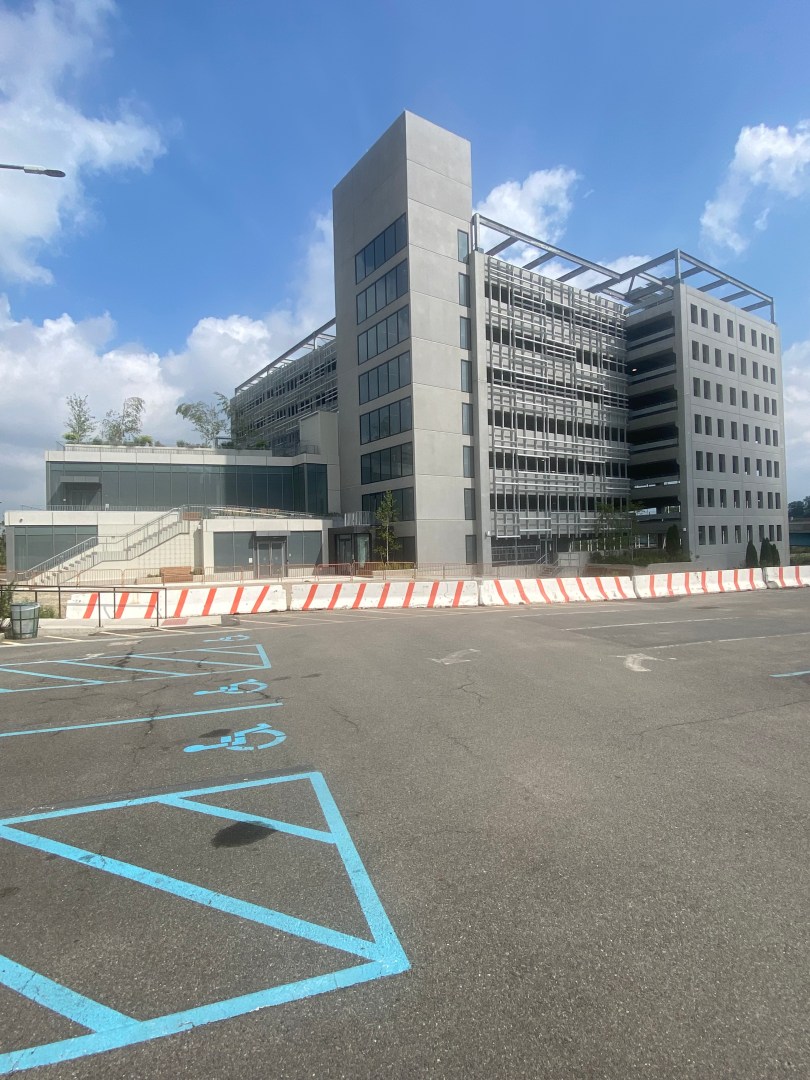
Hence, to help ease parking issues in the community, the NYCDOT recently constructed a new municipal parking garage at 80-25 126th St, located on 126th St between the Grand Central Pkwy eastbound service road and 82nd Ave near Queens Blvd. The garage offers 600 total spaces, including, 30 ADA-accessible spaces and 40 Bicycle spaces. The ADA-accessible spaces will be especially critical for those who need it considering that it likely is already difficult to find parking near major destinations in the community and the garage is near the ADA-accessible Kew Gardens-Union Tpke(E,F) station. The bicycle spaces will help those who choose to cycle to the area and take advantage of nearby cycling infrastructure such as the protected bike lanes on Queens Blvd and the expansive networks of bike trails in the nearby Forest and Flushing Meadows Parks respectively.
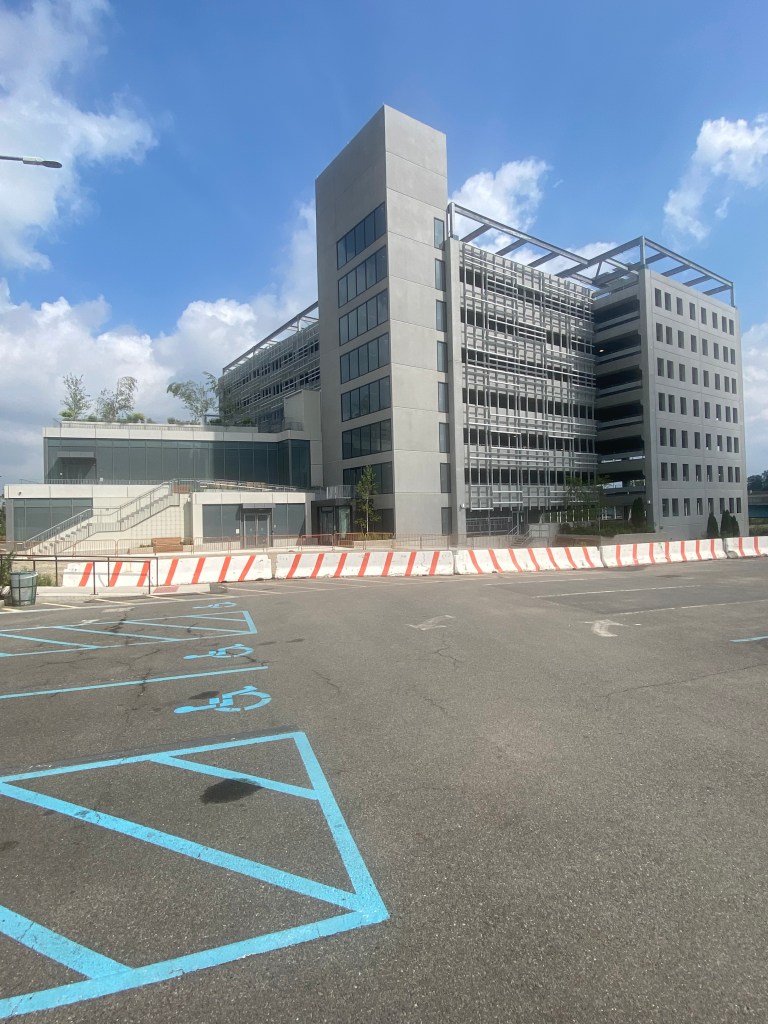
The garage also includes 34 electric vehicle(EV) charging spaces, with 3 of them offering DC Fast chargers that allow EV owners to charge battery-electric vehicles(BEV) from empty to 80% in 20 minutes to an hour, which makes them among the fastest EV chargers out there. While the also common Plug-in hybrid electric vehicles(PHEV) generally do not work with DC Fast chargers and the rest of the chargers in the garage will be the EV standard, most EV owners charge their vehicles at home, and thus they will likely not rely on the parking garage for their regular charging regimens. However, the Level 2 charging stations that can charge from empty to 80 percent in BEVs in 4-10 hours and PHEV’s for 1-2 hours respectively, can still be useful to help give EV motorists the opportunity to give their vehicles and extra boost if needed for a specific situation or for charging when the motorist is parking for a long period of time for purposes such as a long outing, work or to commute somewhere else with the subway or LIRR.
In addition to making parking available for all, the parking spaces will have an impact in the community beyond parking and even motorists as a whole. As less cars will likely be circling the neighborhood for parking, the will mean less congestion for other road users, which should speed up travel times for users of local roads. This is especially important given the high rates of congestion surrounding streets near Queens Borough Hall at most hours of the day including primarily residential ones, according to Google Maps’ traffic forecast. As a significant amount of area residents own vehicles and many parts of Queens and nearby Nassau County are hard to get to by mass transit, less congestion on residential streets will make it much easier for residents to make trips by personal vehicle. Less congestion on busy streets such as Queens Blvd and Kew Gardens Rd also benefit small businesses that benefit from their customers being able to pull up close to them, rather than those spots being taken for long periods for time by those going to the nearby offices or even subway stations who might not return for many hours upon parking.
While that parking garage itself will likely serve as an uncontroversial solution to a common transportation issue in reference to parking, the garage was built as part of a bigger, non-transportation based project that is anything but. The parking garage was the first step as part of a project to build a new 886-bed jail at the site of what is currently the shuttered Queens Detention Complex as well as the east side of the former surface parking lot. It is worth noting that there will also be a smaller, underground 305-space parking lot for jail staff, so all of the parking in the recently finished garage will be for public use. Hence, the only way that the project’s ability to mitigate parking demand can be diminished is if a high number of people visiting inmates daily take up a disproportionate amount of spots.


According to New York City Department of Corrections data from July-September 2012 when there were about 10,000 inmates on Rikers Island on a given day and there were about 1,700 total visitors on a given day. This would mean that 17% of inmates had visitors assuming each inmate that had a visitor each day only had one. However, assuming inmates in the new facility receive visitors at a similar rate and 46% of those visitors have cars that would mean that about 69 spaces out of the 600 in the garage would be of those visiting inmates. I used 46% for this estimate as 46% of NYC households have a car, and an inmate could have visitors from anywhere in the city. Since the NYCDOC currently operates buses from two central NYC sites to Rikers Island for those intending to visit inmates with plans to expand, it is likely that many if not most visiting the Island live in locations throughout the City of New York. While Rikers Island is known for its remote location, the bridge to the Island is easily accessible by car via the Brooklyn-Queens Expressway(I-278) and Grand Central Pkwy. Thus, visiting inmates by car likely will not be significantly impacted in most cases by those visits occurring at the new Queens Jail.
The jail is part of a controversial plan to replace the notoriously troubled Rikers Island with borough-based jails in each of the five boroughs. Despite the plan for the jail in Queens being rejected by Queens Community Board 9 on the grounds that the jails should not be located in residential areas, the city still plans to move forward.
The city states that all of the new borough-based jails will serve as “civic assets for all New Yorkers” and “must relate to the city it is in and create a sense of place for the citizens it serves,” according to its website regarding the plan to close Rikers. In the case of the Queens jail, the plan includes constructing a two-floor community space with multiple verdant outdoor terraces attached to the parking garage. Given New York’s bail reform laws passed in 2020, leading to many people awaiting trial for misdemeanor and even some felony offenses will likely not be waiting in jail for their trials even with the recent changes to the law made by NY Gov. Kathy Hochul and most individuals in the borough-based jails will likely be those accused of violent offenses, those facing charges in multiple incidents or serving short sentences and thus residents and area visitors may be skeptical of the immediate surroundings of the jail becoming such a public and even inviting area.
As of now, a lot more New Yorkers live, work, and go to school near correctional facilities than you would imagine. A study done by the Independent Commission on New York City Criminal Justice and Incarceration Reform in May 2019 showed that there are 11 detention facilities in New York City outside of the eight already on Rikers Island, and those facilities have a combined 158,000 people living within a 5-minute walk of the facilities and 430,000 people living within a 10-minute walk of them. The study found not only that property values and crime rates were not adversely impacted by the correctional centers, property values in certain areas, such as Downtown Brooklyn, increased, including a 55% increase in a five-minute walking distance from the Brooklyn Detention Complex(BKDC) since it was reopened in 2012. The BKDC has since been closed in 2020 and will be the site of Brooklyn’s new borough-based jail.
While this was not stated in the studies, many of the facilities are located in growing communities such as the South Bronx, Long Island City, Downtown Brooklyn and Sunset Park/Industry City. There are a plethora of examples of major developments near the detention centers such as the Industry City arts hub near the MDC Brooklyn(Brooklyn’s federal prison) and the recently renovated office complex known as the Falchi Building in Long Island City near the state-operated Queensboro Correctional Facility. In the South Bronx, the Horizon Juvenile Center which houses some of the highest risk juvenile delinquents and offenders in the city is located directly across the street from the South Bronx Educational Campus which includes two high schools. A new elementary school, PS. 487X is also being constructed adjacent to the South Bronx Campus and is slated to open for the 2024-25 school year. Thus, while many community members are likely skeptical of the current spatial arrangements near the new Queens jail; there is a chance that people will greatly benefit from the community spaces and perception of the space may change in the future given the outcomes of development around correctional facilities in other boroughs.
As the parking lot portion of the project has been completed and demolition of the former Queens Detention Complex is set for this summer, this project will likely spur many discussions on how jails and the areas around them can be a part of our communities and may impact how development is perceived around correctional facilities.
Works Cited
“Frequently Asked Questions.” Archbishop Molloy High School, https://www.molloyhs.org/apps/pages/index.jsp?uREC_ID=747416&type=d&pREC_ID=1157328. Accessed 18 July 2023.
New York City Department of City Planning-Transportation. “Car Ownership in NYC.” Tableau, 24 November 2022, https://public.tableau.com/app/profile/dcptransportation/viz/ACSProfiles/Dashboard1. Accessed 18 July 2023.
New York City Department of Transportation. “NYC DOT – Municipal Parking Facilities.” NYC.gov, 2023, https://www.nyc.gov/html/dot/html/motorist/parkinglist.shtml#queens. Accessed 18 July 2023.
Google Maps. “Google Maps-Traffic.” Google, https://www.google.com/maps/@40.7137044,-73.8311183,16z/data=!5m1!1e1?entry=ttu. Accessed 18 July 2023.
New York City Department of Corrections, et al. COMMUNITY BOARD 9 LAND USE COMMITTEE, 12 April 2021, https://rikers.cityofnewyork.us/wp-content/uploads/20210325_QNCB9-_Presentation_Updated_04_12_2021.pdf. Accessed 18 July 2023.
New York City Department of Corrections. “NYC DOC at a GLANCE.” NYC.gov, 2012, https://www.nyc.gov/html/doc/downloads/pdf/doc_at_a_glance.pdf. Accessed 18 July 2023.
New York City Department of Corrections. “Visitor Transportation.” NYC.gov, 2023, https://www.nyc.gov/site/doc/inmate-info/visitor-transportation.page. Accessed 18 July 2023.
Kaplan, Dana. “COMMUNITY BOARD NO. 9.” Forest Hills Post, 14 May 2019, https://foresthillspost.com/wp-content/uploads/sites/22/2019/05/CB9-Resolution-Opposing-Borough-Based-Jails-Letterhead.pdf. Accessed 18 July 2023.
City of New York. “NYC Borough-Based Jails – Rikers.” Closing Rikers Island, 2023, https://rikers.cityofnewyork.us/nyc-borough-based-jails/. Accessed 18 July 2023.
Reisman, Nick. “Once again, New York’s bail law is set to change.” Spectrum News, 28 April 2023, https://spectrumlocalnews.com/nys/central-ny/ny-state-of-politics/2023/04/28/once-again–new-york-s-bail-law-is-set-to-change. Accessed 18 July 2023.
Independent Commission on New York City Criminal Justice and Incarceration Reform. “More Just NYC – Jail Impact Study.” Squarespace, May 2019, https://static1.squarespace.com/static/5b6de4731aef1de914f43628/t/5cf7bd74342c7a0001525284/1559739765822/NYC+Detention+Facilities+Analysis+%28May+2019%29-Final.pdf. Accessed 18 July 2023.
Brendlen, Kirstyn. “City, contractors get ready to begin demolition at Brooklyn Detention Complex • Brooklyn Paper.” Brooklyn Paper, 21 February 2022, https://www.brooklynpaper.com/prepare-demolition-at-brooklyn-jail/. Accessed 18 July 2023.
“The Falchi Building – 31-00 47th Avenue in Sunnyside, Long Island City, NY.” VTS Marketplace, 2023, https://marketplace.vts.com/building/the-falchi-building-long-island-city-ny. Accessed 18 July 2023.
New York City Administration for Children’s Services. “ACS – Secure Detention.” NYC.gov, 2023, https://www.nyc.gov/site/acs/justice/secure-detention.page. Accessed 18 July 2023.
“Bronx Four Story School Milestone.” Forte Construction Corp, 18 April 2022, https://www.fortecc.com/post/ps-487-milestone. Accessed 18 July 2023.
 Transit Central