
By Joseph Morales
The Bowling Green station on the 4,5 lines in the Financial District is one of New York City’s most historic subway stations, having been in operation for over 115 years. Since opening in 1905, the station has provided access to many of New York’s most famous attractions and key destinations. These include major office buildings, Battery Park, the National Museum of the American Indian, the Staten Island Ferry, the ferries to Ellis Island, and the Statue of Liberty. The station is mainly known by New Yorkers for its nontraditional red walls on the inside as well as its two unique entrances. One of these entrances is the station headhouse or control house, which has been used since the station’s opening in 1905 and is considered a designated NYC landmark and is on the National Register of Historic Places. The other is an escalator surrounded by a glass canopy that, when riding, feels like you’re getting a grand entrance into the neighborhood, with an immersive view of the MTA headquarters, 2 Broadway, greeting you as you come above ground. The canopy opened in the station in 2007, 102 years after its opening.
Now in 2023, the escalators at the Bowling Green station are getting replaced to improve the escalators’ reliability. While the Bowling Green station escalators have had availability rates between 95-98% consistently over the past year, as for any infrastructure that has been performing a task no matter how reliable for as long as the Bowling Green station escalators have, upgrades and replacements are sometimes needed so that the escalators can continue to serve riders reliably for years to come. The escalators are particularly important in the case of Bowling Green as the station entrances/exits can sometimes get congested given the high activity density in the area, especially on mornings when a high number of office workers in the area are working in person.

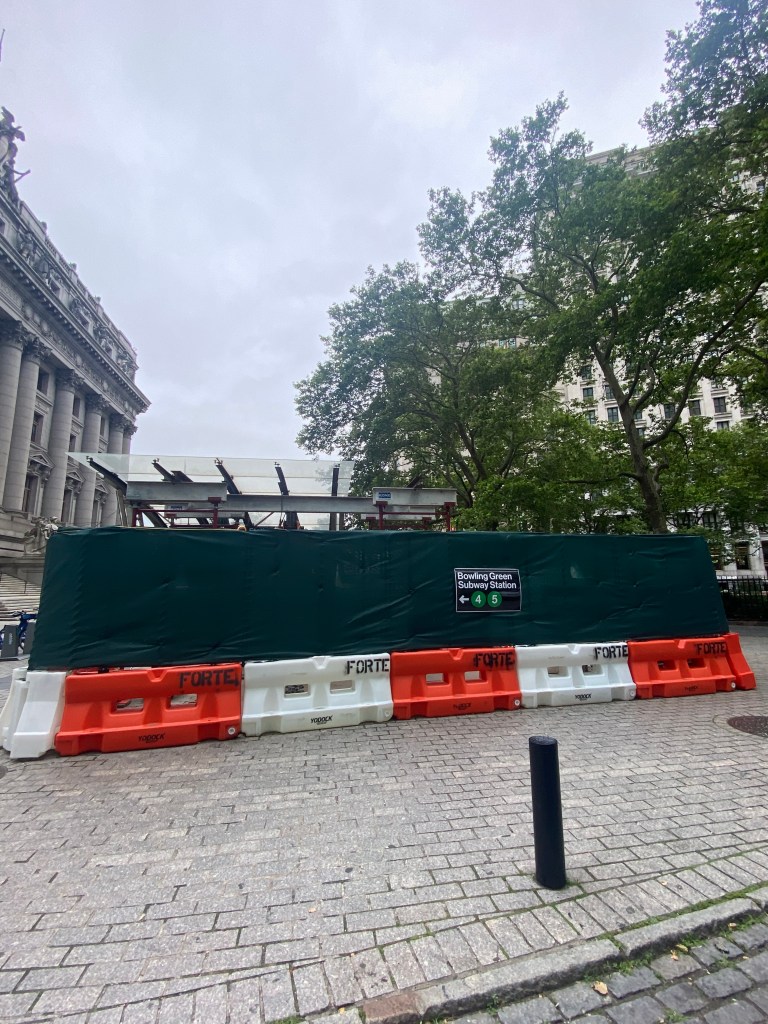
Escalator improvements are also particularly critical to a station like Bowling Green, given that the area surrounding the station has one of the city’s largest concentrations of office buildings. According to a tracker from the news site THE CITY, only 50% of offices in the city have been occupied during the week ending June 21st, 2023. As subway riderhsip has only been back to between 65-70% for the most part in 2023 due to low office occupancy, improvements to station amenities such as escalators can encourage more workers to travel work in-person and ride the subway, helping to increase subway ridership as well as the economic vitality of the broader Financial District community. In addition, as congestion pricing seems more and more likely to become a reality, improvements like this are essential as more people might soon be deciding to switch to transit instead of driving, and thus, these individuals will want to be riding an improved system, particularly if they had begun paying congestion tolls to the MTA before riding. Additionally, the Regional Plan Association(RPA) listed the escalator replacement project at Bowling Green as “at risk without congestion pricing” in a report from August 2022. Thus, completing a successful project at Bowling Green, along with other places, is even more critical to help ensure that drivers who may wind up paying a congestion toll can be confident that their dollars are going to meaningful transportation projects throughout the MTA region.
As the MTA plans to complete this project by November 2023, riders likely hope it can be completed soon so they can once again enjoy the grand entrance into one of America’s busiest business districts. For riders who have trouble with the stairs, the Bowling Green station is also accessible by elevator, greatly helping to mitigate construction impacts for those with mobility disabilities. Given how much a station environment is critical for encouraging people to use mass transit, a successful project at Bowling Green could be an example of how quality station environments can help to encourage subway use in Manhattan, with many workers working from home and congestion pricing on the horizon.
Works Cited
“Subway Trains Running From Bronx To Battery.” The New York Times-Time Machine, 10 July 1905, https://timesmachine.nytimes.com/timesmachine/1905/07/10/101363643.pdf. Accessed 2 July 2023.
Landmarks Preservation Commission. “Battery Park Control House.” nyc.gov, 20 November 1973, http://s-media.nyc.gov/agencies/lpc/lp/0829.pdf. Accessed 2 July 2023.
“New York (NY), New York County.” National Register of Historic Places, https://nationalregisterofhistoricplaces.com/ny/new+york/state2.html. Accessed 2 July 2023.
Metropolitan Transportation Authority. “July 2007: MTA Board Action Items.” Google Books, July 2007, https://books.google.com/books?id=Q4MtWXkIus0C&q=%22bowling+green%22+%22ADA%22+%22subway%22. Accessed 2 July 2023.
Metropolitan Transportation Authority. “Elevator and Escalator Performance Dashboard.” MTA, 2023, http://eedashboard.mta.info/. Accessed 2 July 2023.
Bhat, Suhail, and Will Welch. “How’s New York City Doing?” THE CITY Projects Page – THE CITY, 30 June 2023, https://projects.thecity.nyc/hows-new-york-city-doing/index.html. Accessed 2 July 2023.
Taylor, Tiffany, and Taylor Tiffany Ann. “RPA | How Congestion Pricing Benefits Your Neighborhood.” Regional Plan Association, 16 August 2022, https://rpa.org/latest/lab/how-congestion-pricing-benefits-your-neighborhood. Accessed 2 July 2023.
 Transit Central