By Joseph Morales
*The robotics teams discussed in this article are used as examples only, and these teams have not publicly indicated any intent or desire to participate in the PANYNJ challenge as of the time this article was published.
The Lincoln and Holland Tunnels are among the most critical transportation arteries in the NY-NJ-CT tri-state area, as they are the primary connections between New Jersey and the Manhattan Central Business District. Thus, it is no surprise they are both among the busiest road tunnels in the world, each carrying over 100,000 vehicles daily. In addition, both tunnels carry a plethora of trucks transporting goods throughout the U.S. as well as public and private transport buses that carry riders from commuters to long-distance travelers throughout the tri-state region and beyond.
Due to the number of vehicles the tunnels transport, it is no surprise that congestion is often a misery on both sides of the tunnel on a daily basis, particularly during rush hours. The congestion around streets near the Holland Tunnel is considered to be so bad that the MTA does not even run crosstown M21 bus service on the western end of Houston St in the West Village during the PM peak in either direction due to the impact congestion in the area could have on the entire route that runs between the West Village and the Lower East Side. On top of this, as both tunnels only have two lanes in each direction, it is extremely difficult for emergency vehicles to arrive at the scene of any incidents that occur in the tunnels.

Considering the amount of congestion in the tunnel, the Port Authority Police Department(PAPD) used catwalks in the tunnels to respond to patrol the tunnels on foot. In December 1954, the agency that operates the Lincoln and Holland Tunnels, the Port Authority of New York and New Jersey(PANYNJ) tested the use of catwalk cars that the PAPD could use to patrol the tunnels more efficiently and swiftly for the safety of tunnel users. At first, they were able to move at a maximum speed of 12 mph in both directions before new versions coming out in 1966 were able to move at 35 mph.
While these cars were able to do their jobs as expected, the PANYNJ retired them in 2011, leaving the catwalks in both tunnels vacant. To some extent, it does make sense why the PANYNJ retired the catwalks as officers who manned the cars could not actually use them to get to emergencies due to the limited speed of the cars as well as the fact that only one police officer could man each car. In addition, some could even argue that since surveillance cameras could be used to detect suspicious activities or emergencies in tunnels, officers tasked with patrolling from the catwalks could better serve the public performing other tasks. However, the PANYNJ says that the absence of officers here has led police and staff to face challenges in finding out about and addressing stopped traffic as well as communicating with drivers.
Thus, the PANYNJ is calling on high school students from schools with a STEM(Science, Technology, Engineering, and Math) focus in New York and New Jersey to design a robot that can be used to serve as “the eyes, ears, and mouth of tunnel employees” as part of the agency’s first high school challenge known as The High School Challange: Tunnel Catwalk Robotics. This device would allow Port Authority employees to be able visually to detect traffic stoppages and emergencies in the tunnels and communicate with drivers when necessary. This can enable faster emergency response times and traffic congestion clearance, which can allow for faster trips following delays and, more importantly, could save lives. Shane O’Sullivan, a Holland Tunnel Bridge and Tunnel Agent who responds to emergencies in the Holland Tunnel, said in a Port Authority press release, “A solution will help us improve our response time to vehicle stoppages within the tunnel.” “Being able to address these stoppages immediately will alleviate the rippling effects from prolonged stoppages within the tunnel and help save time for drivers.”
According to the challenge listing, the robot must be “mobile and flexible” and it “must account for limited tunnel space.” More specifically, it will have to account for the specific measurements of space in the Holland Tunnel South Tube and/or Lincoln Tunnel catwalk that are published in a PANYNJ press release. In addition to including cameras and allowing for communication between drivers and employees, the listing states that the robot cannot interfere with tunnel traffic.
The challenge calls for students to work in a group of 5-8, and students must be returning to a NY or NJ high school in the 2023-24 school year in order to be eligible to participate. The students must also receive guidance and a recommendation from staff within their respective high schools. The competition will run from June 28th through November and will provide students with the opportunity to receive with the Port Authority’s employee innovation hub in order to better their projects throughout the design process. They will also have the opportunity to present their robots at an agency-hosted exposition in November, where staff from the agency’s Tunnels, Bridges, and Terminals Department (TB&T) will critique the students’ work based on “potential effectiveness and feasibility” according to a Port Authority press release. The winning team will receive a $750 cash prize in addition to the ultimate possibility of their team’s robot being adopted and constructed by the agency for use in the tunnels.
In case anyone has any doubts, high school robotics teams from throughout our region have a great reputation for developing incredibly innovative and complex machines, as well as performing incredible acts of community service both within and outside of robotics. At the 2023 FRC(FIRST Robotics Competition) NYC regional at The Armory in Washington Heights in which I got the privilege to attend in April, I witnessed robots built by teams build throughout New York compete in the CHARGED UP game, where they were tasked with placing cones and cubes in a grid, as well as docking their robots on a charging station both autonomously and via driver control at numerous stages of the game. This is just a brief summary of how the game works, and more information on the far more complex rules and objectives of the game can be found in the video and game manual linked at the bottom of the article. Many teams from our area were highly successful during the event at this task, including The Saunders Droid Factory from Saunders Trades and Technical High School in Yonkers and StuyPulse from Stuyvesant High School, which is located in Lower Manhattan just a half-mile from the Holland Tunnel entrance. StuyPulse also went on to win the regional and advance to the FRC World Championship in Houston, TX.
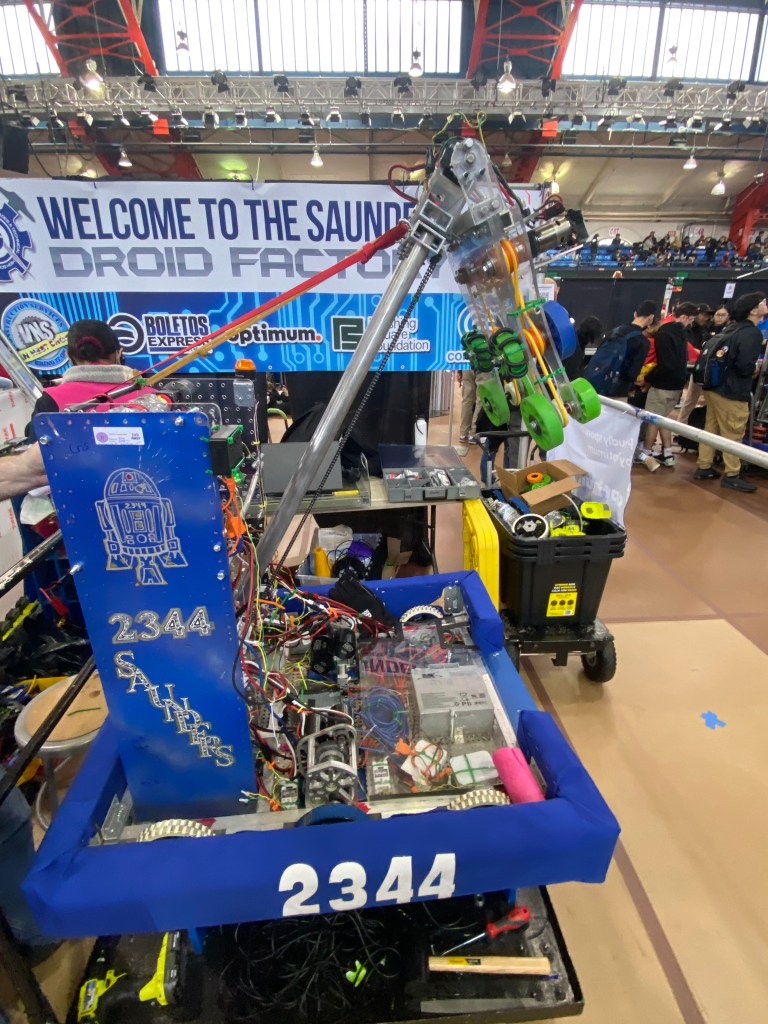

The plethora of teams like these made the entire competition, and the qualification matches to the playoffs were highly competitive throughout. While this challenge may not be as complex as emergency response in the world’s busiest motor vehicle tunnels, it shows that the youth in our region are definitely capable of constructing a device that is able to address not only the issue of emergency response but other issues in our tunnels and broader transportation infrastructure for years to come, not to mention there are many robotics teams in our region that compete in similar but different competitions.
As for community service, teams from throughout our region worked on a variety of meaningful initiatives throughout their schools, the region, and beyond. One of these teams, the Sciborgs from the Bronx High School of Science(Team #1155), have volunteered at countless community events throughout New York City, set up a Youtube Channel showcasing the teams work to others, started an anti-bullying initiative in their school, and have started and mentored countless teams from around the city in FLL, which is FIRST’s lego robotics competition for primarily elementary and middle school students. A link to the Sciborgs Youtube Channel can be found here: https://www.youtube.com/@sciborgs

As the PANYNJ searches for the robot that will make a difference in the Holland and Lincoln Tunnels, all we can do is wonder what the next innovation will be to cruise through the catwalks and which group of young, aspiring inventors will construct it.
Works Cited
Sheidlower, Noah, and Julia Chorun. “Learn About the Secrets of the Lincoln Tunnel – Untapped New York.” Untapped Cities, 17 August 2021, https://untappedcities.com/2021/08/17/secrets-lincoln-tunnel-talk/. Accessed 21 June 2023.
Ford, James. “NJ-bound side of Holland Tunnel will close 6 nights per week for 3 years; drivers aren’t so happy.” PIX11, 18 January 2023, https://pix11.com/news/local-news/manhattan/nj-bound-side-of-holland-tunnel-will-close-6-nights-per-week-for-3-years-drivers-arent-so-happy/. Accessed 21 June 2023.
Gilboy, James. “New York Police Used These Tiny ‘Catwalk Cars’ to Patrol the City’s Tunnels.” The Drive, 1 July 2021, https://www.thedrive.com/news/41375/new-york-police-used-these-tiny-catwalk-cars-to-patrol-the-citys-tunnels. Accessed 21 June 2023.
The Innovation Hub at The Port Authority of New York and New Jersey. The High School Challenge: Tunnel Catwalk Robotics. June 2023. Google, https://drive.google.com/file/d/1lo6zlERBB3QIWkjPwPuKn3S0lugtQivi/view. Accessed June 21 2023.
Valens, Lenis, et al. “Port Authority Calls on High Schoolers to Do the Robot for Tunnel Catwalk Challenge.” Port Authority, 7 June 2023, https://www.panynj.gov/port-authority/en/blogs/projects/port-authority-calls-on-high-schoolers-to-do-the-robot-for-tunne.html. Accessed 21 June 2023.
FIRST Robotics Competition. “FRC Event Web : Team 2344 (2023).” FRC Event, 2023, https://frc-events.firstinspires.org/2023/team/2344. Accessed 21 June 2023.
FIRST Robotics Competition. “FRC Event Web : Team 694 (2023).” FRC Event, 2023, https://frc-events.firstinspires.org/2023/team/694. Accessed 21 June 2023.
FIRST Robotics Competition. “NYNY FRC Event Web: Awards.” FRC Event, 2023, https://frc-events.firstinspires.org/2023/NYNY/awards. Accessed 21 June 2023.
FIRST. FIRST Championship | For Inspiration and Recognition of Science and Technology, 2023, https://www.firstchampionship.org/. Accessed 21 June 2023.
The Sciborgs. “Impact Award Essay.” February 2023.
The Sciborgs. “Sciborgs #1155” February 2023.
“FLL – FIRST ® LEGO ® League Challenge.” NYC FIRST, https://www.nycfirst.org/fll. Accessed 21 June 2023.
 Transit Central