By Joseph Morales
Utica Avenue/Malcolm X Blvd is one of the busiest north-south thoroughfares in Brooklyn. The approximately 6-mile stretch passes through numerous densely populated and busy neighborhoods such as Bedford-Stuyvesant(Bed-Stuy), Crown Heights, East Flatbush, and more. It also connects to the Kings Plaza Shopping Center, one of the largest shopping malls in Brooklyn. In addition, the corridor connects to several other critical east-west arteries in the borough, such as Chruch Ave, Linden Blvd, and Kings Hwy, which are at least five miles long.
Given the amount of density and congestion along the corridor, it is no surprise that public transit seems like a popular mode of transportation. The B46-SBS, which serves the entirety of the corridor, was the 3rd busiest bus route in New York City in 2019-21, the most recent set of years in which ridership data is available on the MTA’s website. With as much as almost 12 million trips in 2019 and only as little as about 6.3 million trips in 2021, the B46-SBS was only behind the Bx12-SBS(Pelham Pkwy/Fordham Rd, Bronx) and M15-SBS(First/Second Avenues, Manhattan) for annual ridership in each of those years. The B46-SBS connects with several major subway and bus lines, including the B82-SBS(Kings Hwy), whose ridership has ranked 9th, 8th, and 7th in the MTA system, respectively, in 2019-21.
Thus, it is no surprise that a subway extension along Utica Avenue is among the most popular transit expansion ideas that railfans have floated around for many years. The idea of a Utica Avenue subway has been so popular that the idea was even proposed by former NYC Mayor John Hylan as early as 1922 before most of the development along Utica Ave had even taken place. The construction of the Utica Avenue Station on the A, C(Fulton Line), which was finished in 1936, also included room for a Utica Ave subway to be branched off from the station. Ideas for a Utica Ave Subway have been included as branches of the IRT Eastern Pkwy Line(2,3,4,5), IND Fulton Line(A, C), and even as part of a Second Avenue Subway.
Unfortunately, a combination of multiple World Wars and financial crises, other transportation projects taking priority, and complex engineering challenges have led to such a subway never being developed. It is also important to note that no matter when such a subway has or will be built, the project will almost definitely require federal assistance. How the federal government spends money is voted on by Congress and approved by the president. Different congress members from all 50 states may have varied views on funding mass transit in general. Thus, the MTA’s chances of obtaining funding may vary by who is in office nationwide and the projects the federal government chooses to prioritize.
Considering just how long a Utica Ave subway has been an idea and the fact that the Utica Ave corridor and its surrounding areas have only grown substantially since the concept was first floated, it is no surprise that the MTA and NYCDOT converted the B46-Limited into an SBS route which began service on July 3, 2016. The new service included bus lanes, off-board fare collection, and spaced-out stops to speed up service. While the NYCDOT has yet to publish a progress report or statistics on the success or lack thereof for the new route as it has with other SBS routes, it is likely that these features led to some improvement, even if it is marginal. However, while speeds on the B46-SBS have ranged at least 1-1.5 mph and has had a wait assessment(rate of buses arriving in clusters) above the Brooklyn borough average since its implementation, it is still considered to be a route that may not fully serve the transit needs of the Brooklyn.
This is why the MTA is evaluating the possibility of implementing revolutionary improvements to transit along the corridor as part of its 20-year needs assessment for the years 2025-2044 to be considered for inclusion in a future capital plan. The options include a significantly enhanced form of BRT(Bus Rapid Transit) or even a subway extension along Utica Ave of some sort. While each would be a significant upgrade from the status quo, there are a plethora of potential constraints and opportunities that are unique to each option that the MTA is considering.
An enhanced BRT would be a significant upgrade from the current B46-SBS. An enhanced BRT would likely have lanes entirely grade separated from general traffic and have extensive station amenities. The most critical constraint with this would almost definitely be road space for a possible route. Most of Utica Ave has a standard street length, and some parts of the northern end of Utica and the entirety of Malcolm X Blvd are incredibly narrow, sometimes even having one lane for vehicles in each direction. There are only bus lanes on some parts of the corridor due to community opposition to loss of driving and parking space during the initial SBS route design. On the southern portion of Utica Ave in the Flatlands section, there is a high density of auto-related businesses that are often forced to rely on sidewalk space to place cars. As previously mentioned, other parts of the corridor have very high commercial and residential densities.
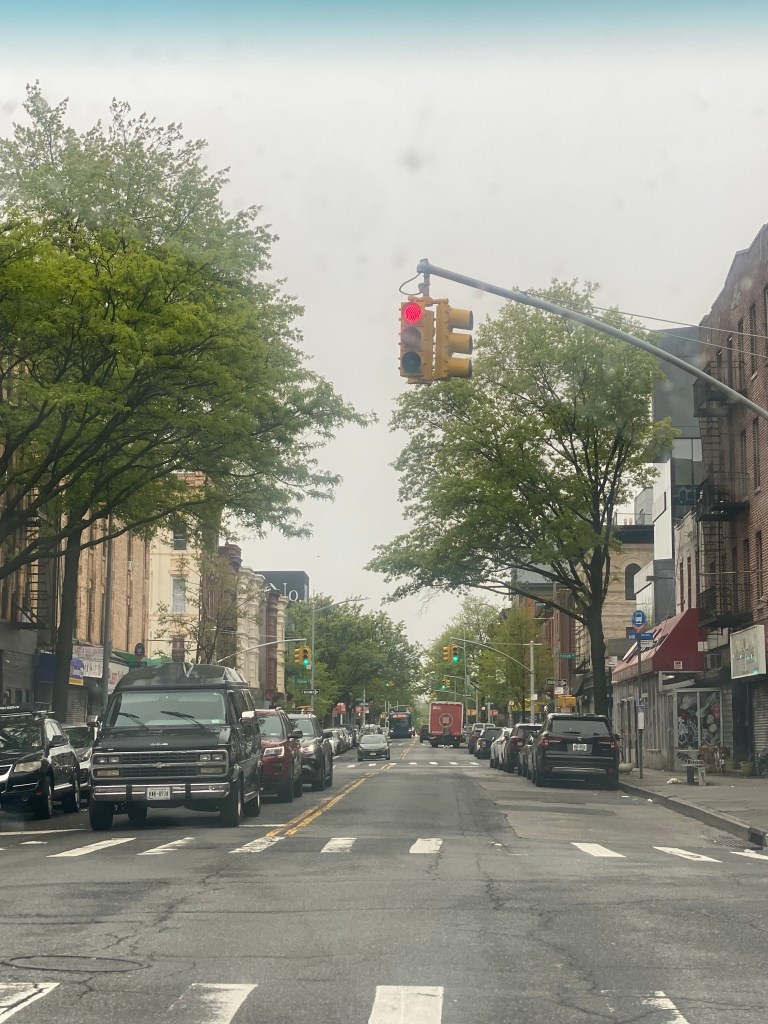


To have such a BRT, either Utica Ave/Malcolm X Blvd would have to be completely closed to vehicular traffic, or a plethora of adjacent properties would have to be demolished through eminent domain to build a corridor, both of which would have draconian adverse effects on local land use and transportation for non-transit users. Even a smaller BRT enhancement, such as a median bus lane, will take up a significant amount of street space and will likely be opposed by many. On top of this, Utica Ave is a designated local truck route. In 2021, the NYCDOT chose not to pursue median-running bus lanes on 21st St in Astoria, Queens, partly for this very reason, even though it is a less busy street with less bus ridership than Utica Ave. These would also be issues should a light rail line were constructed.
If BRT enhancements were the chosen alternative, the NYCDOT would likely use it as an opportunity to introduce added Vision Zero Pedestrian improvements to Utica Ave similarly to how they did with the B46-SBS, Brooklyn’s other three SBS routes and other routes throughout the city. These improvements primarily include measures to reduce crossing distances and improve complex intersections, reducing the chance a pedestrian gets injured while getting to or from the bus, and encouraging bus ridership and walking instead of driving.
While spatial constraints are a given for many surface transit improvement projects throughout the city, the constraints that would come with a subway extension are far more complex. Addressing them could be expensive to a level never seen before in New York City.
This is for multiple reasons, but the most significant reasons outside of the typical costs for a subway would be that because Utica Ave has sandy soil and a high water table, extensive flood protection would be needed to keep the line durable. As no significant engineering studies have been done on the topic, there is no definitive answer regarding how much this would cost. Even without this constraint, just the fact that the line would be built several miles in a place as dense as Brooklyn means there are bound to be unmapped infrastructure and other things found underground that must be addressed before the construction of tracks and rail equipment; hence most of the subway system is currently not ADA-accessible via eleavtor. Additionally, considering the Second Avenue Subway(SAS) Phase 1 costed $2.5 billion per mile and an extension to East Harlem is estimated to cost about $7.7 billion, the price for a longer Utica Avenue extension with flood protections would likely be astronomical. Part of this is also the costs of engineering, design, and construction consultants, for which the MTA spent more than 20% of costs associated with Phase 1 of the Second Avenue Subway, which is more than double the standard in France or Italy, according to a Slate.com article. There are also many other costs associated with such an extension, such as complying with local, state, and federal regulations and mitigating adverse effects of construction for local residents.
Any subway extension would be a branch off of either the Fulton Line(A, C) or the Eastern Pkwy Line(2,3,4,5). While the Malcolm X Blvd area of the corridor is included in the MTA’s most recent study and is among the densest portions of the corridor, there are no proposals to extend a branch off of the Jamaica Line(J, Z) to serve Malcolm X Blvd. A possible benefit to an extension from the Fulton St line could be that the Utica Ave(A,C) station was already partially designed to accommodate such an extension when it was first built. It even includes parts of an unfinished mezzanine and station. While they are not visible to the public, that may explain why the ceilings are lowered in the center of the platforms in the station. However, it may be easier to build an extension that uses smaller trains or is shorter in distance, and that would be the case if the branch extends off of the Eastern Pkwy Line. Another benefit to this would be easier for the MTA to make improvements to Rogers Junction(also known as Nostrand Junction), which is a common pinch point for trains that often leads to subway delays citywide.
Rogers Junction frequently causes delays because the junction, located just past the Franklin Av-Medgar Evers College station(2,3,4,5), train activity requires the 2 and 5 trains to merge past the 3 and 4 trains to get to the Nostrand Avenue line that goes to Flatbush Av-Brooklyn College. As this junction serves multiple long, interborough lines, any delays here as previously stated could impact riders citywide. This is why many railfans who propose Utica Ave Subway extension plans include reconfiguring all subway routes on the Eastern Pkwy line in numerous ways to serve different trunks to prevent lines from merging.,(Ex: 2, 3 to Flatbush Av-Brooklyn College, 5- Utica Avenue Line, 4 to New Lots Ave at all times)Given the junction’s size, rebuilding it would likely require eminent domain of surrounding properties, the demolishing of surrounding subway stations, and other draconian adjustments to either the subway line, local land use, or both to do so. Thus, stopping trains from merging, also known as deinterlining, while building a new subway line could help address these issues more practically. Many similar de-interlining proposals for Rogers Junction have also been floated by railfans, even without the involvement of a Utica Avenue line.
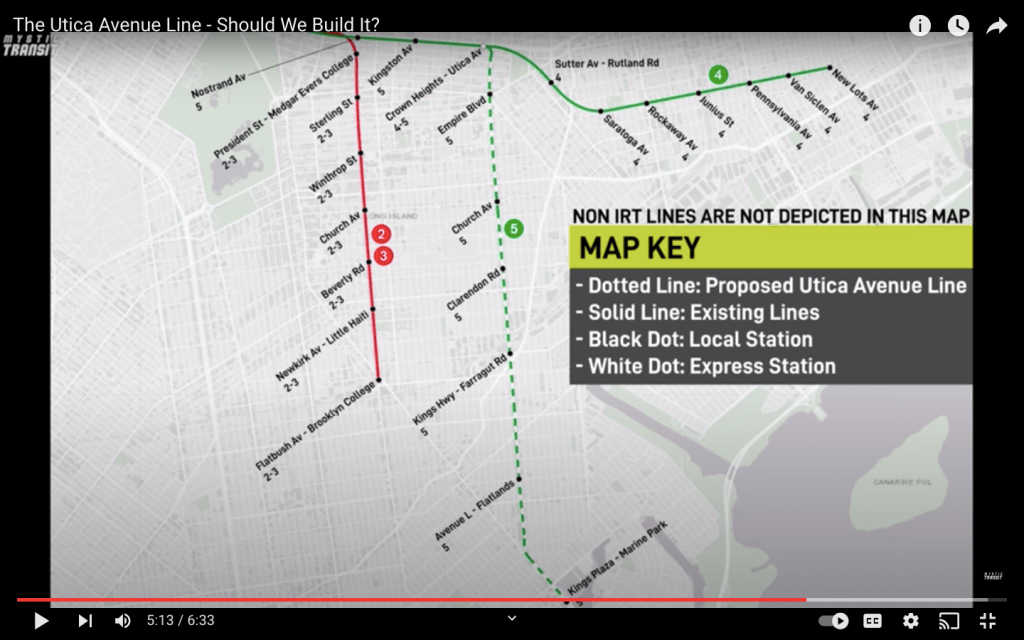
If the MTA were to proceed with a subway option, it would likely have to prioritize between being able to start building from a station already designed for a Utica Ave extension or using the project as an opportunity to improve Rogers Junction. While the MTA can choose to improve Rogers Junction at any time, improvements are most likely more probable if a Utica Avenue Subway is being extended using the junction. Even if they choose to build from the Utica Av(A, C) station, they will face the challenge of intersecting with the Eastern Pkwy line and possibly creating a transfer at Crown Hts-Utica Av(3,4). Also, there are likely many obstacles and constraints to constructing in both areas that we probably cannot tell what the best quality or least expensive option there is until thorough feasibility studies are completed or even when the MTA is conducting an Environmental Assessment or Environmental Impact Assessment for such as project, both of which would almost certainly be required for a subway extension to proceed.
It may seem like the option of building an elevated rail may be more cost-efficient and be able to achieve similar results. While this may be true to some extent, community members would almost certainly be concerned about possible noise, loss of views, and reduction of property values. Even though modern elevated railways might make less noise, one has never been constructed before in New York City. Also, while much of the land use, particularly on the southern end of Utica, is not much different than what is seen under elevated railways citywide (auto shops, fast food restaurants, retail, etc.), the high residential densities throughout the corridor still lead to an elevated line being either opposed or require a level of mitigation for adverse effects that the MTA has never dealt with when it comes to elevated rail.
While it is a complex matter, the MTA has already begun considering options before including transit improvements for Utica Ave before its 20-year needs assessment. The MTA began studying the options in the Winter of 2020, as requested by former NYC Mayor Bill De Blasio in 2015, though that study had been paused due to the COVID-19 pandemic and has yet to be resumed. As part of that study, they had planned to create five possible transit investment packages, which may even include improvements to the IRT Eastern Parkway Line(2,3,4,5) regardless of where the new Utica Avenue line started. They also would consider improvements at the Crown Heights-Utica Av (3,4) station, the New Lots Av(3) station, and Rogers Junction as part of an investment package.
In addition, current Mayor Eric Adams assembled a task force while he was Brooklyn Borough President of area residents and community leaders to study potential transit improvements. While Adams stated at the time he wanted a full, underground subway, he was open to any ideas posed by the task force. He told THE CITY in February 2020, “My first goal is to see if we can get a subway line, there an actual in-the-ground subway. But I am open to whatever comes out of this study from the task force.” It is essential to consider when a project is included on the MTA’s 20-year needs assessment, which means that the project would have to compete with other projects for implementation based on many factors, such as ridership, cost, equity, geographic distribution, and more. Given the number of projects the MTA is also considering and the potential impact and feasibility, whether Utica Ave will be prioritized leaves a lot of room for speculation.
The history and future of public transit along Utica Ave are complex and full of unknowns. No matter what project is chosen should the MTA decide to proceed with one, there is no question that there would be massive bureaucratic hurdles at all levels of government in addition to both expected and unexpected engineering challenges. While any form of significant transit improvements will already require a historic level of political will and engineering expertise, they will have a lasting effect on transportation in the borough of Brooklyn for years to come.
Works Cited
Metropolitan Transportation Authority. “MTA subway and bus ridership for 2019 – New York City Transit.” MTA, 14 April 2020, https://new.mta.info/agency/new-york-city-transit/subway-bus-ridership-2019. Accessed 30 April 2023.
Metropolitan Transportation Authority. “New York City Transit – Subway and bus ridership for 2020.” MTA, 2021, https://new.mta.info/agency/new-york-city-transit/subway-bus-ridership-2020. Accessed 30 April 2023.
Metropolitan Transportation Authority. “Subway and bus ridership for 2021 – New York City Transit.” MTA, 2022, https://new.mta.info/agency/new-york-city-transit/subway-bus-ridership-2021. Accessed 30 April 2023.
Penner, Larry. “OP-ED: Is there really a Utica Avenue Brooklyn subway in your future?” Mass Transit, 5 March 2021, https://www.masstransitmag.com/rail/blog/21213000/oped-is-there-really-a-utica-avenue-brooklyn-subway-in-your-future. Accessed 30 April 2023.
Kabak, Benjamin, and Alon Levy. “A history of futility for Utica, Nostrand extension plans.” Second Ave. Sagas, 7 September 2010, https://secondavenuesagas.com/2010/09/07/a-history-of-futility-for-utica-nostrand-extension-plans/. Accessed 30 April 2023.
vanshnookenragen. The Future of the Utica Ave Subway, 8 March 2018, https://www.vanshnookenraggen.com/_index/2018/03/the-future-of-the-utica-ave-subway/. Accessed 30 April 2023.
Meyer, David. “Relief for Riders on Brooklyn’s Busiest Bus Route as B46 SBS Debuts.” Streetsblog NYC, 7 July 2016, https://nyc.streetsblog.org/2016/07/07/relief-for-riders-on-brooklyns-busiest-bus-route-as-b46-sbs-debuts/. Accessed 30 April 2023.
Metropolitan Transportation Authority. mta.info, April 2023, https://metrics.mta.info/. Accessed 30 April 2023.
Metropolitan Transportation Authority. “MTA’s 2025-2044 20-Year Needs Assessment.” MTA, 2022, https://new.mta.info/20YN. Accessed 30 April 2023.
Meyer, David. “Relief for Riders on Brooklyn’s Busiest Bus Route as B46 SBS Debuts.” Streetsblog NYC, 7 July 2016, https://nyc.streetsblog.org/2016/07/07/relief-for-riders-on-brooklyns-busiest-bus-route-as-b46-sbs-debuts/. Accessed 30 April 2023.
Miller, Stephen, et al. “What Ever Happened to the Utica Avenue Subway Extension?” The Village Voice, 23 November 2016, https://www.villagevoice.com/2016/11/23/what-ever-happened-to-the-utica-avenue-subway-extension/. Accessed 30 April 2023.
New York City Department of Transportation. “NYC DOT – Trucks and Commercial Vehicles.” NYC.gov, https://www.nyc.gov/html/dot/html/motorist/trucks.shtml#routes. Accessed 30 April 2023.
New York City Department of Transportation. “21st Street Transit Priority & Safety Study – Public Meeting December 20, 2021.” NYC.gov, 20 December 2021, https://www.nyc.gov/html/dot/downloads/pdf/21-st-bus-priority-safety-study-mtg-dec2021.pdf. Accessed 30 April 2023.
New York City Department of Transportation. “B46 Select Bus Service | New York City Transit.” NYC.gov, 4 April 2016, https://www.nyc.gov/html/brt/downloads/pdf/brt-cb17-uticaave-apr2016.pdf. Accessed 3 May 2023.
Penner, Larry. “OP-ED: Is there really a Utica Avenue Brooklyn subway in your future?” Mass Transit, 5 March 2021, https://www.masstransitmag.com/rail/blog/21213000/oped-is-there-really-a-utica-avenue-brooklyn-subway-in-your-future. Accessed 3 May 2023.
Metropolitan Transportation Authority. “What does it take to install an elevator in a subway station?” YouTube, 21 October 2019, https://www.youtube.com/watch?v=DveunMW9_bU. Accessed 3 May 2023.
Hicks, Nolan. “MTA’s consultant bill for Second Ave Subway was double tunneling cost.” New York Post, 6 February 2023, https://nypost.com/2023/02/06/mtas-consultant-bill-for-second-ave-subway-was-double-tunneling-cost/. Accessed 3 May 2023.
Grabar, Henry. “Consultants Gone Wild.” Slate, 23 February 2023, https://slate.com/business/2023/02/subway-costs-us-europe-public-transit-funds.html. Accessed 3 May 2023.
Mystic Transit. “The Utica Avenue Line-Should We Build It?” Youtube, 12 March 2022, https://www.youtube.com/watch?v=qYDUMMqt4B8&t=212s. Accessed 4 May 2023.
Fitzsimmons, Emma G. “Mayor de Blasio Revives Plan for a Utica Avenue Subway Line (Published 2015).” The New York Times, 22 April 2015, https://www.nytimes.com/2015/04/23/nyregion/mayor-de-blasio-revives-plan-for-a-utica-avenue-subway-line.html. Accessed 4 May 2023.
Dowd, Trone. “Utica Ave. Subway Extension Dream Gets a Brooklyn Boost.” THE CITY — NYC News, 11 February 2020, https://www.thecity.nyc/brooklyn/2020/2/11/21210535/utica-ave-subway-extension-dream-gets-a-brooklyn-boost. Accessed 4 May 2023.
 Transit Central