
By Joseph Morales
Queens Blvd is one of the busiest streets in all of Queens, stretching from Downtown Jamaica in Southern Queens, about 7.5 miles to the Ed Koch Queensboro Bridge, which connects Queens to Midtown Manhattan and is the only way to get to Queens to Manhattan by car without paying a toll. Along the way, the Boulevard passes through many diverse neighborhoods with high population densities such as Forest Hills, Elmhurst, Woodside and Long Island City. Many major destinations are located along the corridor as well such as the Queens Center Mall and Queens Borough Hall. Many schools, hospitals, retail stores and other facilities are located along or off the bustling street as well.
As only around 41.4% of Queens households have access to a car according to 2022 American Community Survey, many people walk, drive, take transit and bike onto Queens Blvd. Queens Blvd is extremely well served by mass transit with 4 subway lines and numerous bus lines.
Unfortunately, the bustling boulevard has been notoriously known as one of the most if not the most dangerous street for pedestrians in New York City. For several decades, the boulevard has held titles such as “Boulevard of Death” and “Boulevard of Broken Bones” as between 1990 and 2018, at least 186 people were killed in traffic accidents along Queens Boulevard with 138 being pedestrians according to the Queens Eagle. These issues have largely been associated with the street having a massive width and before improvements, it was a street that looked like not much more than a highway with some traffic signals, crosswalks and sidewalks. A lack of crosswalks and pedestrian space along with the amount of time pedestrians had to cross the boulevard were also among concerns. It is even worth noting that as a result of the street having always been a busy thoroughfare and being as wide as it is, the New York City Planning Commission proposed converting it into an expressway similar to the Long Island Expressway(I-495) in 1941, though the project was never completed due to the onset of World War II. Evidence of this project’s commencement is evident by the depressions in the road’s underpass beneath I-495(Long Island Expressway) as shown below:
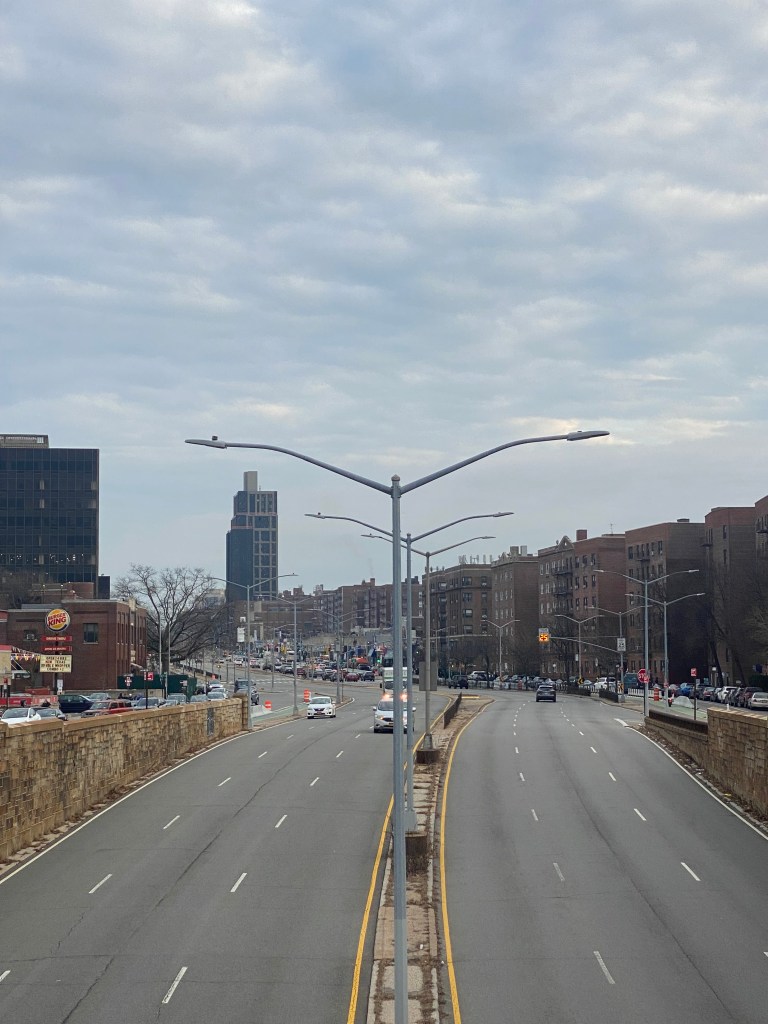
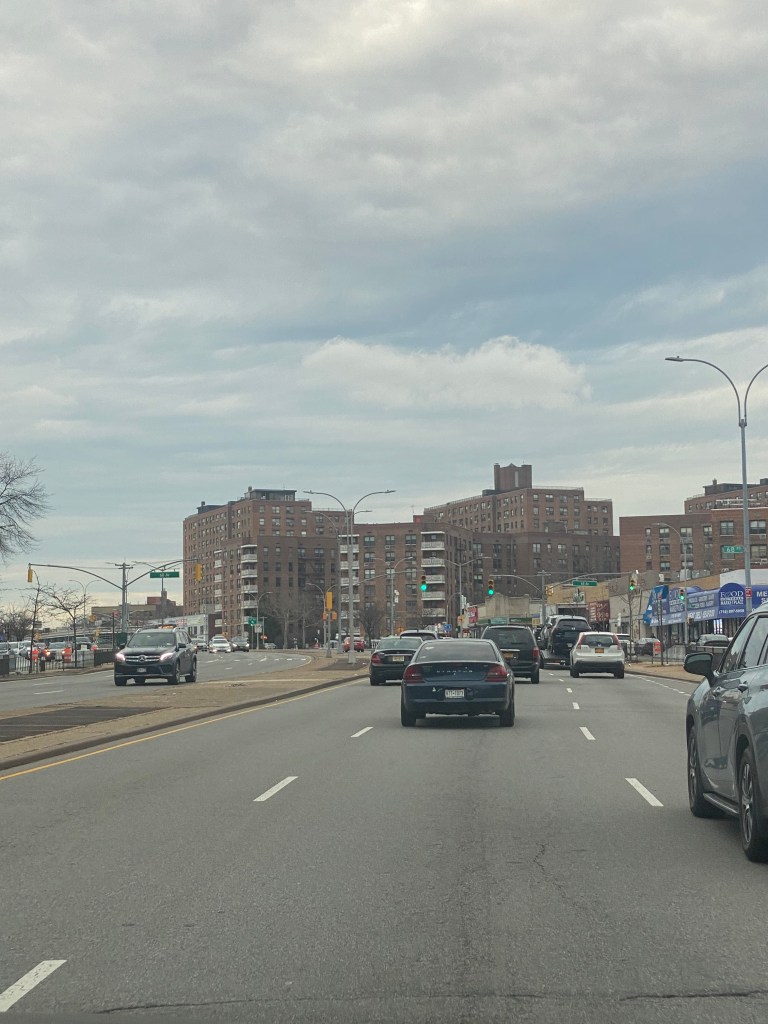
Therefore, the NYCDOT has taken many steps since 1997 in order to improve safety on the boulevard. These improvements have paid major dividends as between 2000 and 2006, the NYCDOT completed numerous studies on different portions of the corridor and made many improvements such as new curb and median improvements, closed slip lanes, repainted crosswalks and more. They also increased the time pedestrians had to cross the boulevard from 32-50 to 60 seconds to cross, as pedestrians often times had difficulty crossing the boulevard with one walk signal given the width of the boulevard. They even added signs saying “A Pedestrian Was Killed Crossing Here” signs were pedestrians fatalities occurred to encourage pedestrians to cross the street carefully. These improvements definitely helped as pedestrian accidents decreased from a peak of 154 in 1993 to an all-time low at the time of 63 in 2002. Fatalities had also decreased from a peak of 18 in 1993 to hovering between 1 and 2 each year between 2004 and 2006.
While the NYCDOT had made substantial progress, a larger-scale transformation of the boulevard along with a few other major changes was still yet to come. One of the simplest but most crucial changes was a speed limit decrease to 25 in most spots after former Mayor Bill De Blasio signed a law that decreased the citywide speed limit from 30 to 25 unless otherwise posted. Queens Blvd between Roosevelt and 51st Avenues had a speed limit as high as 35 mph had then its speed limits decreased to 30 in May 2014 and later on to 25. This is because the NYCDOT felt that the street was designed to accommodate higher speeds but then decreased it to 25 due to reduce the number of accidents that result in fatalities.
Speed is a major factor as to whether or not someone dies in a motor vehicle accident. According to EMC insurance, the likelihood of someone dying in a car crash doubles for every 10 mph of increased vehicle speed.
Outside of speed limit regulations, the largest thing the NYCDOT did was commit to a full transformation of the boulevard through a Great Streets Capital Project as well as an operational project. Former Mayor Bill De Blasio expressed the desire to turn Queens Blvd from what many thought of as a “Boulevard of Death” to a “Boulevard of Life.” The operational project has included expanding upon the work that had already done on the boulevard as well as adding protected bike lanes on both sides of the street. The bike lanes have been a major success as cycling has boomed by as much as 141% on certain parts of the corridor upon the bike lane’s installation. This project was done in four phases, with Phase I being between Roosevelt Ave and 73rd St in 2015, Phase II being between 73rd St and Eliot Ave in 2016, Phase III being between Eliot Ave and Yellowstone Blvd in 2017 and Phase IV being between Yellowstone Blvd and Union Tpke in 2018. The protected bike lanes were eventually extended to Queens Boulevards’ terminus after advocacy from community members and transportation advocates including Transportation alternatives Executive Director Danny Harris. The NYCDOT has and is continuing to build more pedestrian space as well as crosswalks throughout the corridor, such as at the intersection of Queens Blvd/Eliot Ave near the Long Island Expy.
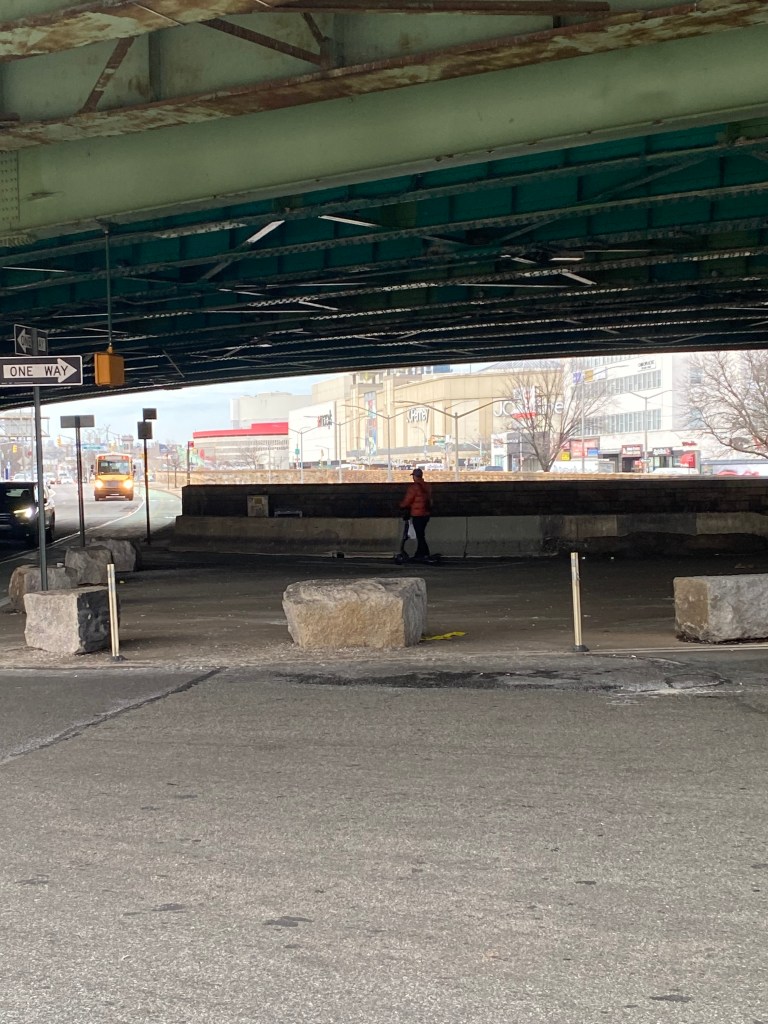

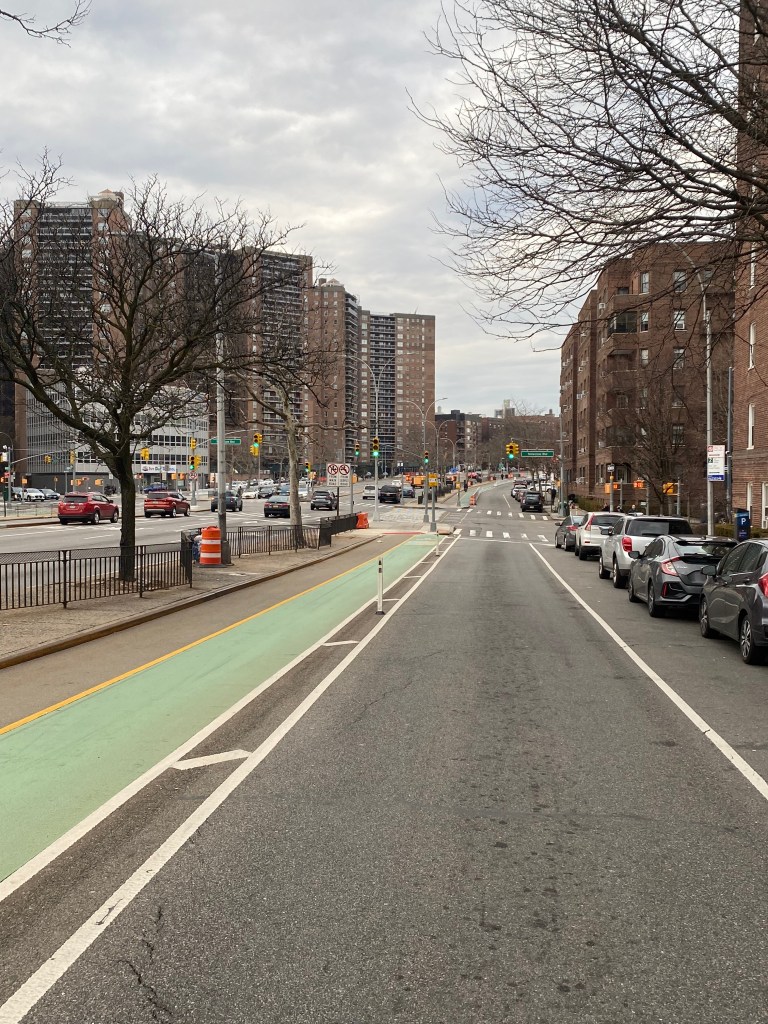
While much of the capital project comprises of similar work to the operational project, the work is of an overall larger scope. As part of the capital project, the NYCDOT is currently planning to turn the median of the boulevard into a linear park with about 60,000 sq ft of trees and greenery in order to create a safe way for pedestrians to traverse the neighborhoods along Queens Blvd as well as to provide public space for the communities. Greenery is known to be an effective way to reduce traffic incidents as a study from the University of Washington showed that there was a 46% decrease in crash rates across 10 arterial roads and highways studied in urban areas throughout the country.
The NYCDOT is also planning on moving buses from the busy and congested service road of Queens Blvd, to the much wider center lanes of Queens Blvd between Union Turnpike and Roosevelt Ave which should greatly increase bus speeds. The NYCDOT will also improve 43 bus shelters and benches along the bus routes. At Woodhaven Blvd, buses would still use servcie road in order to stop in dedicated bus lanes at the Queens Center Mall. This is critical for riders on the Q32 and Q60, which carry thousands of riders from Jackson Heights and South Jamaica respectively into Midtown Manhattan on a daily basis.
The NYCDOT has already made progress on the capital project with Phases I and II which run between Roosevelt Ave and 73rd Street along with 73rd Street and Eliot Ave respectively. They are also currently in the design stages of Phases III and IV which run between Eliot Ave and Yellowstone Blvd and Yellowstone Blvd and Union Turnpike respectively. Experts expect construction to start on these phases by 2024 though it was expected to start in 2019.
While there are still many improvements to be made, most can certainly agree that the NYCDOT has substantially improved Queens Blvd for all road users since the 1990’s and the work has certainly saved lives. While this project may not be considered perfect, it leads many to wonder if it worked on what was once New York City’s most dangerous street, where else can it work?
Works Cited
Cuba, Julianne. “WAIT FOR IT: City To Move Buses To Dedicated Lane on Queens Boulevard — Eventually.” Streetsblog NYC, 22 April 2022, https://nyc.streetsblog.org/2022/04/22/wait-for-it-city-to-move-buses-to-dedicated-lane-on-queens-boulevard-eventually/. Accessed 28 January 2023.
“Speed: How It Increases the Risk of Car Crash Injuries | EMC.” EMC Insurance, https://www.emcins.com/losscontrol/insights-d/2020/08/speed-increases-risk/. Accessed 28 January 2023.
New York City Department of Transportation. “QUEENS BOULEVARD.” NYC.gov, 5 March 2018, https://www1.nyc.gov/html/dot/downloads/pdf/queens-blvd-roosevelt-ave-mar2018.pdf. Accessed 28 January 2023.
New York City Department of Transportation. “QUEENS BOULEVARD.” NYC.gov, 4 September 2019, https://www.nyc.gov/html/dot/downloads/pdf/queens-blvd-73rd-st-eliot-ave-cb4-sep2019.pdf. Accessed 28 January 2023.
New York City Department of Transportation. “QUEENS BOULEVARD.” NYC.gov, 10 May 2017, https://www1.nyc.gov/html/dot/downloads/pdf/queens-blvd-eliot-ave-may2017.pdf. Accessed 28 January 2023.
New York City Department of Transportation. “SAFE STREETS NYC.” NYC.gov, 2007, https://www.nyc.gov/html/dot/downloads/pdf/safetyrpt07_4.pdf. Accessed 28 January 2023.
Rivoli, Dan. “City promises ‘Boulevard of Life’ on busy Queens Boulevard.” NY1, 22 September 2021, https://www.ny1.com/nyc/all-boroughs/traffic/2021/09/23/city-promises–boulevard-of-life–on-busy-queens-boulevard. Accessed 28 January 2023.
Saltzman, Jeff. “Queens Boulevard Express Highway (NY 25, unbuilt).” NYCRoads.com, http://www.nycroads.com/roads/queens-blvd/. Accessed 28 January 2023.
Warner, Adam. “Upcoming Redesign Will Make “Boulevard of Death” Safer, DOT Says.” NBC New York, 31 March 2015, https://www.nbcnewyork.com/news/local/nyc-dot-queens-blvd-plan-safety-pedestrians-deaths/2018063/. Accessed 28 January 2023.
 Transit Central