By Joseph Morales
Rockefeller Center is one of the most famous recreational and tourist destinations in Midtown Manhattan as well as all of New York City during the holiday season. Treasured by locals and visitors alike, Rockefeller Center is world-famous for its 82-foot tall Christmas Tree, ice skating rink, observatory and slew of other attractions that draws over 750,000 people daily, this is about double the average weekday ridership for all MTA Buses total in 2019. In addition to Rockefeller Center itself, the surrounding neighborhood is home to many tourist attractions that increase the density of pedestrians in the area such as St. Patrick’s Cathedral, the Museum of Modern Art, Radio City Music Hall and much more. There is also a high density of transit options, employment and housing in the area which all increase pedestrian volumes.
As you might expect, given the fact that Rockefeller Center sees so many visitors daily in a space that spans just a few blocks, the sidewalks often get extremely congested and sardine packed. This can make walking through what is otherwise a marvelous place feel undesirable and may deter visitors especially during peak periods such as weekends. It can also make it hard for certain visitors to access the many attractions Rockefeller Center has to offer such as parents with young children, the elderly, people with mobility disabilities and all others who may find it difficult to navigate the crowds.
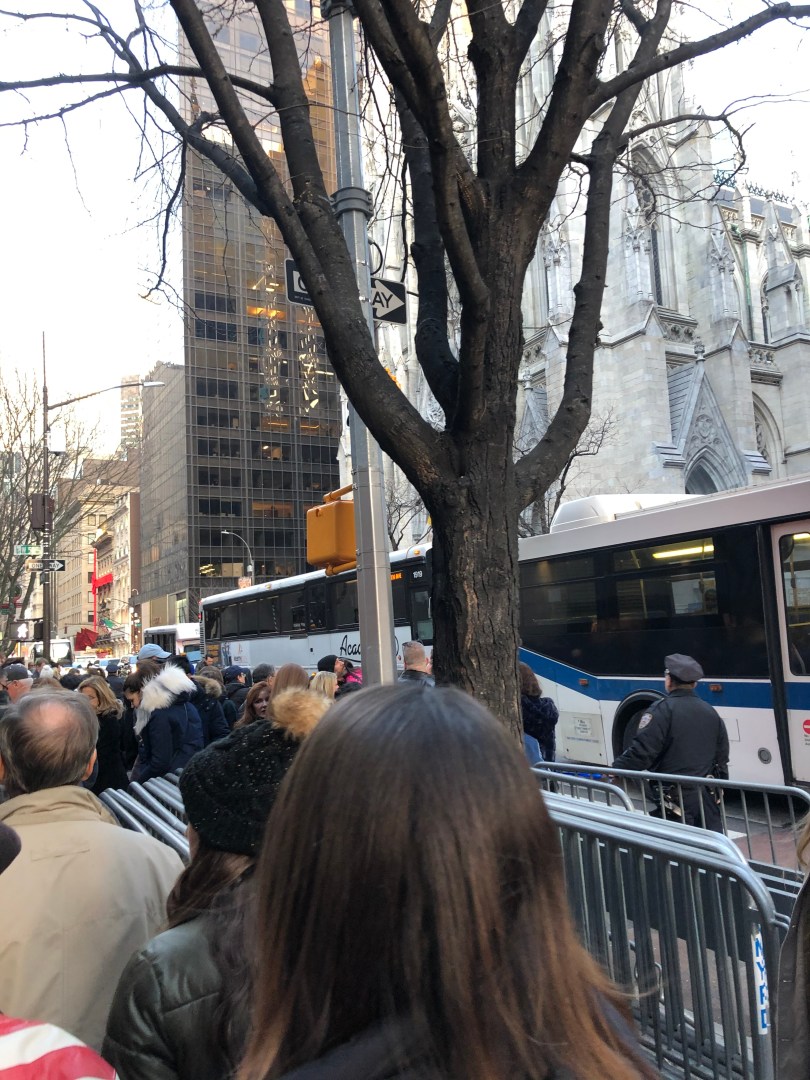
As only about half of NYC office workers working in-person full time and the city still trying to fully revive its tourism industry from the pandemic, the city is taking new measures to reduce crowding in and around Rockefeller Center during the holiday season and make visiting Rockefeller Center a less crowded and enjoyable experience for all. In 2019, the city began closing 48th and 49th streets between 5th and 6th Avenues and making the pedestrian only. They also began closing a small lane on 5th Avenue between 48th and 52nd Streets with metal barriers in order to increase pedestrian space along 5th Avenue. These changes have been successful and have led to reduced crowding in the area despite the lane being a small parking lane. Not only did this measure improve pedestrian conditions, but the changes only led to a small amount of parking spaces being lost and no travel space lost for cars and buses. This led to the measures having little adverse impact on motorists as most motorists who drive into Midtown Manhattan generally plan on parking in its many parking garages as street parking has always been extremely limited when existent.
Now the city is taking it a step further by turning all of 5th Avenue into an open street between 48th and 57th Streets from 12PM-6PM on three Sundays between December 4th and December 18th to reduce crowding on sidewalks and allow pedestrians to use the iconic street for their enjoyment. This will allow for many activities to take place on the corridor such as live performances from choirs, a samba group and more, adding to the plethora of activities already available for those in the Rockefeller Center and Midtown areas. Food and drinks would be served and seating would be provided for everyone to enjoy the shows. This program should also provide strong boosts to business for local businesses along the corridor as according to an NYCDOT study done in collaboration with Bloomberg Associates found that businesses on that bars and restaurants located along Open Streets averaged sales 19% above their pre -pandemic levels while bars and restaurants on surrounding streets averaged sales 20% below their pre-pandemic levels, indicating that open-streets played a major role in helping these places grow their businesses throughout the existence of the program.

Bustling 5th Avenue across the street from St. Patrick’s Cathedral during the Holidays on December 23rd, 2019
However, many might oppose the Open Streets plan claiming it may result in gridlock that significantly slows down car and bus travel. The closure of one of Manhattan’s busiest southbound corridors might force traffic onto Park and 7th Avenues as well as the FDR Drive and Henry Hudson Pkwy’s greatly increasing congestion. In addition, rideshare and taxi drivers who frequently have to make local trips in the area might be adversely impacted by not being able to transport passengers quickly and might even lose customers if people decide to walk and ditch paying for a cab altogether. As many taxi drivers are immigrants as well as low-income, the city might want to consider how open streets affect taxi and rideshare drivers throughout Manhattan as well as the outer boroughs. Other businesses that have vehicles that pass through 5th avenue might have their productivity reduced as well.
The congestion also may slow down the many bus routes that traverse 5th avenue daily which include local buses as well as express buses from all 5 boroughs. Many bus riders along the corridor are riding express buses from the outer boroughs that are generally infrequent on Sundays which already leads to longer wait times. Therefore, adding additional travel time to these buses might make riding the express bus less desirable for those who are taking routes along the 5th Avenue corridor regardless of their destination. For those riding local buses that already move slower along 5th Avenue, these trips might also become less desirable due to increased walking distances from bus stops along the new detour. This might disproportionately affect elderly and disabled riders who cannot use the subway and rely on these buses for accessible and convenient transportation.
On the flipside, this congestion might be mitigated by more people choosing to use mass transit instead of driving. After all, Rockefeller Center is located near a plethora of subway lines and is also near Grand Central Terminal that serves the Metro-North Railroad and maybe even LIRR depending on when East Side Access is finished. The presence of pedestrian only space might also encourage those who might’ve found it more difficult to walk before such as the elderly and parents with children to take mass transit to the Rockefeller Center as they might not have to deal with such large crowds in order to walk to activities and attractions.
The pedestrianization of 5th Avenue as well as many streets around Rockefeller Center this holiday season is one of the city’s greatest experiments in terms of opening streets to pedestrians in recent city history. A report on CBS New York on Sunday, December 4th showed that while 5th Avenue was crowded, it was full of excitement and holiday cheers as New Yorkers made good use of the extra breathing room available out on the street. This project has the potential to change how people enjoy Rockefeller Center for years to come and hopefully, it can be a success that could be used as a model for cities nationwide.
Works Cited
“Holiday Gridlock Alert: New York City to close off parts of 5th Avenue to cars for three Sundays.” ABC7 New York, 4 December 2022, https://abc7ny.com/nyc-holiday-open-streets-5th-ave-traffic-gridlock-alert/12522843/. Accessed 4 December 2022.
New York City Department of Transportation, and Bloomberg Associates. “Streets for Recovery: The Economic Benefits of the NYC Open Streets Program.” NYC.gov, https://www1.nyc.gov/html/dot/downloads/pdf/streets-for-recovery.pdf. Accessed 4 December 2022.
Rosenbaum, Eric. “New York City is getting closer to the tipping point in return to office work.” CNBC, 16 September 2022, https://www.cnbc.com/2022/09/16/new-york-city-is-nearing-the-tipping-point-in-return-to-office-work.html. Accessed 4 December 2022.
Rosenberg, Andrew. “Rockefeller Christmas Tree Facts.” NYCgo.com, 29 November 2016, https://www.nycgo.com/articles/mind-blowing-facts-about-the-rockefeller-center-christmas-tree/. Accessed 4 December 2022.
 Transit Central