By Joseph Morales
The Northern Blvd corridor between 114th St and Broadway is one of the busiest stretches in East Elmhurst and Jackson Heights. The area is both a busy commercial and residential area with a plethora of small businesses with roots from all over the world. There is also a good amount of public transit along the corridor. Despite the 7 train being about 0.5 miles south, the Q66 local bus as well as 4 Queens-Manhattan express buses use the corridor. In addition, the M and R trains are located at the Northern Blvd Station which is on Northern Blvd and Broadway. Around 15,000 bus riders ride the bus along this portion of Northern Blvd on any given weekday. Public Transit and walking is a critical part of how people in the surrounding community get around in Queens Community District 3, where the corridor is located as 64% of residents here take public transit to work and 8% walk according to data from the New York City Department of City Planning. Only 50% of housing units have at least one vehicle.
Unfortunately, since Northern Blvd has not been the safest street for pedestrians in recent years. According to NYCDOT data between 2015-2019, there have been a total of 809 injuries with 27 injuries and 9 fatalities as a result of incidents on the corridor. Of the injuries, 119 were pedestrians, 45 were cyclists and 645 were motorists. Pedestrians accounted for all 9 fatalities, though 15 total pedestrians were killed or seriously injured(KSI) with 16 motor vehicle occupants and 4 cyclists KSI respectively. 40% of pedestrians injured were crossing in the crosswalk with a walk signal and were struck by a driver who failed to yield. This may be because of the bustling boulevard’s status as a wide, arterial roadway with a lot of vehicles moving along the corridor as well as turning on and off of the corridor. The width of the roadway also creates longer crossing distances for pedestrians which is also a factor that can lead to increased pedestrian incidents.
Adding to this concern are rush hour regulations that turn the curbside parking lane on both sides of Northern Blvd into traffic lanes during rush hours. However, many motorists still park in these hours due to the high density of businesses along Northern Blvd. Thus, the amount of cars needing the lane for travel and for parking may cause unpredictable driving behavior that can lead to incidents, endangering both motor vehicle occupants and pedestrians alike. This has also likely led to a number of rear-end collisions as these types of incidents accounted for 36.9% of total motor vehicle occupant injuries between 2012-16 on a stretch of Northern Blvd that includes all but 0.5 miles out of the 4.6 mile corridor.
To address the concerns, the NYCDOT has and will continue to take many steps. In 2018, the NYCDOT installed left turn calming at 7 locations as well as leading pedestrian intervals(LPI) at all feasible locations. Leading pedestrian intervals give pedestrians a walk sign to cross a street before a green light is given to vehicular traffic on the same street. In this case, the traffic signals equipped with leading pedestrian intervals along Northern Blvd, give pedestrians a 10 second head-start to cross the street, reducing the likelihood of an incident due to a driver failing to yield while turning. In 2019, the agency installed 10 new concrete pedestrian safety islands at high crash intersections between 70th St and 90th St and another 5 islands between 71st and 112th St in 2020. The pedestrian safety islands were constructed in response to community requests for additional pedestrian safety islands and medians. Though the presentation for the Northern Blvd project did not include data from recently installed islands, data on nine pedestrian safety islands installed along the corridor in 2015 shows that the islands resulted in a 30% decrease in pedestrian injuries and a 15% decrease in total injuries. The DOT has also removed rush hour regulations that turned curbside parking lanes into travel lanes. They have also installed curb extensions also known as neckdowns at certain intersections.
As for bus riders, bus speeds are considered slow on the corridor especially during rush hours. Though bus speed on the corridor averaged 11 mph during the AM and PM rush hours in a 2021 NYCDOT presentation, bus stops are as close as ‘470’ feet together which is extremely closer than the MTA’s average stop distance guideline of ‘750’ feet between bus stops. For an example of how close together 470’ feet really is, some of the farthest home runs that were hit in the 2022 MLB Home Run Derby traveled just about that distance. In terms of Northern Blvd, stops are about 1-2 blocks apart. When the bus has to make every stop on routes along the corridor with high ridership such as the Q66, it makes it hard for the bus to get people where they want to go quickly and reliably. Some of the slowest speeds are at the corridor’s eastern end of the corridor in Corona and East Elmhurst near Downtown Flushing, a major transit and commercial hub . Though this is only one segment of the route, delays on one segment of a route can delay riders on entire routes regardless of where they are going. Given the number of routes along the corridor, this bottleneck can affect riders from throughout Queens.
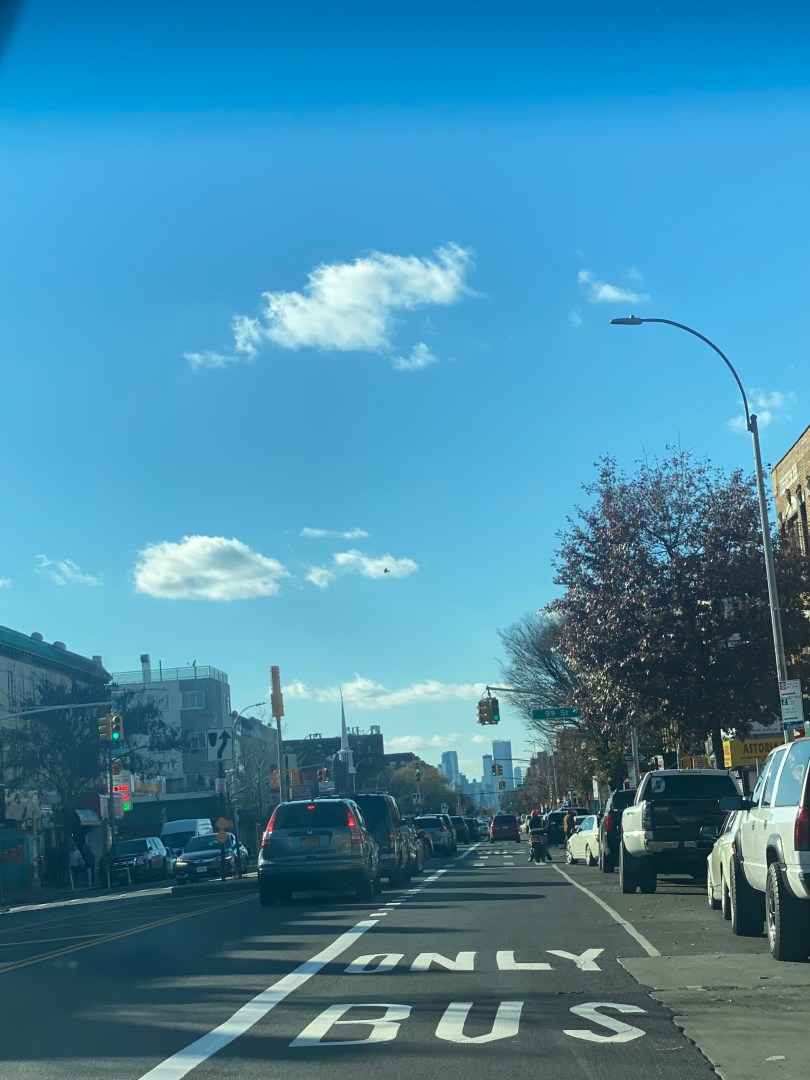
Therefore, upon community request, the NYCDOT worked with MTA NYCT (MTA New York City Transit) in order to remove certain bus stops and increase the amount of space between bus stops to the MTA’s guideline of 750’ feet which could set precedent to future measures in projects such as the MTA’s borough based bus network redesigns in which the MTA plans to increase bus stop spacing in all five boroughs including Queens to speed up buses. NYCDOT is also installing curbside bus lanes along the entire corridor between 114th St and Broadway. This project will help immensely in order to speed up Northern Blvd bus lanes and speed up buses along the corridor. Construction began to construct the bus lane last week and construction should be done by Spring 2023. The city has allotted $79 million to go toward the completion of the bus lane project. When presenting the concept of the bus lanes to the local community board, the NYCDOT compared Northern Blvd to Merrick Blvd, a corridor similar to Northern Blvd in Southeastern Queens increased bus speeds by as much as 20.8% in the AM Peak. Transit-signal priority is also being implemented along the corridor, where traffic signals will be able to detect oncoming buses and hold the green light longer for those buses.
There may be some concerns as to how a lane in both directions being off-limits to vehicles will adversely affect roadway congestion for motorists. Though the NYCDOT says the street may have some increased traffic immediately after the bus lanes are implemented, they say that traffic will divert to nearby alternate routes such as Astoria Blvd, 31st Ave and the Grand Central Pkwy which might help to ease that increased congestion. There are also other nearby routes that motorists can use such as 37th Ave, 35th Ave and 32nd Ave that run routes that are parallel to the Northern Blvd corridor where bus lanes will be installed.
These projects are all contributing to the purpose of the Northern Blvd Great Streets Capital Vision Project. A capital project of this nature will use a variety of different tools to calm traffic, improve pedestrian safety and beautify the corridor. This project would not only provide better transportation along the corridor for those between Broadway and 114th St but from the Ed Koch Queensboro Bridge in Long Island City to Woodside as well. A Great Streets project on Atlantic Avenue in East New York, Brooklyn that was completed in June 2020 included 55,000 yards of repaved roadway, new highly-visibility crosswalks, the replacement of water mains and so much more. That is not an outline of what the NYCDOT will do on Northern Blvd, however there are still things that we should see if not see other improvements of such magnitude on Northern Blvd. The capital vision for Northern Blvd includes possibly adding concrete bus bulbs, curb extensions at intersections and a raised plant median to beautify the corridor. Bus bulbs are curb extensions that allow buses to pull up to them rather than pull in all the way into a traditional bus stop, which will increase bus speeds as buses would not have to slow down to get in and out of traffic.
While this is just the beginning, the NYCDOT plans to transform Northern Blvd into a street that works for everyone.

Northern Blvd and 99th St where work is beginning on Northern Blvd Bus Lane.

Northern Blvd and 89th Street where pedestrian safety and bus stop improvements have been proposed.
Works Cited
Smith, Rachel Holliday. “Work Starts on New Northern Boulevard Bus Lane, Busways in Downtown Jamaica Made Permanent: DOT.” Astoria Post, 14 November 2022, https://astoriapost.com/work-starts-on-new-northern-boulevard-bus-lane-busways-in-downtown-jamaica-made-permanent-dot. Accessed 18 November 2022.
New York City Department of Transportation. “Northern Blvd-Broadway to 114th Street- 2021 Street Improvement Projects and Beyond Spring, 2021.” nyc.gov, https://www1.nyc.gov/html/dot/downloads/pdf/northern-blvd-broadway-114-st-cb3-jun2021.pdf. Accessed 18 November 2022.
New York City Department of Transportation. “Northern Boulevard Bus Improvements – CB3 – Summer 2022.” nyc.gov, https://www1.nyc.gov/html/dot/downloads/pdf/northern-blvd-broadway-114-st-transit-jun2022.pdf. Accessed 18 November 2022.
“Northern Boulevard-Jackson Heights/East Elmhurst Safety Improvement Workshop.” NYC DOT’s Projects & Initiatives, https://nycdotprojects.info/sites/default/files/Northern%20Blvd%20October%2015%20Workshop_0.pdf. Accessed 18 November 2022.
New York City Department of City Planning-Transportation. “Car Ownership in NYC.” tableau.com, 2022, https://public.tableau.com/app/profile/dcptransportation/viz/ACSProfiles/Dashboard1. Accessed 18 November 2022.
 Transit Central