By Joseph Morales
When we think of a transit hub in New York City, we generally think of thriving commercial and cultural centers with a plethora of small businesses, department stores, street vendors and occasionally even street performers. One of the city’s most famous transit hubs is Times Square in Midtown Manhattan, which in addition to being a hub for subways and buses is also known as the crossroads of the world. Downtown Jamaica in Queens and The Hub in The Bronx are some notable examples of such hubs in the outer boroughs.
One of the city’s largest hubs and the largest transit hubs in Brooklyn, Broadway Junction is located at the crossroads of Eastern Brooklyn, bordering six diverse and vibrant neighborhoods. These neighborhoods include Brownsville, Bushwick, East New York, Cypress Hills, Ocean Hill and Bedford-Stuyvesant(Bed-Stuy). Broadway Junction is served by five subway lines, six bus routes and the LIRR. Broadway Junction is also not that far from other major business districts. According to the NYCEDC (New York City Economic Development Corporation), Broadway Junction is a 15 minute subway ride from Downtown Brooklyn, Downtown Jamaica, or Williamsburg, 20 minutes to Lower Manhattan and 35 minutes to Midtown Manhattan or JFK Airport. It is also in the vicinity of the East New York Industrial Business Zone which hosts over 100 industrial businesses, making it one of the largest industrial business hubs in the city. The local bus routes also connect Broadway Junction with other parts of Brooklyn.
Unfortunately unlike most of the city’s other hubs, Broadway Junction is not as vibrant nor does it embody a social, economic or cultural center. For starters, Broadway Junction lacks any retail or commercial facilities. Outside of a few small residential buildings, the area is mostly occupied with parking and vacant sites. The street configuration is confusing and there is poor lighting. As a result, it may make people feel uncomfortable or unpleasant walking through the area. Despite the station having over 100,000 daily weekday riders, about 90% of them use the station to transfer to other forms of transit indicating how just how few people travel into Broadway Junction to enter the surrounding community.
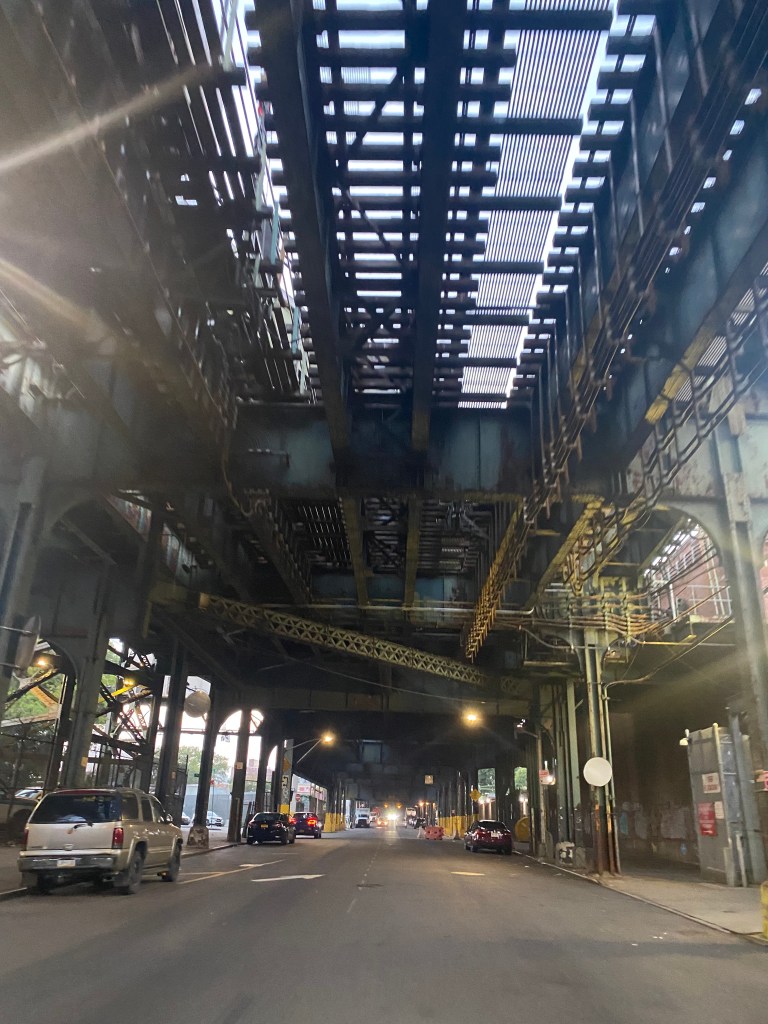
At most hubs in New York City, the streets are in a grid format or a format with limited merges as shown below:
Downtown Flushing in Queens shown in bage. Most streets here are in a grid format.

Williamsburg in Brooklyn. Here, the streets are mainly in a grid.

The Hub In The Bronx. Even though some streets merge, street grid is still easy to navigate.

However, Broadway Junction has many streets that merge with each other at different points. Making it confusing to navigate as shown below:

In addition to street configuration, the subway station itself is not one that embodies what a transit hub typically looks like. Pretty much every subway station in the city’s major transit hubs is accessible except for Broadway Junction. Even for those without mobility disabilities, accessibility is especially important at the Broadway Junction(A,C,L,J,Z) station, which has four levels. The nearest accessible stations are 3 stops away on the A,C, 4 stops away on the L and 6 stops away on the J,Z, making it difficult for residents with mobility disabilities to take the subway to Broadway Junction. Due to the amount of stairs and walking required to reach level, it is tedious especially for the elderly to get around the station complex. In addition, despite the massive crowding at the station there is only one small entrance to the entire station complex. The station itself also is:(take observations at station). The long escalators at the station are also frequently non-functional, forcing passengers to walk up long flights of escalators or stairs to access trains. In addition, the escalators are very narrow. This not only makes crowding an issue, but it can be a safety issue if a rider wants to walk or jog down an escalator while another one is standing still particularly during peak hours. There is also no direct pedestrian link between the East New York LIRR station and Broadway Junction Subway Station, leading to missed opportunities for an LIRR connection to a large portion of Brooklyn, Queens and Long Island.

Pedestrian safety is also a concern. Many intersections, such as the intersection of Atlantic AV/Pennsylvania Av and the intersection of Jamaica Av/Jackie Robinson Pkwy/Bushwick Av have cars coming in high volumes from numerous directions. Both intersections have a high number of crashes according to crashmapper.org.


Many different solutions have been proposed from both the city and the private sector alike to transform Broadway Junction into the hub that it has the potential to be. The MTA has already included a plan to build elevators at Broadway Junction in its 2020-24 capital plan. The city is receiving a $15 million grant from the USDOT(United States Department Of Transportation) RAISE Program(Rebuilding American Infrastructure with Sustainability And Equity) in order to assist with construction of the elevator. As for land use, the Brooklyn-based real estate developer Totem Group has submitted a proposal to the NYC Department of City Planning for a rezoning that would include an 18 story senior housing facility with 416 units next to a church and hotel at Herkimer Street and Van Sinderen Avenue. On another site, the developers are proposing to unite two triangular lots for a massive, mixed use complex between Fulton Street, East New York Avenue and Williams Place. The complex would include three residential towers with up to 24 stories and each attached to a three story commercial building. A residential tower would have 248 units and the commercial buildings would provide a grand total of 850,000 square feet of office space. On a third site, there would be a park constructed.


There has been some resident concern over these projects driving up home prices or over whether these residential developments may be considered affordable, but still be unaffordable for neighborhood residents. This is because whether or not housing is affordable has to do with the cost of rent for a family making a certain percentage of the area median income(AMI), which is usually based on the entire city’s median income rather than that of Broadway Junction. For example, an example provided by City Limits stated that an apartment priced for a family making $85,920(80 percent of AMI) may still be too expensive for a family making the East New York median of $44,234. Thus, while Totem is considering financing to make their development 100 percent affordable, initiatives may need to be put in place by the city and developer to make the development affordable to the community at large.
In addition, to these developments, the NYCEDC released the report Broadway Junction: A Vision For The Future to outline recommendations to make Broadway Junction a more vibrant transit hub. Suggestions included improving the intersection of Georgia, Jamaica Avenues, and Fulton Street through traffic calming measures, making the Broadway Junction Station accessible, reconfiguring streets to make the neighborhood easier to navigate, and more. There are many more efforts by the EDC, Mayor Eric Adams, and other key contributors to improve Broadway Junction. Hopefully one day, Broadway Junction will realize its potential as a booming transit hub that serves as a commercial and cultural center like many other transit hubs throughout the city.
Works Cited
Brachfeld, Ben. “Broadway Junction to become ADA-accessible with slate of new elevators • Brooklyn Paper.” Brooklyn Paper, 22 November 2021, https://www.brooklynpaper.com/broadway-junction-ada-accessibility/. Accessed 27 September 2022.
Brand, David, et al. “Brooklyn Developer’s Rezoning Proposal Would Add 400-Foot Towers to Broadway Junction.” City Limits, 5 January 2022, https://citylimits.org/2022/01/05/brooklyn-developers-rezoning-proposal-would-add-400-foot-towers-to-broadway-junction/. Accessed 27 September 2022.
“BROADWAY JUNCTION.” NYC Economic Development Corporation, https://edc.nyc/sites/default/files/2019-09/broadwayjunction.pdf. Accessed 27 September 2022.
“Broadway Junction | NYCEDC.” NYC Economic Development Corporation, https://edc.nyc/project/broadway-junction. Accessed 27 September 2022.
 Transit Central