By Joseph Morales
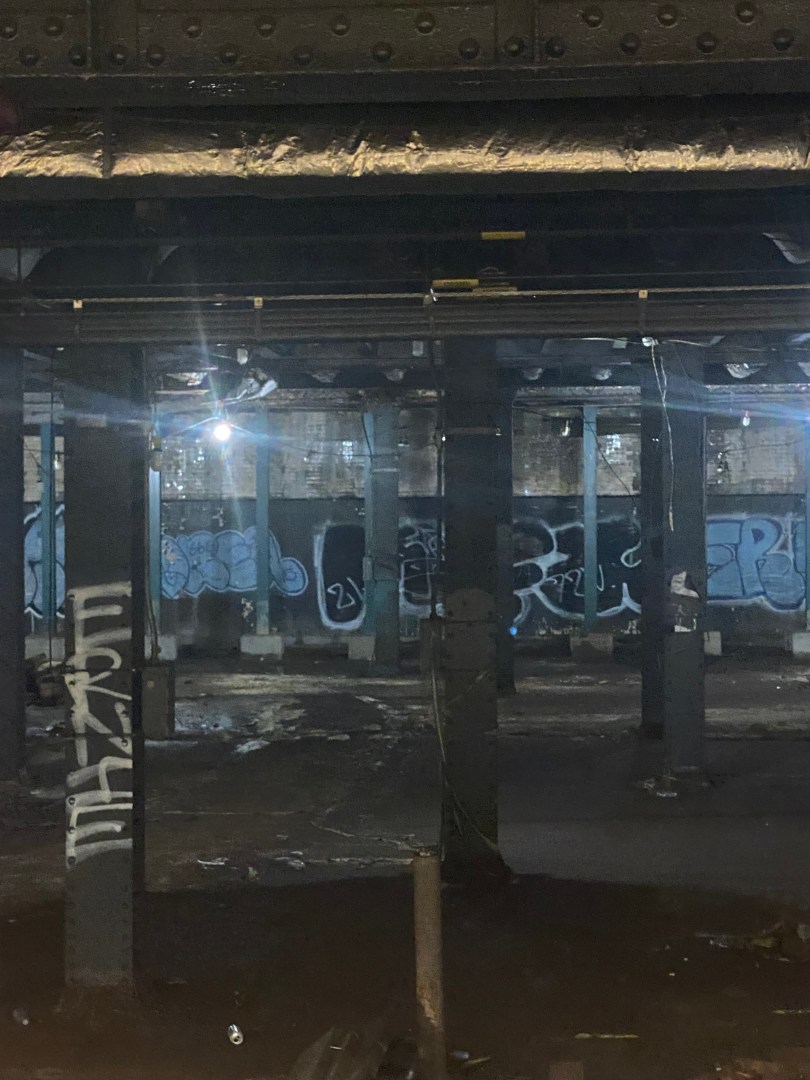
If you ride the M, J or Z train into the Delancey-Essex St station on the Lower East Side near the Williamsburg Bridge you may notice what looks like a massive idle area on the right side of the platforms. You may wonder what it is or was, given that it looks very much like a station for something-but nothing is there. What it is, is the abandoned Williamsburg Bridge Trolley Terminal, which once upon a time, was a massive hub for trolley riders.
From 1903-1948, the Williamsburg Bridge Trolley Terminal served at least 8 trolley lines with 8 loop tracks that took riders to destinations throughout Brooklyn. In March 1904, the BRT(Brooklyn Rapid Transit Company) decided that trolleys from Brooklyn would terminate here and used loop lines to travel back into Brooklyn. Later in 1905, the BRT decided to build a trolley terminal at Delancey Street for its trolleys as well as a train station for its new BRT Broadway Elevated Line, which is now known as the BMT Jamaica Line. The station for the BMT Jamaica Line, is now known as Delancey-Essex Street and is still in use to this day. Before the trolley terminal was completed, trolleys terminated at stub end tracks on the street, which was inefficient and led to congestion.
The terminal opened on May 19, 1908 with New York City Mayor George McClellan Jr, operating the first trolley into the terminal. In addition to operating this first trolley into the terminal, McClellan Jr. is also well known for operating the first IRT subway car from City Hall to the 103rd St Station on the Lexington Avenue Line, despite the plan being to hand the controls over to an IRT motorman once he started the train. This terminal allowed the station to double capacity and become the trolley hub that it was known for being today.
Unfortunately, due to the business nature of transit operations in those times, the BMT stopped running their lines over the Williamsburg Bridge due to disputes with the city over tolls as well as decreasing profits. Service over the bridge was replaced by shuttle service and in 1931, only the Tompkins, Ralph, Reid and Nostrand Avenue lines continued using the terminal. On December 6, 1948, the last trolley line, the Williamsburg Bridge Local, was converted into the B39 bus route and the terminal has sat idle ever since.
The lanes on the south side of the Williamsburg Bridge that were designed for streetcars, however, have now been converted into car lanes. The entrance from the bridge to the trolley terminal is blocked off by vehicular ramps onto the bridge. The Bridge itself also had 6 rail tracks, one on the northside used by Manhattan Streetcars, two on the southside used by Brooklyn streetcars, and two in the center that are now used by the J, M and Z trains.
The trolley station itself was designed with 8 loop platforms where riders can stand next to trolleys and wait to board them. As the late Peter Hine, former Senior Project Manager at the MTA Real Estate Department who ventured into the station shows in a video posted in 2011, some remnants of the tracks still remain.
Back in 2011, the MTA was looking for someone to turn the 60,000 sq ft space into something that can generate revenue. the 60,000 sq-ft space. 4 years later, the Lowline Lab launched, which was a prototype for what was proposed by the Lowline team led by designers James Ramsey and Daniel Barasch to become an underground park in the abandoned trolley terminal. The prototype which was displayed in a building a few blocks away on 140 Essex St was a huge success and drew over 100,000 people between October 2015 and February 2015, including the mayor of Seoul, South Korea. Construction began in 2019 with completion expected in 2021. Unfortunately, the construction on what was slated to become the world’s first underground park was halted in February 2020 due to a lack of fundraising. Now, there are no signs of construction in the station nor a clue of what’s to come for the terminal. It remains to be seen what the future holds for what was once a major transit hub in the 20th century.

Abandoned Trolley Terminal at Delancey-Essex Street

Abandoned Trolley Terminal at Delancey-Essex Street
Acknowledgements
The Lowline. The Lowline | The World’s First Underground Park – LES NYC, http://thelowline.org/. Accessed 30 May 2022
Lange, Philip, and James Ramsey. “Lowline Lab.” The Lowline, http://thelowline.org/lab/. Accessed 30 May 2022.
Mystic Transit. “The Delancey Street Trolley Terminal | Tales From the Subway.”, uploaded by Mystic Transit, 10 May 2022, https://www.youtube.com/watch?v=a0RG-4gfkaM&t=305s. Accessed 30 May 2022.
“Essex St Trolley Terminal.” uploaded by mtainfo, 24 November 2011, https://www.youtube.com/watch?v=xB_FfiECLKU. Accessed 30 May 2022.
The New York Times. “Williamsburg Bridge Plans.” 2022, https://timesmachine.nytimes.com/timesmachine/1905/08/17/105975910.pdf
The Brooklyn Daily Eagle. “Underground Terminal Will Be Used Tonight.” Newspapers.com, 1908, https://www.newspapers.com/image/53879366/?terms=%22williamsburg%2Bbridge%22%2B%22trolley%22. Accessed 30 May 2022.
Hu, Winnie. “Failing New York Subway? Not Always — Once There Were Chandeliers (Published 2019).” The New York Times, 11 April 2019, https://www.nytimes.com/2019/04/11/nyregion/city-hall-station.html. Accessed 30 May 2022
Hu, Winnie. “Move Over, Rats. New York Is Planning an Underground Park. (Published 2016).” The New York Times, 7 October 2016, https://www.nytimes.com/2016/10/08/nyregion/move-over-rats-new-york-is-planning-an-underground-park.html. Accessed 30 May 2022
The New York Times. “Double Trolley Service For The New Bridge.” nytimes.com, https://timesmachine.nytimes.com/timesmachine/1904/03/16/101388800.pdf. Accessed 30 May 2022.
 Transit Central